
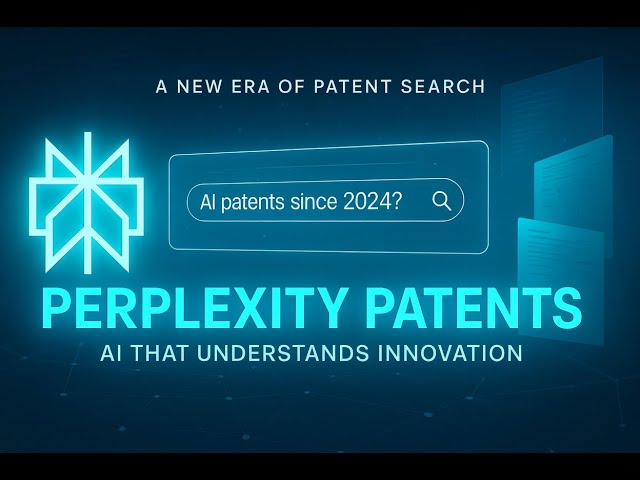
If you’ve ever tried searching for patents the traditional way, you know it rarely feels smooth. Long forms, cluttered results, outdated interfaces—everything feels like it belongs to a slower era. So when new AI-driven tools enter the picture, they almost feel like shortcuts you weren’t supposed to find. That’s exactly how many users reacted the first time they came across perplexity patents—a feature that quietly shifts how patent research works without demanding that you learn an entirely new system.
What’s interesting is how this kind of tool doesn’t just improve speed. It changes the rhythm of how researchers explore information. Instead of scrolling through endless technical documents, people suddenly get cleaner summaries, faster insights, and context that makes complex filings feel less intimidating. You don’t need to be an expert in patent law to understand a broad concept; the AI does the difficult parsing while you focus on the meaning.
This shift mirrors a bigger trend happening across industries. People want information, yes, but they want it delivered in a way that doesn’t exhaust them. A lot of patent searches begin casually—someone checking whether an idea already exists, a student researching a topic, a founder exploring innovation patterns, or a developer trying to understand what’s protected. These aren’t always formal investigations. Sometimes they start from simple curiosity. And yet the available tools used to feel designed only for specialists.
So when someone hears about features like perplexity patents, AI search, curiosity rises quickly. Not because they’re chasing cutting-edge technology, but because the tool promises something they’ve wanted for years: clarity. Real clarity. The kind that feels effortless even when the topic is notoriously dense. And once you see how the system compresses information, cross-links concepts, or maps prior art, you start imagining how this could reshape entire workflows.
But beyond the excitement, there’s the practical question that follows: how much can a tool truly simplify something as complicated as patent research? That’s where the exploration begins.
Why Patent Research Has Always Felt Complicated
Patent documents aren’t written for casual readers. They’re structured with legal precision, technical vocabulary, and dense formatting. Even seasoned professionals sometimes re-read sections multiple times to decode meaning. For beginners, the experience can feel overwhelming.
This complexity is why so many people dread patent exploration. It’s not the search itself that’s difficult—it’s interpreting what you find. Tools that simplify language or highlight connections reduce that burden significantly.
How AI Search Changes The Way We Interpret Patents
AI-driven search tools made a simple promise: they’d do the heavy lifting. Instead of reading dozens of documents, users could ask questions naturally and receive synthesized answers. That’s where systems offering perplexity patents in AI search stand out.
Rather than showing raw results, they explain. They contextualize. They highlight what matters instead of burying the user under information stacks. It’s almost like having a research partner who understands both the technical side and the practical side.
The Beta Phase And Why It Attracts Curiosity
Early access products always invite curiosity. When people encounter mentions of perplexity patents beta, they see two things: promise and experimentation. Beta phases often indicate rapid improvement, meaning users get to watch the tool evolve in real time.
There’s also the subtle thrill of using something before it becomes mainstream. Researchers often enjoy discovering features that feel ahead of their time.

Why APIs Are Becoming Essential For Patent Workflows
Developers and startups now integrate patent insights directly into their systems. Instead of manually checking databases, they automate queries and feed the information into internal tools. That’s where something like the perplexity patents api becomes powerful.
An API removes the human bottleneck. It pulls organized insights directly into dashboards, research platforms, or innovation trackers. The flow becomes smoother, faster, and more structured.
Identifying Real Use Cases For Different Industries
Different industries rely on patents differently. A healthcare startup might search for drug formulations; a tech company might monitor semiconductor designs; a student might explore historical filings to trace how ideas evolved.
AI tools empower all these groups by simplifying something universal: the need to understand complex technical information quickly. This universality is what makes enhanced search tools appealing far beyond legal teams.
Micro-Scenarios That Show The Tool’s Practical Value
Consider an engineer working late at night, trying to determine whether their design overlaps with existing filings. Instead of pulling up ten PDFs, they ask the AI. Within seconds, they have clarity. Or imagine a founder pitching an idea—they need confirmation that the concept isn’t already patented. Again, fast AI search solves the chaos.
These aren’t dramatic stories. They’re everyday scenarios. Yet they underline why efficient search matters more than people assume.
What Makes Good Patent Search Tools Feel Invisible
The best tools don’t pull attention to themselves. They blend into the workflow, offering support without demanding thought. When someone wonders how to use perplexity patents, they usually discover the answer instantly because the interface avoids unnecessary complexity.
There’s a kind of elegance in that simplicity. You aren’t trained. You just explore—and the system responds naturally.
Why AI Summaries Are Changing Patent Learning
Understanding patents used to require deep technical reading. Now, AI condenses the important parts without diluting meaning. It highlights prior art, compares similar filings, and sometimes predicts how certain claims relate to broader technology landscapes.
This isn’t about shortcutting expertise—it’s about accelerating understanding. Professionals still dig deeper when needed, but the initial friction disappears.
How AI Tools Support Innovation Instead Of Replacing Experts
People sometimes fear automation will replace analysts or researchers, but with patent systems, the opposite is true. AI tools enhance human capability. They reduce repetitive work, minimize human error, and allow experts to focus on interpretation, strategy, and decision-making.
In this sense, AI isn’t the final step. It’s the starting point—the spark that speeds up everything that comes after.

What The Future Could Look Like For AI-Powered Patent Search
The next phase may include predictive modeling, deeper correlation mapping, or real-time monitoring of global filings. Tools could alert companies whenever relevant patents appear or evolve. They might even simulate how an idea fits into existing frameworks.
With features like perplexity patents beta already pushing boundaries, the future suggests layers of intelligence stacked quietly behind simple interfaces.
Conclusion
Patent exploration no longer needs to feel overwhelming. With tools like perplexity patents, smarter systems such as perplexity patents AI search, and developer-friendly integrations like perplexity patents api, researchers finally gain clarity without extra effort.
Features within how to use perplexity patents show how intuitive the workflow can be, while ongoing developments—including perplexity patents beta—hint at a future where searching, summarizing, and understanding patents become second nature. At its core, AI-enhanced patent search isn’t just a convenience; it’s a transformation shaping how innovation is discovered.