
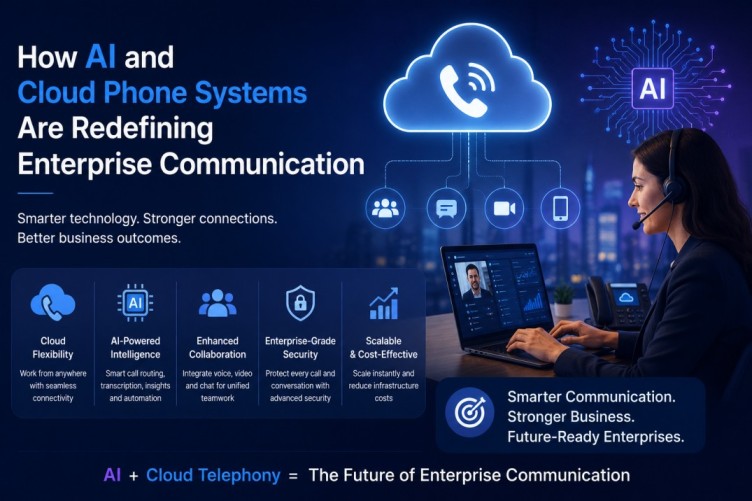
The days of bulky, on-premise PBX boxes gathering dust in server rooms are rapidly coming to an end. Today, enterprise communication is highly dynamic, deeply integrated, and entirely cloud-based. Following a permanent shift towards flexible working arrangements, organisations are rethinking how they connect their remote teams and service their customers. This shift is much more than just a passing phase. In fact, data indicates that 75 percent of companies are adopting unified communication platforms to drive their digital transformation, contributing to a global UCaaS market expected to exceed $276 billion by 2034, according to Fortune Business Insights. As traditional telecommunications converge with advanced software, businesses are discovering powerful new ways to boost employee productivity and elevate client experiences across the board.
The Infrastructure Powering Cloud Telephony
For a modern cloud communication platform to function seamlessly, it requires absolute reliability at the network level. Research shows that a lack of dependable internet access can negatively impact up to 20 percent of an Australian business’s overall productivity. Because high-definition voice over IP and artificial intelligence data processing demand perfectly symmetrical speeds, many organisations are moving away from standard shared broadband services. Instead, they are aggressively upgrading to dedicated NBN Enterprise Ethernet. This premium connection provides wholesale speeds of up to 10 Gbps that are never shared with neighbouring premises.
To protect mission-critical communication, these enterprise connections offer robust service level agreements that feature 99.95 percent uptime guarantees and 24/7 fault restoration targets ranging from 4 to 12 hours. Partnering with a specialised, Australian-owned telecommunications provider such as Telex ensures businesses get the carefully tailored cloud phone systems and dedicated bandwidth necessary to support these advanced applications without interruption. A strong local presence is highly valued by small-to-medium enterprises, as it guarantees seamless number porting and rapid, timezone-aligned assistance during any unexpected network outages.
Navigating Latency and Network Architecture
The transition to next-generation phone systems also requires a deeper understanding of underlying digital infrastructure. Cloud deployments now account for over 62 percent of the broader artificial intelligence telecommunications market. Network operators are increasingly leveraging shared computing power to run massive data models, allowing them to bypass the need to build costly, energy-intensive in-house data centres. The global market for these advanced tools reached a staggering 4.9 billion dollars in 2025 and is projected to grow at a compound annual growth rate of 32.7 percent over the next decade.
However, maintaining crystal-clear voice calls and instant data retrieval requires absolutely minimal network latency. Reliable enterprise communication relies heavily on robust infrastructure, so understanding the architectural trade-offs between edge computing and cloud computing can help businesses ensure their VoIP systems operate without frustrating delays. While edge processing brings critical computations closer to the user to eliminate lag for real-time hardware applications, scalable cloud computing remains the vital backbone that connects distributed global enterprise workforces.
The Rise of Agentic AI in Customer Service
Perhaps the most exciting development in cloud telephony is the shift from basic, rules-based conversational chatbots to highly autonomous systems known as Agentic AI. More than 68 percent of major telecom operators have already integrated artificial intelligence into their network monitoring operations to optimise traffic and dramatically reduce service interruptions. Furthermore, by 2025, 44 percent of communications service providers reported having AI agents actively running in their customer-facing interactions.
These highly intelligent tools are moving telecommunications from passive customer care to a model of deeply proactive service. Integrating Agentic AI into your cloud telephony setup provides several distinct operational advantages:
- Proactive issue resolution: Advanced AI platforms can independently ingest customer complaints regarding slow internet, run autonomous network diagnostics, and instantly escalate actionable repair steps to engineering teams.
- Deep software integration: Modern cloud communication platforms embed directly into existing CRM and ERP systems. This gives AI agents real-time access to extensive customer histories, allowing them to reconcile billing differences autonomously.
- Advanced customer analytics: Currently capturing nearly 39 percent of the market share for AI in telecommunications, real-time analytics allow businesses to continuously track client sentiment and adapt their service scripts on the fly.
- Automated failover protocols: Cloud-native PBX systems have evolved to automatically forward enterprise calls to backup mobile networks if the primary office internet connection drops, ensuring total business continuity.
As the commercial telecommunications landscape continues to evolve, the integration of intelligent software and cloud-based network architecture will only deepen. Companies that invest in robust internet infrastructure and intelligent phone systems today will be perfectly positioned to deliver exceptional, uninterrupted service tomorrow. By embracing these cutting-edge communication tools, Australian businesses can easily future-proof their daily operations and maintain a critical competitive edge in an increasingly digital business world.