
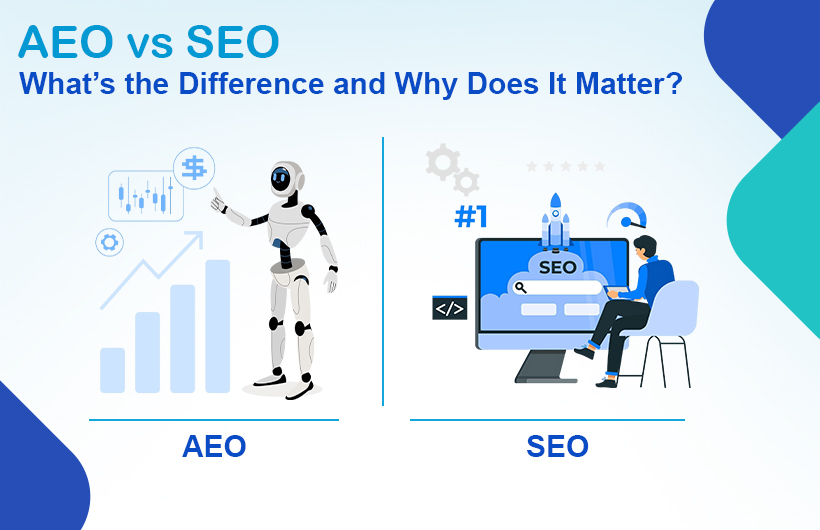
People keep talking about AEO like it just dropped from the ceiling last Tuesday and now every website on earth needs to rebuild itself for AI. That’s not really what’s happening. But also, pretending nothing has changed is lazy. Search behavior is shifting, answer engines are eating simple queries, and the old “rank a page, get a click, call it a day” model has started looking a little worn around the edges.
So when people ask about AEO and SEO difference, they’re usually asking two things at once. First, what do these terms actually mean in plain English, not consultant fog. Second, do I need to change my content strategy right now or is this another shiny acronym marketers will tattoo on a pitch deck for six months and then quietly stop mentioning.
My take? AEO matters. SEO still matters more for most businesses. That tension is real, and I don’t think it disappears anytime soon.
Because SEO is still the larger system. It helps your pages get discovered in search results, brings traffic to your site, builds authority over time, and supports everything from product pages to blogs to location landing pages that some poor intern had to write seventeen versions of. AEO, on the other hand, is about structuring content so answer engines, voice assistants, AI search tools, and zero-click search experiences can pull a direct answer from it fast.
That sounds small until you realize how many searches now end without a click.
And that’s where the friction starts. SEO traditionally wants people on your site. AEO often serves users before they ever get there. One is trying to win the visit. The other is trying to win the answer.
They overlap, sure. But they are not the same thing. Not even close once you get into the gears of it.
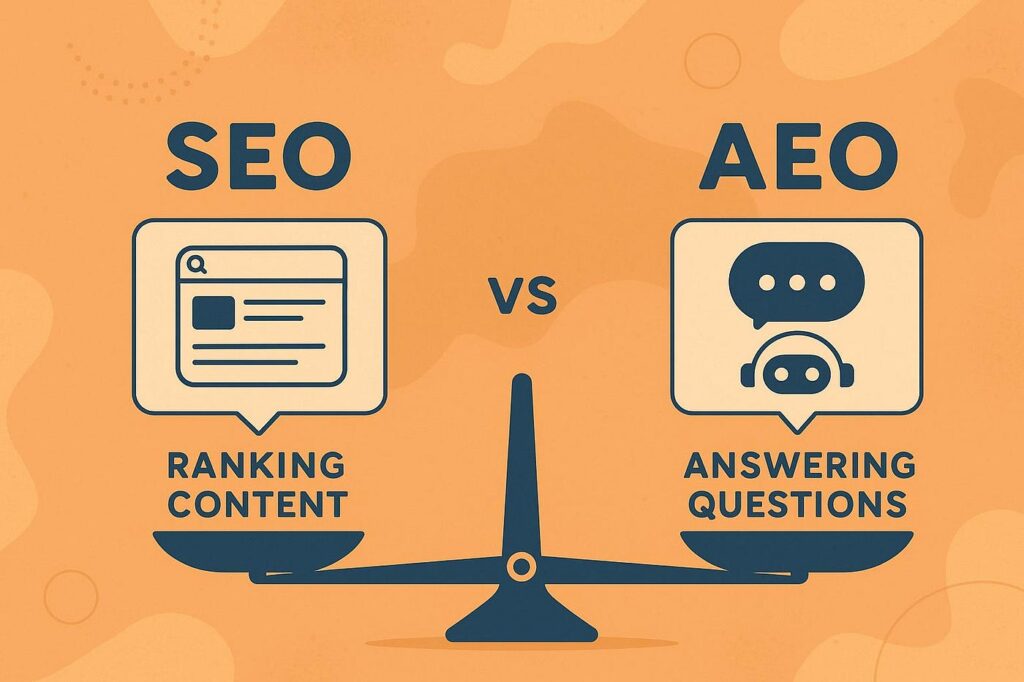
SEO was built for rankings, AEO was built for answers
This is the cleanest starting point.
SEO, search engine optimization, is about improving your visibility in search engines like Google and Bing. You optimize pages so they rank higher for relevant keywords, attract clicks, and pull users into your website. That includes on-page SEO, technical SEO, content strategy, backlinks, internal links, page speed, crawlability, user experience, and roughly five hundred tiny decisions that all seem small until traffic falls off a cliff.
AEO, answer engine optimization, is narrower. It focuses on making your content easy for machines to extract, interpret, and present as direct answers. Not just rank. Answer.
That means if someone asks, “What’s the difference between AEO and SEO?” an answer engine might grab a short, structured explanation from your content and show it instantly. Maybe in a featured snippet, maybe in an AI overview, maybe in a voice search reply, maybe inside some interface that hasn’t fully settled into shape yet.
So the first big point in understanding AEO and SEO difference is this: SEO chases visibility in search results. AEO chases usability inside answer systems.
That may sound like wordplay. It isn’t. It changes how you write.
SEO likes depth, AEO likes clarity up front
A strong SEO article often goes broad and deep. It covers context, intent, subtopics, related keywords, internal linking opportunities, examples, comparisons, objections, maybe a FAQ section at the end because of course there is. It’s trying to satisfy the searcher and signal topical relevance to the search engine at the same time.
AEO likes that depth too, but only after the answer arrives early and clean.
That’s the shift some writers still miss. They bury the answer six scrolls down because that used to feel “more natural” or because they’re trying to perform expertise with a long dramatic setup. Meanwhile the answer engine has already moved on to a competitor who said the thing plainly in forty words.
If SEO writing is a long road trip, AEO wants the destination on the first signboard.
So for AEO, you usually need crisp definitions, short answer blocks, structured headings, direct question-based subheads, schema markup where relevant, concise explanations, and language a machine can lift without pulling a hamstring.
Not robotic language. Clear language.
That distinction matters because people hear AEO and immediately start writing like malfunctioning instruction manuals. Bad move. Machines need structure, yes, but humans still have to trust what they’re reading. If your content sounds like a toaster wrote it under duress, nobody wins.
Clicks are the heart of SEO, zero-click visibility is part of AEO
This is where the whole thing gets slightly uncomfortable.
Traditional SEO has long been tied to traffic. You rank, users click, they land on your page, and then maybe they convert or at least remember your brand. The click is central. That’s the engine. No click, no visit. No visit, no chance to guide the person deeper into your ecosystem, which is an ugly word but still the right one.
AEO does not always need the click. In some cases, it almost works against the click.
You publish a useful answer. An AI-powered result or search feature lifts that answer. The user gets what they need right there. Done. Your brand may get cited, maybe. You may gain trust or visibility, maybe. But the traffic? Not guaranteed. Sometimes not even close.
This is why a lot of publishers look at answer engines the way people look at a raccoon in the kitchen. Interesting, possibly important, but also not what they asked for.
Still, ignoring it would be silly. Search is drifting toward immediate answers whether site owners like it or not. So when thinking about AEO and SEO difference, one of the biggest practical differences is this: SEO is often traffic-first, AEO is often answer-first, even when traffic gets diluted.
That’s not a small strategic change. That’s a business model issue for some companies.
Keyword targeting and question targeting are cousins, not twins
SEO content usually begins with keyword research. You identify target phrases, evaluate search volume, study intent, map keywords to pages, and build content around those opportunities. Fairly standard stuff. Sometimes useful. Sometimes hilariously overdone.
You’ve seen pages trying to rank for one awkward phrase repeated with the grace of a dropped brick.
AEO still cares about queries, but it leans much more into natural-language questions and direct-answer formats. People don’t always search answer engines the way they type into old-school search bars. They ask fuller questions. They speak in sentences. They sound like themselves.
That means AEO often benefits from content that mirrors how real people ask things:
What is AEO?
How is AEO different from SEO?
Does AEO replace SEO?
How do I optimize for AI search?
This is one of the clearest areas where AEO and SEO difference shows up in content planning. SEO can target both short-tail and long-tail keywords across all sorts of page types. AEO leans harder on question intent, conversational phrasing, and extractable answers.
It’s closer to preparing your content for an interview than for a billboard.
Structure matters more in AEO than most people realize
AEO loves structure. Honestly, it’s a little obsessed with it.
Clear H1s. Logical H2s. FAQ sections that ask real questions. Bullet points where they make sense. Tables when comparison helps. Schema markup. Definitions near the top. Short paragraphs that don’t wander off to buy snacks halfway through the sentence.
That doesn’t mean SEO ignores structure. Good SEO has always needed it. Search engines are not magicians. They need signals. They need organization. They need to understand what the page is about and how the information is arranged.
But AEO turns that volume up.
An answer engine is not just trying to rank your page. It’s trying to extract a reliable piece of it, maybe one chunk, maybe one paragraph, maybe one list. So if your content is strong but sloppy, useful but tangled, insightful but shaped like a garage drawer full of batteries and expired coupons, it may not get used.
I once heard a podcast host compare bad information architecture to handing someone a lasagna through a keyhole. Same ingredients, terrible delivery. That stuck.
And that’s AEO in a nutshell, really. You are making your knowledge easier to lift.
Authority still matters, but it looks a bit different
SEO has long depended on authority signals like backlinks, topical relevance, domain strength, content quality, freshness in some cases, and user satisfaction. You build authority over time, and search engines slowly trust you more. Or don’t. Sometimes for reasons that feel spiritual.
AEO still needs authority, but it places heavier emphasis on content reliability, source clarity, factual precision, and machine-readable trust cues. The content has to be accurate, direct, and attributable enough that an answer engine feels comfortable using it.
So yes, authority remains important in both. But with AEO, the emphasis often shifts from “can this page rank well overall?” to “can this source be trusted to answer this exact question cleanly?”
That’s not a tiny difference.
A random blog with loose claims, no structure, no sourcing logic, and vague fluff might still accidentally rank for low-competition terms with decent SEO fundamentals. Getting pulled into answer systems is a different beast. The margin for mush gets smaller.
AEO does not replace SEO, and people need to calm down
This part gets exaggerated constantly.
Every time a new search feature appears, somebody declares SEO dead. They’ve been doing this for years. SEO has been “dead” so many times it now qualifies as a recurring TV character.
AEO is not replacing SEO. It is changing the shape of search optimization, yes. It is forcing content teams to think beyond rankings and clicks, yes. But websites still need crawlable architecture, internal linking, metadata, keyword alignment, page experience, authority signals, and all the old plumbing nobody posts about on LinkedIn because it isn’t glamorous.
AEO builds on top of SEO. It does not erase it.
If your site has weak SEO foundations, chasing AEO alone is like repainting a shopfront while the floor inside is collapsing. Nice color, shame about the structure.
This is why I think the panic around AEO and SEO difference is partly semantic. People hear “difference” and assume they must choose one. Usually they should not. Usually they need to adapt their SEO strategy so it also works in answer-driven environments.
Different emphasis. Shared foundation.
The content style changes more than the technical side, at least at first
A lot of teams hear AEO and run straight toward tooling, markup, automation dashboards, and diagrams with arrows. Fine. Some of that matters. But the first real shift is usually editorial.
Can your content answer the question quickly?
Can it define terms simply?
Can it break down comparisons in a format machines can quote?
Can it sound like a smart human instead of a keyword blender?
Can a distracted reader and an AI system both figure out what the page is saying without needing aspirin?
That’s the actual work.
Yes, structured data helps. Yes, technical SEO still matters. Yes, site performance, schema, and page design all play a role. But if the writing itself is muddy, AEO has nothing solid to work with. Bad content wrapped in excellent markup is still bad content, just wearing a tie.
And this is where things get weird. The rise of answer engines may actually reward simpler writing. Not shallow writing. Cleaner writing. Writing that gets to the point, names the point, supports the point, then moves on before it starts admiring itself in a mirror.
I didn’t expect that to be the interesting part, but it is.
Businesses should stop asking which one matters more in the abstract
AEO versus SEO is not some universal cage match where one wins forever. It depends on the business model, the type of query, the customer journey, and what you actually need from search.
If you run an ecommerce store, traditional SEO still matters a lot. Product pages, category pages, buying guides, comparison content, review signals, all of that still drives discovery and revenue. AEO can help with FAQs, comparison snippets, and informational queries, but you still need the traffic path.
If you’re a B2B company with complex services, AEO can help position you as a trusted source for top-of-funnel questions. But you also need SEO depth for service pages, case studies, industry content, and branded discovery.
If you publish informational content and rely on ad revenue, answer engines create a real headache. You may become the source without getting the click. That tension is unresolved and probably stays unresolved for a while.
So the better question is not “Which is more important?” The better question is “Where in my funnel do I need visibility, and what kind of visibility actually helps?”
That’s less sexy. Also more useful.
The real difference is in the goal
Strip away the acronyms and the chatter and here’s the core of the AEO and SEO difference:
SEO wants your content to be found and clicked in search results.
AEO wants your content to be understood and surfaced as an answer.
SEO is trying to win position.
AEO is trying to win extraction.
SEO helps search engines index and rank your pages.
AEO helps answer systems interpret and reuse your information.
They overlap all over the place, but the intent behind them isn’t identical. That matters because strategy follows intent. If you know the job, you make better content decisions. If you don’t, you end up with half-optimized pages trying to impress everyone and satisfying nobody.
Kind of like those restaurant menus that serve pasta, tacos, sushi, and “sizzlers” under fluorescent lighting. Pick a lane.
Where this is going
I don’t think websites disappear. I don’t think SEO disappears. I do think easy informational content gets squeezed harder as answer engines get better at summarizing it instantly. That means content with original perspective, firsthand detail, strong brand voice, credible expertise, and deeper usefulness becomes more valuable, not less.
The internet may end up rewarding content that can do two things at once: answer fast and still be worth visiting.
That’s the trick now.
And maybe that’s the strangest part. For years, SEO content often got longer, puffier, more padded, more obviously built to perform relevance rather than communicate. AEO might push some of that nonsense off the table. If a machine can answer the simple version, then your page has to offer more than a rearranged definition and a stock photo of a person pointing at a laptop.
Honestly, good. That stuff was getting unbearable.
FAQs
1. What is the main difference between AEO and SEO?
The main difference is the goal. SEO focuses on helping pages rank in search engines and earn clicks, while AEO focuses on helping content get pulled into direct answers by AI tools, voice assistants, and search features.
2. Is AEO going to replace SEO?
No, and people saying that are getting ahead of themselves. AEO builds on SEO rather than replacing it. You still need strong site structure, relevant content, crawlability, and authority if you want answer-oriented visibility to work well.
3. Does AEO help with voice search?
Yes, very much. AEO is closely tied to voice search because voice assistants usually return one direct answer instead of a list of ten blue links. Clear structure and concise responses make content easier to use there.
4. Should small businesses care about AEO right now?
Yes, but not at the expense of basic SEO. A small business should first make sure its website, local SEO, service pages, and content foundation are solid. After that, adding answer-focused formatting is a smart next move.
5. What kind of content works best for AEO?
Question-based content, definitions, comparisons, FAQs, how-to pages, and pages with clear headings usually work well. The best AEO content gives a direct answer quickly, then adds useful context without wandering all over the place.
6. Can one article be optimized for both AEO and SEO?
Absolutely. In fact, that is probably the best approach for most brands. You can build a page with keyword relevance, depth, and internal links for SEO, while also adding concise answer sections and structure for AEO.