
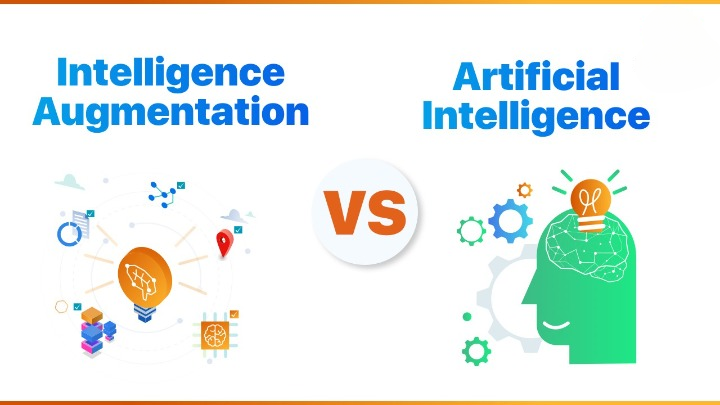
Technology is advancing at an incredible pace. New words come out every hour: AI, machine learning, chatbots, automation. All companies are caught under this pressure to become digital and keep up with their competitors. But here is the reality of things: not all companies require the most advanced AI solution. What they actually need is the proper balance between Intelligent Automation vs Artificial Intelligence, and determine which one actually fixes their issue.
Let us make this as simple as it should be, so that even a kid at school can comprehend it.
What Information Is Artificial Intelligence (AI)?
Artificial intelligence is the collective term used for making a computer think, learn, and decide, just like a human being.
Examples you already know:
- Netflix suggests films you may like.
- Google Maps indicates the shortest distance.
- Chatbots answer on websites.
AI is most effective when there is a vast amount of data available to learn from. It can recognise patterns, make predictions, and even adapt and get better over time.
But here’s the thing: AI can be costly, complicated, and even overkill for small or mid-tier businesses.
What Is Intelligent Automation?
Next, let’s discuss Intelligent Automation (IA). Let it be imagined as a clever assistant that comes and does routine, mundane tasks efficiently, without errors.
Examples of Intelligent Automation:
- Automating customer emails into the right folders.
- Scanning invoices with intelligent document capture and filling in details in the system.
- Sending reminders to staff or customers at the right time.
It does not “think” like AI, yet it’s reliable, cost-effective, and easy to deploy.
The Difference Between Intelligent Automation and AI
Here’s a simple way to distinguish Intelligent Automation from Artificial Intelligence:
AI = Thinks and learns
Intelligent Automation = Gets work done quickly and correctly
AI is like having a super-smart consultant that can examine and predict. Intelligent Automation is like having a hardworking assistant who never tyres and never makes mistakes.
Most businesses do not need a consultant yet. They need a reliable assistant first.
Why Businesses Get Confused
Most companies hear “AI” and think it is the only way to grow. Big technology firms market AI as the magic potion for everything. However, the truth is that AI works only when you have:
- Clean and well-organized data.
- A team of people who can leverage AI.
- A budget to work with sophisticated tools.
On the contrary, Intelligent Automation provides faster implementations, quicker service, lower costs and improved results in weeks rather than years.
Therefore, the question companies should no longer be asking is, “Should we use AI?” but rather “What are the issues we need to address immediately?”
A Real-World Example
Consider the retail shop that processes 500 invoices per month.
- If they employ others to enter details manually today, it is time-consuming and opens room for errors.
- Perhaps artificial intelligence would forecast spending patterns without addressing the manual entry issue.
- If they apply IntelligentAutomation with smart document capture, the bills are scanned and the information drawn out, so data is auto-entered.
The company saves money, employees save time, and errors are reduced. In this case, Intelligent Automation was the preferable choice compared to AI.
Where Intelligent Automation Reigns Supreme
- Speed – Works 24/7 without ever stopping.
- Cost – Cheaper to initiate than AI.
- Simplicity – Easy to deploy, no need for advanced teams.
- Reliability – Once rules are set, it doesn’t make mistakes frequently.
It’s why most small and medium-sized businesses utilize automation first before looking into AI.
Where AI Shines
- Decision Making – AI can predict sales, customer patterns, or future demand.
- Personalisation – Think about how Amazon shows you things that you would like.
- Learning – AI improves as time goes by and gets smarter with more data.
But yet, if your data is dirty or you are a small firm, AI can feel like buying a sports car when you just need a bicycle.
Intelligent Automation + AI = Best Combination
Here’s where it gets interesting—companies don’t have to choose one. Intelligent Automation and AI can go hand-in-hand.
Example:
Intelligent Automation unearths customer insights from emails and surveys through intelligent document capture.
AI then analyzes this feedback to reveal underlying trends like “customers adore the speed of our delivery but hate our packaging.”
They are a dynamic duo—one gathers data, the other analyzes it.
Why Intelligent Document Capture Is a Game-Changer
Let’s discuss a little more about intelligent document capture because it is one of the most useful tools of today.
Companies receive millions of documents: invoices, contracts, receipts, forms. It is time-consuming and boring to key in data from these.
With intelligent document capture:
- Paper or electronic documents are imaged.
- The system reads and extracts key information.
- Information is sent directly to business applications.
This prevents hours of typing, eliminates human error, and speeds up customer service. For most firms, this single process of automation is a game-changer.
Myths About Intelligent Automation vs Artificial Intelligence
Myth: AI is always going to be better than automation.
Reality: AI only works if you’ve got pristine data and money to spend. Automation solves instant problems faster.
Myth: Automation causes job killings.
Truth: It eliminates mundane tasks. Workers can attend to creative and strategic work.
Myth: Only large businesses can implement AI and automation.
Truth: Even small stores can utilize basic automation tools today, such as auto-billing or inventory monitoring.
What Businesses Really Need
Here’s the candid talk:
- If your business is bogged down with paperwork, manual data entry, or cumbersome processes → Begin with Intelligent Automation.
- If your company already has clean data, good systems, and wants to predict the future → Move to AI.
- If you want both worlds → Combine them.
It is not about chasing buzzwords but about addressing real problems.
Future of Work with Intelligent Automation and AI
The future will not be “AI replacing people.” Instead, it will be human, Intelligent Automation, and AI working together.
- Humans bring creativity, empathy, and decision-making.
- Intelligent Automation executes routine, rule-based procedures.
- AI learns, analyzes, and informs business strategy.
They both make a synchronizing system in which businesses can become faster and wiser.
Final Thoughts
When you are studying Intelligent Automation vs Artificial Intelligence, don’t consider them as rivals. Consider them as collaborators.
Ask yourself:
- Do I need speed and accuracy now? → Choose Intelligent Automation.
- Do I need predictions and smart insights in the future? → Incorporate AI.
- Do I want the most powerful solution? → Use both step by step.
The reality is that businesses don’t necessarily need the most recent, most expensive technology. What they really need is a solution that solves today’s challenges and positions them for tomorrow. And a lot of the time, that starts with intelligent automation before jumping into full-fledged AI.