
Display technology has quietly become one of the most influential components in modern computing and gaming workflows. Whether the priority is productivity, visual comfort, or competitive clarity, how a screen handles brightness, contrast, color accuracy, power efficiency, and long-term usability directly shapes user experience.
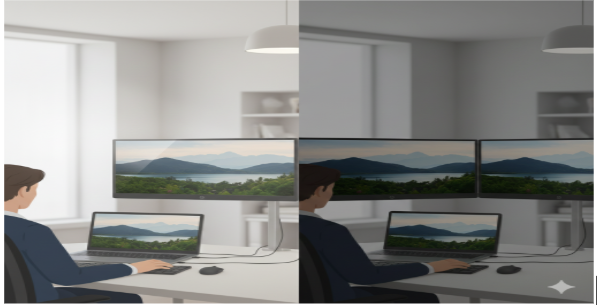
This article compares traditional LED display architectures with the newer NxtLED™ technology, examining their technical differences and real-world implications. We also reference how these technologies appear in portable and flexible setups, including dual-screen and folding monitor configurations increasingly used by remote professionals and gamers.
1. How Traditional LED Displays Work
In most laptops and external monitors, “LED display” refers to LED-backlit LCD technology. The structure is well established:
- An LED backlight provides uniform illumination
- Liquid crystal layers control light passage per pixel
- RGB color filters create the final image
This architecture is cost-effective and widely adopted, but it introduces structural limitations. Because the backlight remains active across the panel, dark scenes often suffer from light bleed, reduced contrast, and uneven brightness—issues that become more noticeable during long sessions or in mixed lighting environments.
2. How NxtLED™ Advances the Display Stack
NxtLED™ represents an evolutionary redesign of conventional LCD systems. Instead of focusing on incremental panel tweaks, it treats backlighting, optical layers, and color processing as an integrated system.
In real-world implementations such as UPERFECT NxtLED™ displays, this approach combines multiple hardware-level optimizations:
- A high-efficiency backlight engine that improves perceived luminance without proportional energy increase
- An Omni Visible™ optical matrix that redistributes light more evenly across the panel
- A Color Fidelity Engine that preserves accurate color at varying brightness levels
- A ComfortVision module incorporating DC dimming and low-blue-light design without color distortion
Together, these elements form a more cohesive display architecture than standard LED-backlit LCDs.
3. Brightness and Efficiency: Beyond Raw Numbers
Traditional LED panels illuminate the entire display uniformly. While simple, this approach wastes energy and reduces contrast by allowing bright regions to bleed into darker ones.
NxtLED™ optimizes how light is delivered and shaped across the panel, resulting in:
- Higher perceived brightness without a matching rise in power consumption
- Improved usability in bright or variable lighting conditions
- Reduced glare and more consistent luminance across the screen
For mobile professionals or gamers working in cafés, shared spaces, or travel environments, this means clearer visibility without constantly pushing brightness to maximum.
4. Eye Comfort and Long-Session Stability
Eye strain is one of the most common complaints associated with traditional LED displays. Many rely on PWM (pulse-width modulation) or software-based blue light filters, which can introduce flicker or color shifts at lower brightness levels.
NxtLED™ addresses comfort at the hardware level:
- DC dimming eliminates brightness-related flicker
- Optical filtering reduces high-energy blue light without yellow tinting
- Color accuracy remains stable even during night or low-light use
In extended workflows—coding, design, analysis, or long gaming sessions—this leads to reduced visual fatigue and more consistent focus.
5. Color Depth, Contrast, and Detail Retention
Traditional LED LCDs perform adequately within standard color spaces, but they struggle with contrast depth. Blacks often appear gray due to constant backlight activity, and fine gradients can lose definition.
NxtLED™ improves contrast perception through refined light distribution and optical layering, allowing:
- Deeper, more defined dark regions
- Better separation between adjacent colors
- Stable visuals across wide viewing angles
For creators working with color-sensitive content or gamers relying on environmental detail, this translates into more reliable visual information.
6. Power Consumption and Long-Term Usability
Increasing brightness on traditional LED displays usually results in significantly higher power draw and heat output. Over time, this can reduce panel longevity and impact battery-powered setups.
NxtLED™ achieves brightness gains more efficiently, offering:
- Lower average power consumption
- Reduced thermal stress on internal components
- Slower luminance degradation over long-term use
This efficiency is particularly important in portable dual-screen setups powered through a single USB-C connection, where stability and power headroom matter more than peak brightness specs.
7. Portable and Folding Monitor Use Cases
As work and gaming setups become more flexible, displays are expected to adapt to different environments and form factors. Portable dual monitors and folding monitor designs are now common among freelancers, remote workers, and travelers.
In these use cases, display technology must handle:
- Changing ambient light conditions
- Extended viewing hours
- Compact power and connectivity constraints
NxtLED™ is well suited to these demands. When used in folding or multi-screen configurations, consistent brightness, reduced glare, and stable color help maintain focus without constant visual readjustment.
For example, in a dual-screen setup with one screen for active work and another for reference material, uniform luminance and color consistency reduce eye strain and cognitive load. Gamers similarly benefit from clearer motion and contrast in varied lighting environments.
8. Engineering Trade-offs and Practical Impact
| Feature | Traditional LED/LCD | NxtLED™ |
|---|---|---|
| Backlight Control | Uniform | Optimized light delivery |
| Brightness Efficiency | Moderate | Higher perceived brightness |
| Eye Comfort | Software-based | Hardware DC dimming + optics |
| Color Stability | Limited at high brightness | Consistent across levels |
| Contrast | Moderate | Improved depth |
| Power Consumption | Higher at max output | Optimized |
| Outdoor Visibility | Limited | Stronger |
| Long-Term Stability | Standard | Lower heat stress |
NxtLED™ does not attempt to replace OLED or microLED technologies outright. Instead, it refines LCD-based systems to better align with real-world usage—prioritizing efficiency, comfort, and consistency over raw specification inflation.
Conclusion: A Practical Evolution in Display Technology
For professionals and gamers using portable, dual-screen, or folding monitor setups, the advantages of NxtLED™ are most visible in daily use rather than spec sheets. Improved brightness efficiency, better contrast handling, reduced eye strain, and stable long-term performance make it a practical evolution of traditional LED displays.
In implementations like uperfect NxtLED, this translates into displays that work reliably across varied environments—from focused productivity to immersive gaming—without the burn-in risks or cost premiums of more experimental panel technologies.
As computing becomes more mobile and flexible, display technology that adapts to real-world conditions matters more than peak numbers alone. In practical use, NxtLED™ prioritizes sustained clarity, viewing comfort, and efficiency across changing environments rather than short-term visual impact. This makes it especially well suited for modern workflows that move between work, travel, and entertainment. For users who rely on portable, dual-screen, or folding setups, this balance of performance and usability ensures the display remains reliable not just on day one, but over years of consistent use.