

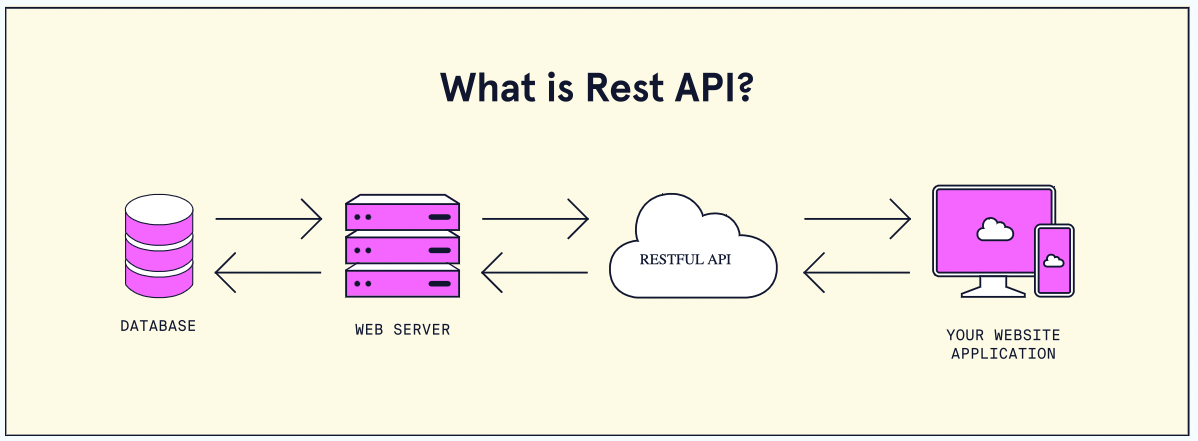
For developers, architects, and technical leaders, knowing what is REST API is essential in today’s linked digital economy. REST APIs offer a consistent interface for data transmission over HTTP, powering everything from cloud services to mobile applications. However, in the absence of context, the phrase may seem abstract. In essence, a REST API builds scalable, stable web services by adhering to architectural principles like resource-based URIs and statelessness. The deeper subtleties of REST are what really enhance one’s technical skills, even if many developers are familiar with JSON payloads and GET/POST protocols.
Understanding REST API interview questions, which include everything from endpoint design to performance optimization, becomes essential as you get ready for technical positions. In the meantime, specific technologies like REST Assured are needed to verify these APIs. Understanding what is REST Assured API testing guarantees that your services operate as intended in practical settings. Understanding what is REST API in Spring Boot allows Java and Spring aficionados to increase productivity through embedded servers and auto-configuration. Lastly, a comparison between REST and its predecessor, SOAP, explains why REST has become more popular than more inflexible, XML-based protocols due to its ease of use and lower weight.
We will explore these fundamental elements in 10 targeted parts of this blog. The significance of what is idempotent in REST API, the reasons why some actions may be safely retried, and practical implementations of idempotency will all be covered. We’ll go over practical testing techniques, RESTful endpoint design best practices, and API security tactics. You will have a comprehensive grasp of REST by the end, including theory, real-world application, and insightful analogies to SOAP.
Fundamentals of RESTful Architecture
Representational State Transfer, or REST, is based on six guiding constraints: optional code-on-demand, consistent interface, client-server separation, cacheability, and statelessness. The consistent interface requirement, which standardizes how resources are identified (using URIs) and modified via HTTP methods, is essential to the development of RESTful APIs. By guaranteeing that every request includes all relevant background, statelessness avoids the server depending on previous exchanges. Performance is maximized via cacheability, and scalability is encouraged by layered system architecture. Comprehending these concepts facilitates the development of reliable, consistent, and maintainable APIs.
Idempotency’s Significance in REST
What is idempotent in REST API architecture is one of the most commonly asked questions. No matter how many times they are carried out, idempotent procedures always provide the same outcome. For example, after the initial successful deletion, DELETE /items/123 may be called again without causing any problems. Because clients may retry requests without worrying about unexpected side effects, this trait is essential for creating robust systems that can recover from network disruptions. To improve dependability in dispersed situations, idempotency implementation frequently uses conditional headers or unique request IDs to provide safe retries.
Getting Ready for Interview Questions on REST APIs
Anticipate inquiries on CRUD operations, error management, status codes, and versioning strategies while answering REST API interview questions. Interviewers frequently ask you to define endpoints for hierarchical resources or compare the semantics of PUT and PATCH. Prepare to talk about security procedures like OAuth2 or JWT, the effects of statelessness, and caching headers like ETag. Deeper knowledge is displayed by showcasing practical experience, such as managing pagination or implementing HATEOAS (Hypermedia as the Engine of Application State) connections. Being well-prepared guarantees that you can express both your conceptual knowledge and your useful design decisions.
REST Assured Automated Testing
Java developers who want to automate REST API validation must comprehend what REST Assured API testing is. A fluent DSL for creating tests that send HTTP requests and assert answers is offered by REST Assured. Base URI configuration, authentication token injection, and JSON schema validation are all simple processes. Continuous integration pipelines can detect regressions early when REST Assured is combined with testing frameworks such as JUnit or TestNG. You can ensure that any modifications to controllers or data mappings won’t result in unforeseen errors and maintain excellent service quality by incorporating these tests into your build process.
Using Spring Boot to Create RESTful Services
Learning about Spring Boot’s REST API demonstrates how the Spring ecosystem speeds up the creation of REST services. You can concentrate on creating @RestController classes and @RequestMapping annotations, as Spring Boot automatically configures embedded Tomcat servers and Jackson JSON mappers. You can use Spring Data JPA to connect to databases and deliver resource APIs with little XML or boilerplate code. HTTP method mapping is made easier by features like @GetMapping and @PostMapping, and consistent error replies are guaranteed by @ControllerAdvice’s exception handling. Spring Boot is the perfect platform for enterprise-grade REST services because of its quick deployment and integration with Spring Security for authentication.
REST and SOAP Comparison: Important Distinctions
When asked how a REST API differs from a SOAP API, respond that the former prioritizes simplicity and makes use of lightweight JSON payloads and conventional HTTP methods. On the other hand, SOAP offers built-in WS-** standards for security, transactions, and dependability, and enforces a rigorous XML-based envelope structure. REST’s simplicity and ease of use have led to its acceptance in online and mobile apps, whereas SOAP is best suited for situations needing formal contracts and comprehensive corporate functionality. Weighing considerations such as transactional assurances, overhead tolerance, and interoperability needs is necessary when choosing between them.
Resource-Oriented Endpoint Design
Designing a REST API effectively requires resource-oriented thinking. Use plural URIs for collections and recognize nouns, such as /users or /orders. Use routes that include hierarchical connections (e.g., /users/{userId}/orders). Use the proper HTTP methods: DELETE to remove, PUT to update or replace, PATCH for partial updates, POST to create, and GET for retrieval. Use query parameters to sort and filter data while maintaining endpoint usability. When interacting with your API, discoverability is improved and client-side complexity is decreased using clear, predictable URI rules.
Making Appropriate Use of HTTP Status Codes
API state is concisely communicated through the accurate usage of HTTP status codes. If a GET request is successful, return 200 OK; if a resource is created, return 201 Created; and if a DELETE operation is successful without a response body, return 204 No Content. When input validation fails, use 400 Bad Request; if authentication is absent, use 401 Unauthorized. To distinguish between authorization problems and non-existent resources, distinguish between 403 Forbidden and 404 Not Found. A more seamless integration process results from client developers using the right code to help with error management and debugging.
Using Best Practices to Secure REST APIs
Enforcing HTTPS, putting OAuth2 or JWT-based authentication into place, and verifying all inputs to prevent injection attacks are all part of protecting REST endpoints. CORS regulations manage cross-origin requests, while rate limitation through API gateways stops misuse. Defenses are further strengthened by sanitizing response payloads and preventing the disclosure of private internal information. Only authorized users may perform tasks thanks to role-based access constraints. Token expiration plans, dependency updates, and routine security audits provide a thorough security posture that is essential for data protection and compliance.
Lifecycle Management and Versioning
Determining a versioning method is essential since APIs change over time. Use custom Accept versions to include version IDs in headers or in the URI (e.g., /v1/products). Use dual-running versions to enable backward compatibility and explicitly communicate deprecation deadlines. Use semantic versioning techniques to distinguish between significant improvements and breaking changes. As your API develops, good lifecycle management guarantees that customers can move gradually without experiencing any interruptions in service, maintaining confidence, and lowering integration challenges.
In conclusion
Modern web services are built on top of REST APIs, which combine robust architectural requirements with ease of use. You may guarantee reliable, scalable services by learning what a REST API is, practicing for REST API interview questions, and comprehending what idempotent means in REST API. Development and quality assurance are streamlined by utilizing REST Assured API testing and REST API in Spring Boot tools, and protocol selection is guided by a thorough understanding of the distinctions between REST and SOAP APIs. With the greatest design, security, and versioning techniques at your disposal, you can create APIs that excite developers and spur technological advancement.