
For years, industry analysts have declared that “email is dead.” Social media platforms, instant messaging apps, and AI-driven marketing channels often overshadow the humble inbox. Yet despite these claims, email remains one of the most powerful and consistent tools for businesses of all sizes. Research shows that email marketing continues to generate one of the highest returns on investment (ROI) among digital channels, making it indispensable for building relationships, driving sales, and retaining loyal customers.
What has changed, however, is the nature of email marketing itself. Gone are the days when businesses relied on simple bulk-sending tools. Today’s email marketing platforms are sophisticated ecosystems that combine automation, data-driven segmentation, personalization, and cross-channel communication. Many of them even incorporate CRM features, chatbots, and SMS to provide marketers with a 360-degree approach to engaging their audience.
In this article, we’ll explore the 7 best email marketing platforms available today. Our list includes industry leaders such as Mailchimp and Constant Contact as well as versatile alternatives like SendPulse, Mailjet, Brevo, MailerLite, and Elastic Email. Each section will provide an in-depth look at a platform’s features, free plan or trial, cheapest paid plan, and overall evaluation.
SendPulse
Features
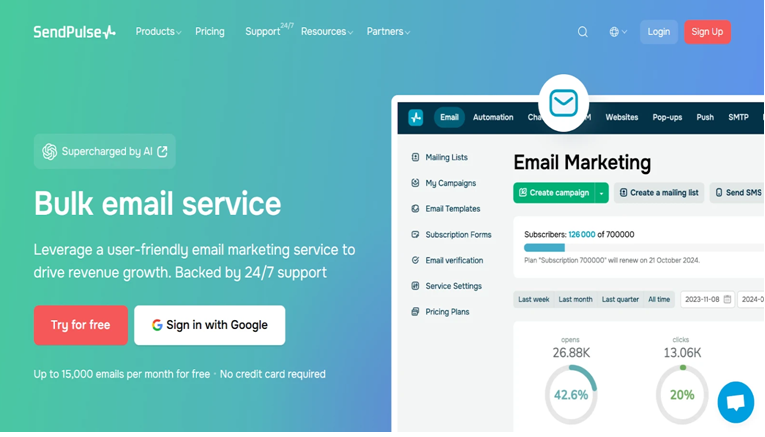
SendPulse is more than just an email marketing tool—it’s a complete multichannel marketing automation platform. In addition to email campaigns, it supports SMS, web push notifications, chatbots for WhatsApp, Facebook Messenger, Instagram, and Telegram, as well as a built-in CRM for managing customer data. Its drag-and-drop editor makes designing campaigns simple, with customizable templates and personalization options.
Users can create automated workflows that combine multiple channels, such as sending an email followed by an SMS reminder or chatbot message. Advanced features like segmentation, A/B testing, analytics dashboards, and role-based user permissions make SendPulse highly versatile for businesses of all sizes.
Free Plan/Trial
SendPulse stands out for offering one of the most generous free plans in the industry. Users can manage up to 500 subscribers and send up to 15,000 emails per month at no cost. Unlike competitors that impose restrictive daily caps, SendPulse provides monthly flexibility that better matches real marketing needs. The free plan also includes access to automation flows, templates, and multichannel tools, so businesses can test advanced strategies without immediate investment. Although certain premium features, such as dedicated IP addresses, are excluded, the free tier is more than sufficient for small businesses to launch professional campaigns.
Cheapest Paid Plan
When businesses outgrow the free tier, SendPulse offers paid plans starting at roughly $8/month for 500 subscribers and unlimited emails, making it one of the most affordable entry points among major platforms. Pricing scales predictably with subscriber count, so there are no unexpected jumps in cost as your audience expands. Paid tiers unlock higher send volumes, advanced automation options, transactional email services, and priority support. For companies with larger subscriber bases, higher plans also include dedicated IPs and additional deliverability tools.
Evaluation
Overall, SendPulse offers a rare combination of affordability, functionality, and scalability. Its interface may feel a little dated in places, but its feature set rivals or surpasses more expensive competitors. The generous free plan and low-cost paid options make it accessible to startups and small businesses, while its automation and multichannel tools appeal to more advanced marketers. For organizations seeking an all-in-one platform that grows with them, SendPulse is arguably the best balance of cost and capability in today’s market.
Mailchimp
Features
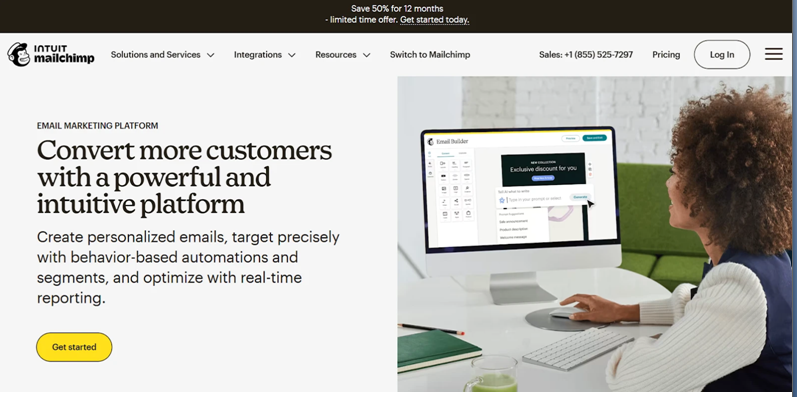
Mailchimp is one of the most recognizable names in email marketing, widely used by small businesses, startups, and solopreneurs. The platform offers an intuitive drag-and-drop email builder, a wide range of templates, and strong automation features. Users can segment audiences, run A/B tests, and track performance with real-time analytics dashboards. Mailchimp also integrates with popular tools like Shopify, WooCommerce, WordPress, Zapier, and Canva, making it easy to connect marketing campaigns with e-commerce or content workflows. Its brand recognition and user-friendly design remain two of its strongest assets.
Free Plan / Trial
Mailchimp provides a free tier with up to 500 contacts and 1,000 email sends per month. However, this plan comes with limitations: daily send caps, Mailchimp branding in email footers, and restricted access to advanced automation. It’s suitable for very small businesses or personal projects, but most organizations will find themselves needing to upgrade quickly.
Cheapest Paid Plan
The cheapest paid plan begins at around $13/month for up to 500 contacts and 5,000 emails, offering expanded features such as advanced templates, multi-step automation, A/B testing, and email scheduling. As your contact list grows, pricing increases sharply—one of Mailchimp’s most common criticisms. Businesses with large subscriber bases can face significantly higher costs compared to other platforms offering similar functionality.
Evaluation
Mailchimp remains a strong contender thanks to its brand reputation, ease of use, and robust integrations. It’s an especially good fit for small businesses that value simplicity and want a platform that scales without much technical setup. For marketers willing to pay for convenience and polish, Mailchimp is a solid option.
Constant Contact
Features
Constant Contact has built its reputation as a reliable email marketing service tailored for small businesses and nonprofits. It offers an easy-to-use drag-and-drop email editor, customizable templates, and tools for event management such as RSVP tracking and registration forms. Beyond email, it provides basic marketing automation, social media posting, and integrations with platforms like Shopify, WooCommerce, Eventbrite, and QuickBooks. The reporting dashboard provides insights into opens, clicks, and engagement, enabling users to refine their campaigns. Its combination of email and event marketing tools makes it unique among competitors.
Free Plan/Trial
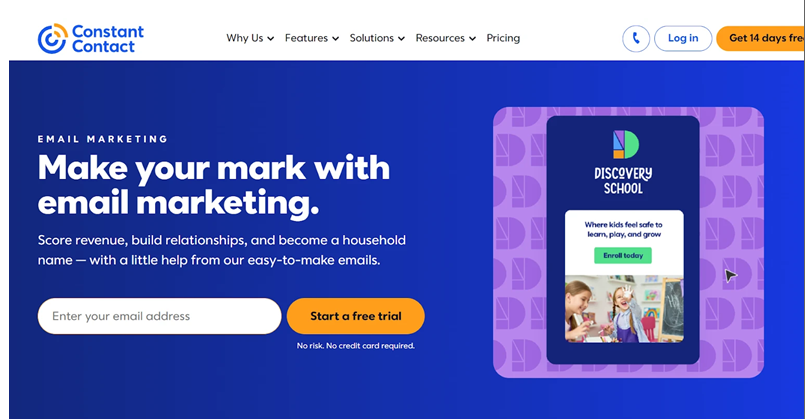
Unlike some competitors, Constant Contact does not provide a permanent free plan. Instead, it offers a 14-day free trial that allows businesses to test the platform. During the trial, users can explore most of the core features, but they’ll need to upgrade to continue sending campaigns. The absence of a long-term free plan makes it less accessible to startups or very small businesses.
Cheapest Paid Plan
Constant Contact’s paid plans start at around $12/month (Lite Plan), which includes 500 contacts, customizable templates, and basic reporting. Pricing scales with the number of contacts, and costs can grow quickly for larger lists. The advantage is that even lower-tier plans allow unlimited email sends.
Evaluation
Constant Contact is ideal for organizations that run frequent events or need straightforward email marketing paired with social and event management tools. Its platform is beginner-friendly, and the unlimited sends in paid plans are attractive for businesses with active campaigns. However, the lack of a meaningful free plan and relatively higher entry-level costs make it less competitive for budget-conscious users. Overall, it’s a good fit for nonprofits, community organizations, and small businesses that prioritize reliability and simplicity over cutting-edge features.
Brevo (formerly Sendinblue)
Features
Brevo positions itself as a comprehensive digital marketing platform that extends beyond email into SMS marketing, CRM, and live chat. Its drag-and-drop editor is modern and intuitive, with templates and personalization tools to create visually appealing campaigns. Brevo also supports advanced features like A/B testing, transactional emails, segmentation, and workflow automation. The platform integrates seamlessly with e-commerce and CMS systems such as Shopify, WooCommerce, WordPress, and Salesforce. With its multichannel capabilities, Brevo appeals to businesses seeking a single solution for both marketing and customer relationship management.
Free Plan/Trial
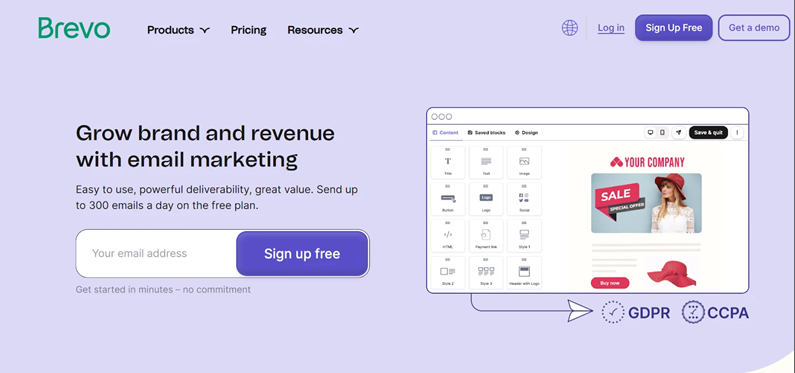
Brevo’s free plan allows unlimited contacts but caps sending at 300 emails per day. This structure is more flexible in terms of audience size but restrictive for businesses that need to send larger campaigns at once. Brevo’s free plan does include access to automation tools and core campaign features, making it practical for testing the platform.
Cheapest Paid Plan
Paid plans start at around $8.08/month for 500 contacts and 5,000 emails, removing the daily sending limits and enabling higher monthly volumes. These plans also include advanced reporting, A/B testing, and the ability to manage transactional email at scale. As with many competitors, pricing scales according to email volume rather than subscriber count, which can be beneficial for businesses with large lists but lower sending frequency.
Evaluation
Brevo is a strong contender for businesses that want more than just email marketing. Its combination of email, SMS, CRM, and automation provides a versatile toolkit for customer engagement. For businesses that prioritize multichannel communication and appreciate volume-based pricing, Brevo is a solid, modern choice.
Mailjet
Features
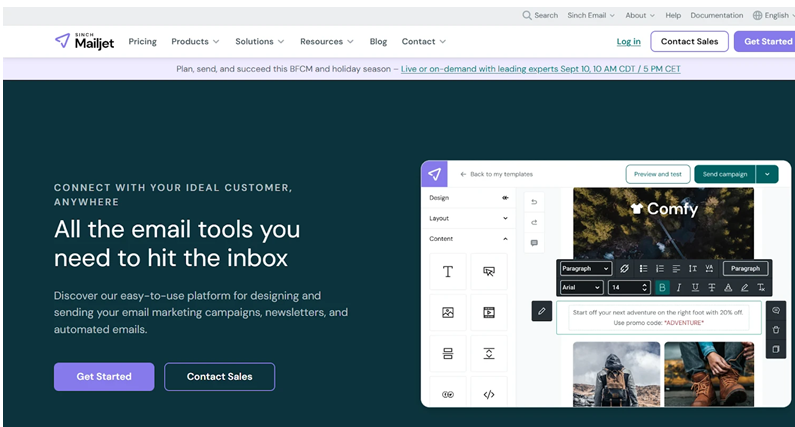
Mailjet focuses heavily on providing a collaborative email marketing platform that’s particularly appealing to teams and developers. It offers a drag-and-drop email editor, advanced segmentation, and transactional email services. One of its standout features is real-time collaboration, allowing multiple team members to work on email designs simultaneously—similar to how Google Docs enables shared editing. Mailjet also provides APIs that make it attractive to developers integrating email into custom applications. Integrations with WordPress, Shopify, Zapier, Magento, and Salesforce further extend its versatility.
Free Plan/Trial
Mailjet’s free plan allows up to 1,500 contacts and 6,000 emails per month, with a cap of 200 emails per day. While the total monthly volume is fairly generous, the strict daily cap can be restrictive for businesses that prefer sending larger newsletters or campaigns at once. The free tier includes the drag-and-drop editor but excludes advanced features like segmentation, A/B testing, and dedicated support. For light users, it’s workable, but scaling campaigns quickly will require upgrading.
Cheapest Paid Plan
The paid plans start at about $15.30/month for unlimited contacts, 15,000 emails, and no daily sending limit. Higher tiers include advanced segmentation, A/B testing, dedicated IPs, and priority support. Pricing is based on email volume rather than subscriber count, which can be more cost-effective for some business models. For developers or teams who need collaborative tools and flexible APIs, Mailjet’s paid plans provide good value compared to more rigidly structured competitors.
Evaluation
Mailjet is best suited for businesses and teams that value collaboration and developer-friendly tools. Its ability to blend marketing and transactional email in one platform makes it a flexible solution. Overall, it’s a smart choice for tech-savvy teams or organizations looking for a collaborative email design experience.
Elastic Email
Features
Elastic Email is an email service provider known for its strong API-first approach and competitive pricing. It offers both marketing and transactional email capabilities, giving users the flexibility to manage newsletters, campaigns, and automated workflows. The drag-and-drop editor and template library allow quick campaign creation, while features like A/B testing, segmentation, and real-time analytics help optimize performance. Elastic Email integrates with platforms such as WordPress, Zapier, and Shopify, making it adaptable for different business needs. Its developer-friendly infrastructure, including SMTP relay and robust API endpoints, makes it especially appealing for technical users.
Free Plan/Trial
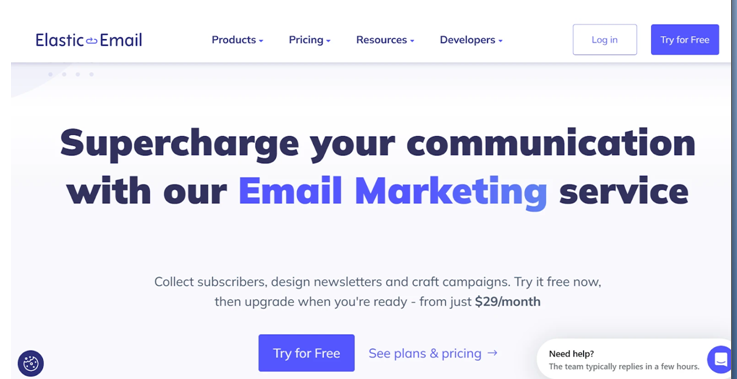
Elastic Email’s free plan is relatively modest: it allows 100 emails per day and 2,500 contacts. The free tier includes core tools like the editor and templates, but excludes advanced automation and detailed reporting. For businesses that want to experiment, it provides an entry point, but the limitations mean serious use requires upgrading.
Cheapest Paid Plan
Paid plans begin at around $29/month and offer up to 37,500 emails and 2,500 contacts per month, along with advanced features like autoresponders, detailed reporting, and premium support. Elastic Email also provides a “pay-as-you-go” model where businesses can purchase email credits instead of committing to monthly fees. This flexibility is particularly beneficial for companies that send emails irregularly or seasonally. Higher tiers include options for dedicated IP addresses and enhanced deliverability tools.
Evaluation
Elastic Email stands out for its affordability and developer-focused design, making it a strong choice for businesses with technical teams or those who need flexible, API-driven email solutions. For cost-conscious organizations comfortable with a more technical setup, Elastic Email delivers excellent value and reliable performance.
MailerLite
Features
MailerLite has built a reputation as one of the most user-friendly email marketing platforms, especially for beginners and small businesses. It provides a clean drag-and-drop editor, a generous selection of responsive templates, and straightforward automation workflows. Key features include segmentation, landing page and website builders, pop-ups, and A/B testing. It integrates with popular platforms like Shopify, WooCommerce, WordPress, and Zapier, making it easy to fit into existing workflows. The simplicity of the interface, combined with enough depth for advanced users, makes MailerLite a favorite among budget-conscious marketers.
Free Plan/Trial
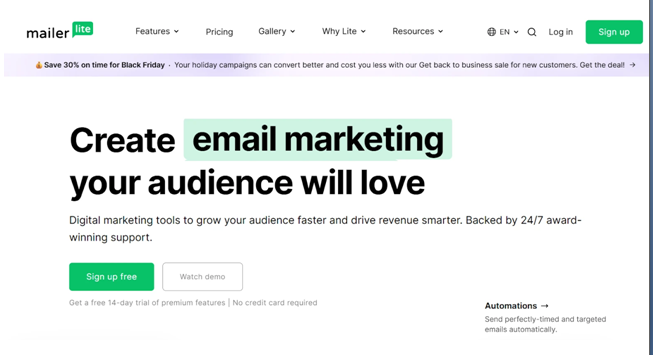
MailerLite’s free plan is one of the most generous in the market: up to 500 subscribers and 12,000 emails per month. The plan includes core features like the drag-and-drop editor, basic automation, and access to landing pages. However, it lacks advanced features like live chat support and certain templates. Still, for startups and small businesses, it provides a highly functional free tier to get campaigns off the ground.
Cheapest Paid Plan
Paid plans start at around $9/month, unlocking 500 subscribers and unlimited monthly emails and additional features such as advanced automation, custom domains for landing pages, and priority support. MailerLite’s pricing model is transparent and affordable, which contributes to its strong reputation in the SMB market.
Evaluation
MailerLite is an excellent choice for small businesses, bloggers, and startups that want ease of use, affordability, and solid functionality without overwhelming complexity. Its generous free plan and low entry-level pricing make it particularly attractive for users with smaller contact lists. It excels at delivering reliable, easy-to-manage campaigns. Overall, it’s a strong, budget-friendly option that balances simplicity with capability.
Final Thoughts
Choosing the right email marketing platform is no longer just about sending bulk newsletters—it’s about finding a solution that balances affordability, functionality, and scalability. Each of the ten platforms we’ve reviewed brings something unique to the table: Mailchimp’s brand recognition, Constant Contact’s event tools, Brevo’s flexible pricing, MailerLite’s simplicity, ActiveCampaign’s advanced automation, GetResponse’s all-in-one marketing hub, and Omnisend’s e-commerce focus. However, most of these either limit their free tiers, raise costs quickly as lists grow, or lack the versatility needed for small businesses to scale without friction.
What sets SendPulse apart is its ability to combine robust features with one of the most generous free plans available. Unlike many competitors, SendPulse doesn’t compromise on automation, segmentation, or multichannel tools at the entry level. Its affordability, ease of use, and multi-channel capabilities make it a platform that businesses can start with and grow into.
Now that you have an email marketing tool, it’s a great time to explore how customer relationship management (CRM) systems can help you organize leads, track interactions, and improve sales results. Take a look at this article with the best CRM tools to find options that integrate smoothly with your existing marketing setup and help you build stronger, more personalized customer relationships.