
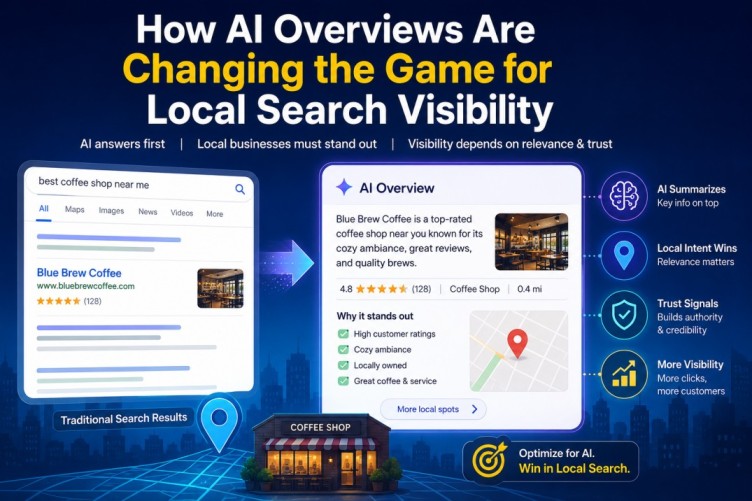
Search behaviour has undergone a massive transformation in recent years. By late 2026, the reliance on traditional search engine results pages has noticeably waned as users increasingly turn to generative AI tools. According to recent survey data, 45 percent of consumers now use generative AI tools for local business recommendations. This marks a steep climb from previous years, and adoption is heavily skewed towards younger demographics. Groups like Gen Z exceed 70 percent usage rates for starting queries directly with conversational AI. With this shift, digital marketers face a new reality where traditional website optimisation is no longer the sole driver of local traffic.
The New Fundamentals of Search Visibility
Before diving into hyper-local strategies, it is crucial to understand the broader shift in how content is crawled and served. Search engines have integrated large language models that summarise information directly at the top of the results page. However, while the interface has changed, executing new SEO techniques in 2026 still requires building non-commodity content and ensuring strong information architecture. Foundational elements like crawlability remain paramount because AI models need structured, reliable data to generate their conversational answers.
As we look closely at the Australian market, over 60 percent of searches now end in zero clicks. Users are satisfying their queries directly from AI-generated summaries without ever visiting a traditional website. Furthermore, data reveals a growing disconnect between conventional and AI rankings. Studies show that AI recommendations and Google’s traditional local pack overlap only 48 percent of the time. This shift demands a pivot from outdated keyword density practices to Generative Engine Optimisation, a framework focused on explicitly feeding language models with high-value, nuanced information rather than just optimising for traditional web crawlers.
Navigating the Localised AI Landscape
Local search brings its own unique set of challenges and opportunities in the generative era. When users ask an AI assistant for a nearby service, the algorithm behaves differently than it does for broad informational queries. For agencies and businesses operating in highly competitive metropolitan markets, adapting to these nuances is an absolute necessity. Executing targeted campaigns for AI SEO in Sydney exemplifies the hyper-specific, location-based optimisation required to trigger brand appearances today. Instead of just ranking for generic terms, the goal is to become the trusted entity that a language model naturally recommends when a user asks for the best local provider in a conversational tone.
To achieve this, businesses must understand that AI models synthesise proximity, relevance, and real-world reputation in real time. Because these language models are highly conversational, digital marketers must adopt Answer Engine Optimisation to capture voice search and long-tail regional queries. Certain local service verticals are experiencing disproportionately high AI intervention, with healthcare and home service queries triggering AI Overviews more than half the time. Research shows that customers who ask an AI for a business recommendation boast an estimated 14.2 percent conversion rate, making them roughly five times more likely to convert than users clicking a standard search result.
Why Traditional Local Data Still Reigns Supreme
Despite the rapid advancement of generative technology, large language models still struggle with real-time location accuracy. They cannot physically verify a storefront or assess local inventory, which means they must rely heavily on established local SEO foundations. A massive study highlighted by Search Engine Land confirms that AI Overviews are significantly less likely to appear for local queries compared to informational ones. Instead, Google’s AI models cite structured local business data, particularly Google Business Profiles, far more frequently than external websites to formulate accurate local responses.
This reliance on off-page platforms means that businesses must completely rethink their local visibility strategies. Over 75 percent of the sources cited by AI answers about a brand are off-page platforms like directories, forums, and review sites. To thrive in this new AI-driven local search environment, businesses should focus on several critical actions:
- Maintain a fully completed and regularly updated Google Business Profile to provide AI models with accurate category tags and custom attributes.
- Encourage consistent, high-quality customer reviews, as recent local search ranking reports prove that real-world customer experience metrics heavily dictate AI-driven visibility.
- Structure on-page content in a conversational format that directly answers specific questions potential local customers might ask.
- Ensure business citations are completely consistent across all major regional directories and industry-specific platforms.
The integration of generative AI into local search is not a passing trend. Consumer trust is evolving rapidly, with nearly a quarter of consumers now expressing comfort with AI assistants making choices on their behalf. By combining foundational SEO principles with aggressive local data management, businesses can ensure they remain visible, trustworthy, and highly recommended in the modern conversational search era.