
SEO in 2026 is surrounded by more noise than ever. Every major Google update creates another wave of articles promising the “latest SEO techniques,” another list of SEO trends 2026, and another acronym claiming to replace traditional SEO.
Some of these changes genuinely matter. Others are useful ideas that have been misunderstood, while some are simply internet myths dressed up as technical strategy.
The more useful question is not “What are all the new SEO trends?” It is:
Which changes deserve your attention, which are useful but misunderstood, and which should you simply ignore?
That distinction matters because AI has changed how people discover information, but it has not eliminated the fundamentals of search. Google itself now provides dedicated guidance for generative AI features, and that guidance continues to emphasise established SEO practices alongside original, useful and non-commodity content.
SEO Hasn’t Been Replaced by AI Search
The phrase “SEO is dead” has appeared almost every time search has changed. Voice search was supposed to kill it. Mobile was supposed to kill it. Social media was supposed to kill it. Now AI search is supposedly doing the same thing.
The reality is more interesting. Search has changed its interface and behaviour, but websites still need to be discovered, crawled, understood and evaluated before they can contribute information to search experiences.
Google’s current documentation explicitly says that its existing SEO best practices remain foundational for visibility in generative AI features. In other words, AI Search has expanded the search environment rather than creating an entirely separate discipline.
That means the fundamentals still matter:
- Crawlable and technically accessible websites
- Clear information architecture
- Useful and original content
- Descriptive titles and headings
- Strong internal linking
- Relevant external references
- Good page experience
- Content that genuinely satisfies the user’s purpose
The mistake is assuming that because these practices are not new, they are no longer important. In reality, new SEO techniques in 2026 are increasingly about applying old fundamentals to a much broader discovery environment.
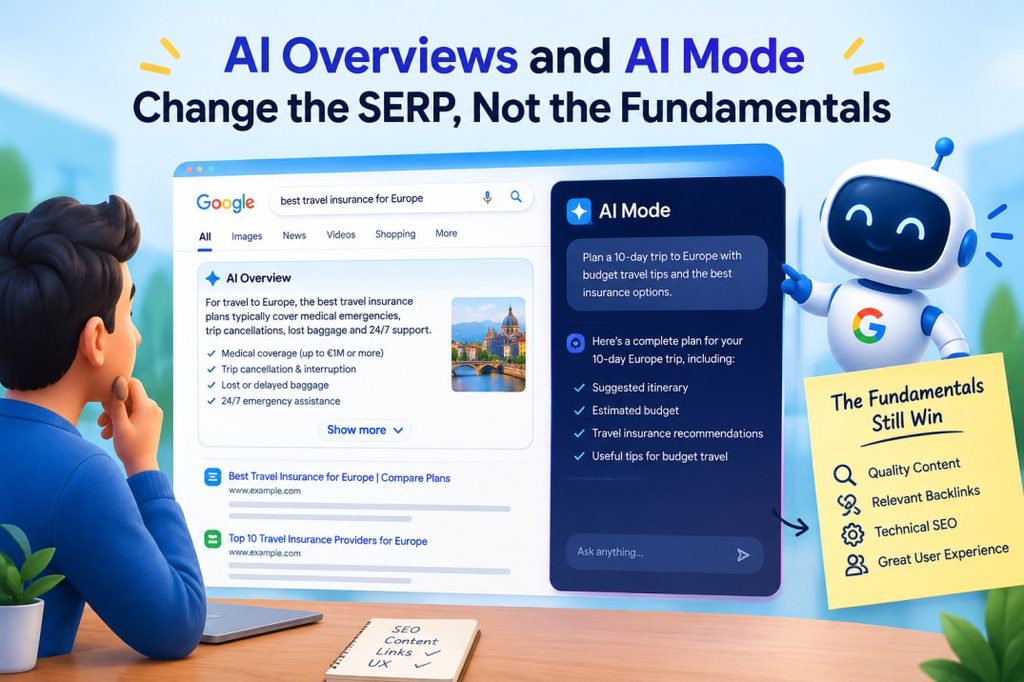
AI Overviews and AI Mode Change the SERP, Not the Fundamentals
AI Overviews and AI Mode have changed what a search result can look like. Instead of simply presenting a list of pages, Google can now generate an answer, connect information from multiple sources and allow users to continue exploring the subject conversationally.
That changes the search experience, but it does not mean websites can forget about search fundamentals. Google’s 2026 guidance specifically discusses how established SEO practices continue to help websites appear in its generative AI features.
The bigger change is that visibility is no longer limited to winning a particular blue-link position.
A useful page might now be discovered through:
- A conventional Google Search result
- An AI Overview
- AI Mode
- Google Discover
- Google Images
- Video results
- News surfaces
- Branded searches following an earlier discovery
This means SEO teams need to stop thinking only in terms of “How do I rank this keyword?”
A better question is:
“How can this piece of information become discoverable wherever someone is looking for it?”
That is a much more useful way to approach SEO after AI search.
Build Non-Commodity Content
This is arguably one of the most important developments among the latest SEO techniques.
AI has made generic information extremely cheap to produce. A business can now create a reasonably readable article explaining almost any basic topic within minutes. That makes generic explanations less distinctive than they were before.
Google’s current generative AI guidance puts particular emphasis on unique, valuable, non-commodity content. The recommendation is not simply to make content longer or more optimised; it is to provide something genuinely useful and distinctive.
That can mean creating:
- Original research based on your own data
- Unique examples from actual projects
- Interactive tools that solve a specific problem
- Calculators that help users make decisions
- Comparison datasets competitors do not have
- Expert interviews containing genuine specialist opinions
- First-hand observations from real implementations
- Original charts, benchmarks or experiments
Consider an article about website development costs.
One website might publish another generic list of hourly rates and project ranges. Another could build a calculator that lets users estimate development requirements based on integrations, user accounts, payment systems, content migration, security requirements and maintenance.
Both pages target the same general subject.
Only one has created something that is difficult to reproduce by simply asking an AI system to “write an article about website development costs.”
That is the direction content needs to move in.
Strengthen Information Architecture
As websites become larger, SEO becomes less about individual pages and more about how those pages work together.
A website should make it obvious which pages are foundational, which are supporting resources and which are specialised answers. Users should be able to move naturally from one subject to another without having to search the entire website again.
Internal linking plays an important role here. Google describes links as a crucial resource for discovering pages and recommends descriptive anchor text that helps users and search engines understand the destination.
This is where topic clusters can be useful, provided they are built around genuine relationships rather than SEO spreadsheets.
For example, a website focused on disaster management software might connect:
Disaster management software → GIS disaster response → satellite imagery → emergency communication → offline-first applications → field reporting → disaster data security
Those links make sense because the subjects genuinely belong together.
The goal is not to create a certain number of internal links per article. The goal is to build an information structure that makes the website easier to understand.
Optimise for Discovery, Not Just Rankings
Traditional SEO tends to treat Google Search as the main destination. But discovery is now distributed across several Google surfaces.
Google’s documentation recognises separate search experiences for web results, images, video and Discover, while Search Console also provides ways to analyse different search appearances and traffic sources.
That means a single piece of content can have several discovery opportunities.
An original research article could produce:
- Search traffic from people researching the topic
- Discover visibility because the subject is timely
- Image traffic through original charts
- Video traffic through an accompanying explanation
- Brand searches from people encountering the company for the first time
- AI-search visibility if the research becomes useful to a generated answer
This changes how content should be planned.
Instead of asking only, “Which keyword should this page rank for?”, ask what formats and discovery paths naturally fit the information.
A technical tutorial might benefit from video. A research report might benefit from original charts. A comparison might work better with structured data or an interactive tool. A breaking industry analysis may have more potential in Discover than a routine evergreen article.
The content should determine the format—not the other way around.
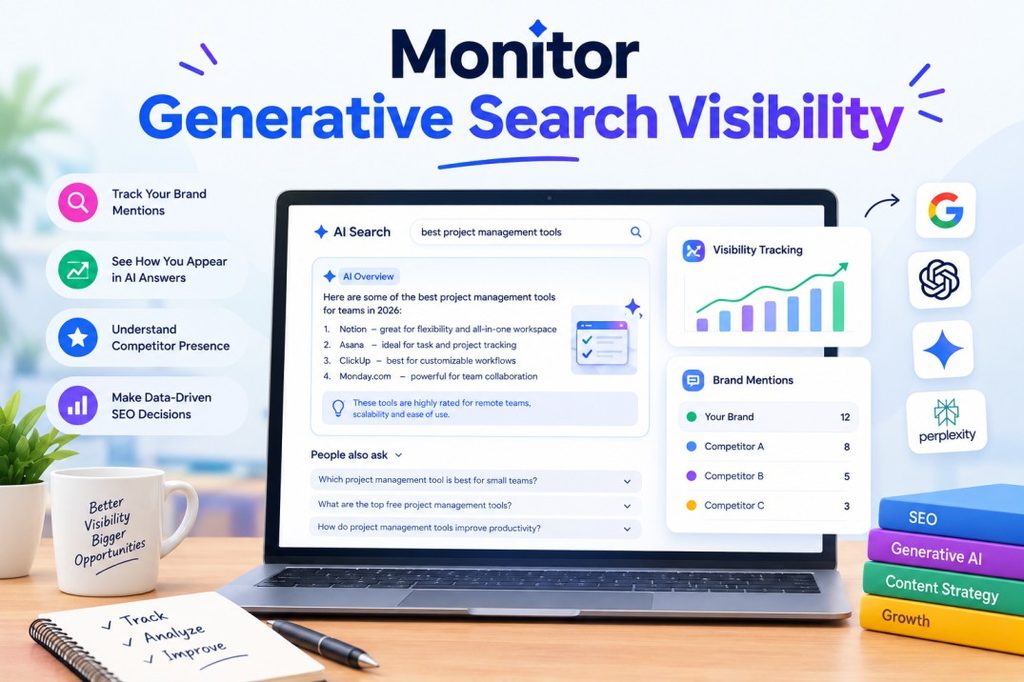
Monitor Generative Search Visibility
One of the genuinely new developments worth watching in 2026 is Google’s expanding measurement of visibility inside generative search.
Google has been adding reporting around AI Overviews and AI Mode, while its documentation now explains how AI-related appearances are represented in Search Console. Google has also clarified that AI Mode data is included in overall Search Console totals.
This gives SEO teams an opportunity to move beyond speculation.
Instead of asking whether AI search “might” be affecting a website, teams can increasingly investigate questions such as:
- Which pages appear in generative search?
- Which topics receive visibility?
- Are informational pages appearing more than commercial pages?
- Which countries or devices show different patterns?
- Does generative visibility correlate with conventional search performance?
- Which pages receive visibility but little downstream engagement?
There is an important distinction here: visibility is not the same as traffic.
A page appearing as a source or link within an AI experience does not automatically mean the user clicked through. So generative-search impressions should be treated as another measurement signal rather than a replacement for clicks, conversions and revenue.
The goal is to understand how discovery is changing, not to create another vanity metric.
Don’t Waste Time on Fake AI SEO Tricks
The rise of AI search has created an entire ecosystem of supposed optimisation tricks.
Some sound technical enough to be convincing. Others are simply traditional SEO tactics with “AI” added to the front.
Google’s own 2026 guidance is useful here because it directly addresses several misconceptions surrounding optimisation for generative AI features.
llms.txt
llms.txt is probably the clearest example of a technique that has received more SEO attention than it deserves.
Google’s latest documentation specifically clarifies that llms.txt files are not needed for Google Search and do not positively or negatively affect Google Search visibility or rankings. Google says site owners can maintain them for other systems that use them, but they should not be treated as a Google SEO requirement.
So if someone tells you that adding an llms.txt file is the secret to ranking in AI Search, be sceptical.
Keyword Stuffing
AI search has not brought keyword stuffing back from the dead.
Repeating “new SEO techniques 2026” twenty times does not make an article more authoritative. In fact, it can make the writing worse for the actual person reading it.
Use important terminology where it genuinely helps explain the subject. Do not make the reader feel like they are trapped inside an SEO spreadsheet.
Query-Page Multiplication
Another tempting strategy is creating a separate page for every possible variation of a search query.
The logic sounds simple:
More queries → more pages → more chances to appear.
But if those pages barely differ and provide little independent value, the strategy quickly becomes content multiplication rather than useful SEO.
Google’s spam policies specifically identify scaled content abuse as the creation of many pages primarily to manipulate rankings rather than help users. The policy applies regardless of whether those pages were generated manually, automatically or with generative AI.
A website does not become more authoritative simply because it has 10,000 URLs instead of 1,000.
Artificial “AI-Readable” Formatting
There is nothing wrong with making content easy to understand.
Definitions, tables, lists, headings, short explanations and clear answer sections are excellent formats when the information calls for them.
The problem begins when marketers invent a supposed AI formatting formula:
- Every heading must be a question
- Every answer must be exactly 40 words
- Every paragraph must begin with a keyword
- Every section needs an “AI summary”
- Every page needs dozens of artificial entities
There is no need to turn good writing into a machine-readable caricature.
Structure content for clarity first.
Buying Fabricated Mentions
Another emerging temptation is trying to manufacture the appearance of authority through paid or fabricated mentions designed specifically to make a company look more prominent in AI-generated answers.
That misses the fundamental point.
If you want other websites, researchers, journalists or AI systems to have a reason to mention your company, create something worth mentioning.
That could be:
- A useful study
- A proprietary dataset
- A genuinely original tool
- A strong industry analysis
- A useful technical resource
- A product experiment
- A survey with meaningful findings
Real authority is considerably harder to manufacture—and considerably harder for competitors to copy.
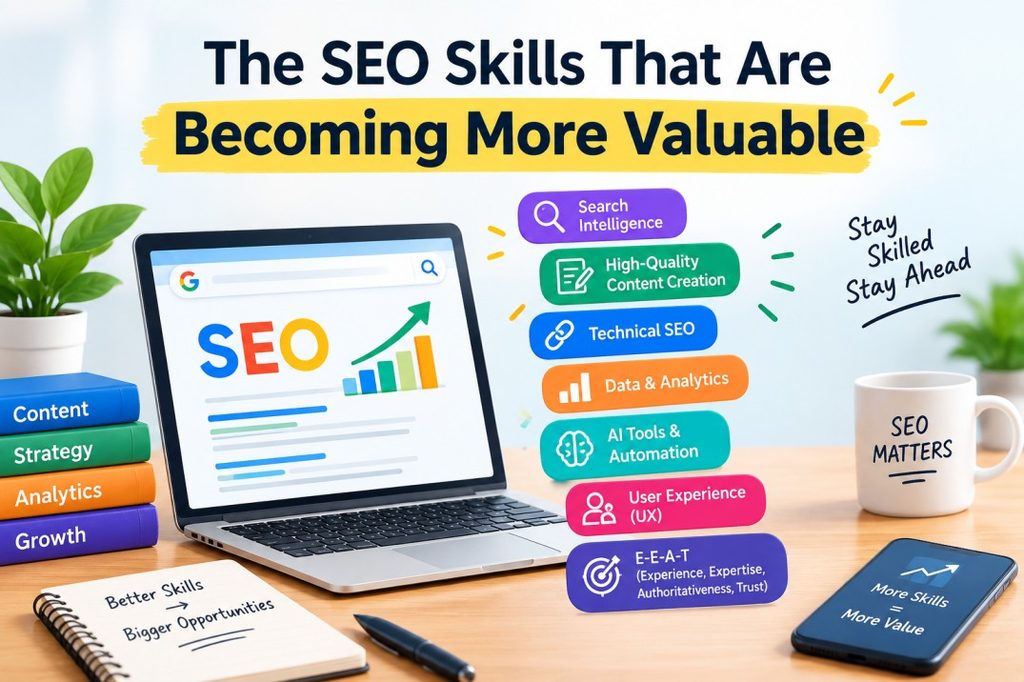
The SEO Skills That Are Becoming More Valuable
The interesting consequence of AI search is that some SEO skills are becoming more valuable, not less.
When generic content can be produced instantly, the advantage shifts towards people who can determine what information is actually worth producing.
Research
SEO professionals increasingly need to know how to find primary sources, examine data, compare competing claims and identify information gaps.
The ability to research properly becomes a competitive advantage when everyone can generate a summary.
Technical SEO
Technical SEO remains fundamental because search engines still need to access, crawl, render and understand websites.
AI has not removed the need for:
- Crawlable links
- Logical URLs
- Indexable pages
- Appropriate redirects
- Mobile usability
- Structured data where relevant
- Sound site architecture
- Fast and reliable technical infrastructure
Google’s developer documentation continues to place these fundamentals at the centre of making websites accessible to Search.
Information Architecture
Someone needs to understand how hundreds or thousands of pages fit together.
That means thinking about:
- Topic relationships
- Internal linking
- Navigation
- Content hierarchy
- URL structures
- Content consolidation
- User journeys
This is becoming particularly important as websites accumulate AI-assisted content at a much faster rate.
Original Content
Original content is no longer simply a nice differentiator.
It is becoming a defence against commoditisation.
If ten competitors can generate essentially the same explanation of a topic, the business that has original research, real examples, proprietary data or first-hand experience has something fundamentally different to offer.
Analytics
SEO teams also need to become better at interpreting fragmented discovery.
Traffic can come from Search, Discover, Images, Video and other surfaces, while generative AI introduces additional ways for people to encounter information.
Search Console’s expanding reporting makes this increasingly measurable, but the real skill lies in interpreting the numbers rather than simply reporting them.
Conversion Thinking
A page receiving 100,000 impressions is not automatically successful.
Ask what happened afterward.
Did people contact the company? Download something? Explore another page? Subscribe? Request a quotation? Buy something? Remember the brand?
SEO is becoming increasingly connected to the entire journey between discovery and decision.
Subject Expertise
Perhaps the most difficult skill to automate is genuine understanding.
A subject expert can explain the exception, identify the trade-off, challenge the common assumption and describe what actually happens in practice.
That is precisely the kind of information that generic content tends to lack.
What Should You Actually Do in 2026?
If you strip away the hype surrounding SEO trends 2026, the practical strategy is surprisingly straightforward.
Focus on the things that make your website more valuable even if you remove the word “SEO” from the conversation:
- Create information competitors do not already have.
- Improve the technical accessibility of your website.
- Build a logical information architecture.
- Connect related pages through meaningful internal links.
- Develop original research, tools, data and examples.
- Adapt valuable information for relevant discovery formats.
- Monitor Search Console and emerging generative-search reporting.
- Measure business outcomes, not rankings alone.
- Use AI to accelerate useful work rather than manufacture expertise.
- Ignore tactics that exist primarily because someone added “AI” to an old SEO trick.
The most important change in 2026 is therefore not that SEO has disappeared.
It is that commodity SEO is becoming easier to produce and harder to differentiate.
Google’s own current guidance points in this direction: create useful, unique content; provide original perspectives; organise information clearly; follow established SEO practices; and avoid strategies designed primarily to manipulate generative AI responses or search rankings.
That gives us a much better definition of the latest SEO techniques.
They are not secret instructions for making an algorithm happy.
They are better ways of creating, organising, measuring and distributing information in a search environment where AI can increasingly understand, summarise and connect what you publish.
And that leaves one principle standing above all the fashionable terminology:
Don’t optimise your website to look useful. Build a website that actually is useful.
That is likely to remain good SEO long after today’s AI search interface has changed again.