
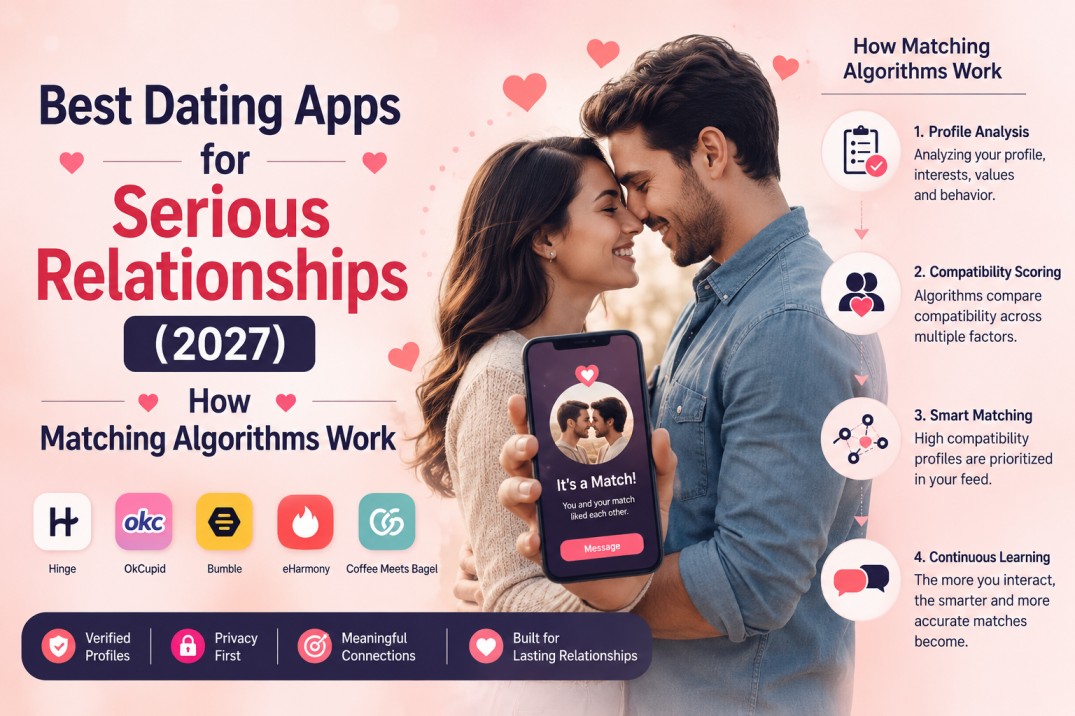
Hinge, Bumble, OkCupid, eharmony and Coffee Meets Bagel are among the strongest contenders for the best dating apps 2027, particularly for singles seeking meaningful connections and long-term relationships. These platforms use different combinations of user preferences, behavioural data, compatibility assessments and machine learning to recommend potential partners.
Online dating has become an established way of finding romantic partners. According to a 2023 Pew Research Center report based on a survey of 6,034 American adults, 30% of US adults had used an online dating platform. Furthermore, 10% of adults who were married, living with a partner or in a committed romantic relationship reported meeting their current partner through a dating website or application.
The technology supporting these connections is also evolving. In 2025, Hinge introduced a deep-learning recommendation system designed to better understand mutual romantic interest. Other dating platforms continue to develop personalised recommendations, compatibility assessments and features that encourage meaningful conversations.
But what actually happens when you swipe right on someone’s profile? Why do certain people appear in your recommendations while others never do? Can artificial intelligence genuinely predict whether two individuals will develop a successful relationship?
This guide explores how dating app algorithms work, the data they analyse, the machine learning techniques that support matchmaking and the platforms worth considering for serious relationships in 2027.
The recommendations are based on publicly documented features available as of November 2026. Actual features, subscription conditions and regional availability may change during 2027.
1. What Are Dating App Algorithms?
Behind every recommended profile is a technological process that determines which individuals may be relevant to your dating preferences. Understanding this process can help you make better decisions when using online dating platforms.
What Is a Dating App Algorithm?
A dating app algorithm is a computational system that analyses available user information, preferences and behavioural signals to identify, rank and recommend potential romantic connections.
Rather than displaying every registered user in random order, the platform attempts to narrow down the available profiles to people who might be relevant to an individual’s dating goals.
A modern dating recommendation system may combine several techniques, including:
- Preference-based filtering
- Geographic matching
- Behavioural analysis
- Compatibility scoring
- Machine learning
- Predictive modelling
- Reciprocal interest prediction
Some applications rely heavily on questionnaire responses, while others place greater emphasis on how individuals interact with recommended profiles.
Why Do Dating Platforms Use Algorithms?
Imagine joining a dating platform with hundreds of thousands of active users. Browsing every available profile would be impractical, especially when many users live far away or have different relationship expectations.
Algorithms help dating platforms organise this information and present more relevant recommendations.
They can help platforms identify individuals within a preferred age range, prioritise geographically relevant profiles and discover patterns in previous interactions.
Some systems may also consider whether the recommended individual is likely to express reciprocal interest.
From a business perspective, recommendation systems can influence user engagement, satisfaction and retention. However, optimising application engagement is not necessarily the same as helping users establish successful long-term relationships.
How Algorithms Influence Profile Recommendations and Potential Matches
Dating recommendations often involve three broad stages: identifying eligible candidates, estimating their relevance and determining the order in which profiles appear.
For example, suppose a 32-year-old user is interested in a long-term relationship with someone aged between 28 and 36 who lives nearby.
The application may first identify profiles satisfying the relevant eligibility conditions. It could then analyse shared interests, relationship intentions and previous interaction patterns before ranking potential recommendations.
As the user continues interacting with the platform, the recommendation system may gradually adjust its predictions.
However, the precise factors, weights and ranking objectives used by commercial dating applications are generally proprietary.
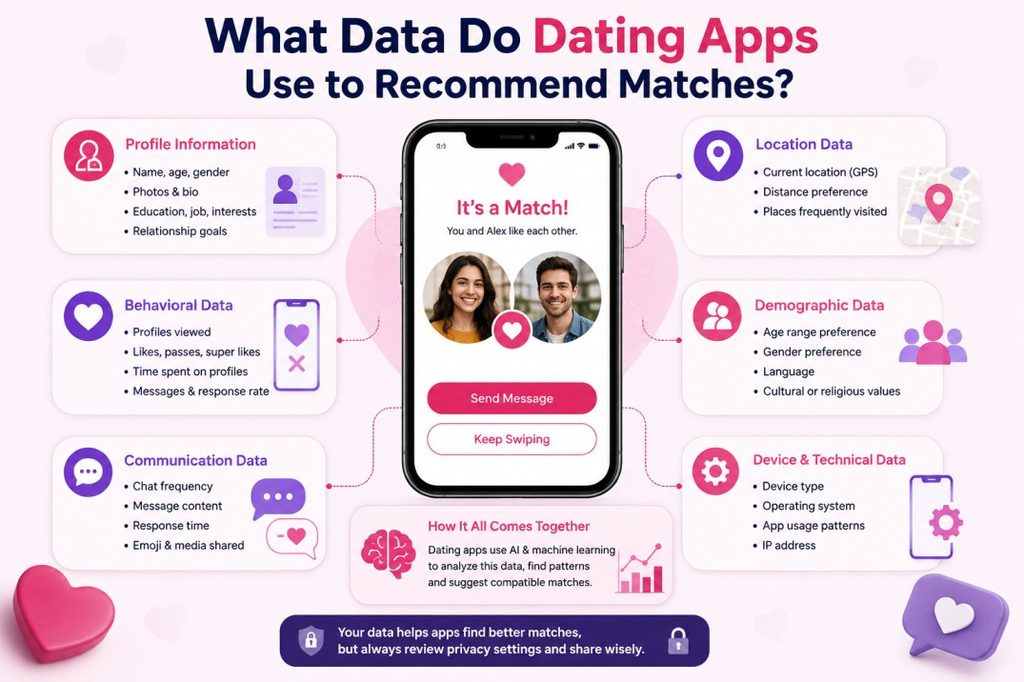
2. What Data Do Dating Apps Use to Recommend Matches?
The quality of a dating recommendation depends partly on the information available to the platform. Different applications collect and process different combinations of explicit preferences and behavioural signals.
a. Profile Information and Demographics
Profile information is usually the starting point for matchmaking.
Depending on the application, users may provide details such as their age, gender, occupation, education, relationship goals, interests, hobbies and lifestyle preferences.
Some platforms also allow individuals to disclose their views on marriage, family planning, smoking, drinking, religion or other personal considerations.
This information helps establish an initial understanding of the individual before the application has accumulated significant behavioural data.
For example, someone interested in marriage may prefer recommendations involving individuals who have expressed similar long-term intentions.
Users should remember that profile information is generally self-reported and may not always accurately represent someone’s circumstances or personality.
b. Location and Geographic Distance
Geographic proximity is particularly relevant because most people eventually want to meet their potential partners in person.
Dating applications can use location information, subject to applicable permissions and privacy policies, to identify profiles within a preferred geographic area.
A user living in Bengaluru who sets a 20-kilometre distance preference may receive different recommendations from someone willing to meet people across the country.
Distance can operate as a strict restriction or a flexible ranking factor, depending on the application’s settings.
Some platforms also provide location-changing features for travellers or people considering relocation.
c. User Preferences and Deal-Breakers
Dating preferences help users communicate what they are looking for in a potential partner.
Common preferences include age, geographic distance, relationship intentions, lifestyle choices and family expectations.
However, not every preference carries the same level of importance.
Someone may prefer a partner who enjoys travelling but consider having compatible relationship goals an essential requirement.
A dating platform that supports deal-breakers can distinguish between these different priorities, helping users avoid recommendations that conflict with their most important expectations.
Nevertheless, the availability and strictness of preference controls vary across platforms and subscription plans.
d. Swiping Patterns, Likes and Passes
Explicit profile preferences provide one source of information. Actual user behaviour can provide another.
When an individual likes, skips or passes on recommended profiles, these actions create feedback that a recommendation system may use to refine future suggestions.
For example, someone who regularly interacts positively with profiles mentioning outdoor activities may receive recommendations containing similar interests.
The system does not necessarily understand the personal reasoning behind every decision. A user might skip a profile because of an incompatible relationship goal rather than its photographs or hobbies.
Consequently, behavioural signals are useful but imperfect indicators of romantic preferences.
e. Messaging Activity and Match Interactions
Depending on its technology and privacy practices, a dating application may analyse interaction-level information after users connect.
Potential signals include whether a conversation begins, whether messages receive responses and whether interactions continue beyond the initial match.
These signals could help a recommendation system distinguish between profiles that simply generate likes and those associated with meaningful engagement.
However, an active conversation does not necessarily indicate romantic compatibility. Some users communicate enthusiastically with several people, while others prefer meeting in person after exchanging only a few messages.
Users should consult the platform’s privacy policy rather than assume that private message content is or is not used for matchmaking.
f. App Usage Patterns and Engagement Signals
Application activity can also influence recommendation systems.
Tinder, for example, publicly explains that activity, geographic proximity and interactions with profiles contribute to its matching approach.
Recommending someone who has recently used the platform may increase the likelihood that a potential connection receives a response.
Nevertheless, frequent application usage does not automatically indicate serious relationship intentions.
There is also no universally verified rule suggesting that logging in at a particular hour, maintaining a specific swipe ratio or purchasing premium membership will guarantee better romantic matches.
3. How Do Dating Apps Calculate Compatibility Scores?
A compatibility score is a numerical representation of estimated suitability between two individuals according to the factors considered by a matchmaking system.
Not every dating application displays such a score. Some platforms use internal predictions solely to organise recommended profiles.
a. Matching Preferences Against Profile Attributes
The first step may involve comparing an individual’s stated preferences with another user’s profile information.
For instance, consider two hypothetical users, Alex and Emma.
Alex is seeking a long-term relationship, enjoys travelling, prefers a non-smoking partner and wants to meet someone within 30 kilometres.
Emma has expressed similar relationship intentions, enjoys travelling, does not smoke and lives 15 kilometres away.
A basic recommendation system could identify several areas of alignment between their profiles.
A reciprocal matching system might additionally examine whether Alex satisfies Emma’s preferences.
b. Assigning Weights to Different Compatibility Factors
Different compatibility factors may have different levels of importance.
A person seeking marriage may attach greater importance to long-term relationship goals than having identical entertainment preferences.
A hypothetical dating application could assign the following weights to five compatibility factors:
| Compatibility factor | Illustrative weight |
| Relationship intentions | 30% |
| Lifestyle compatibility | 25% |
| Shared interests | 15% |
| Geographic proximity | 15% |
| Reciprocal preferences | 15% |
| Total | 100% |
These figures demonstrate how a weighted recommendation system could operate. They do not represent the actual internal formula of any commercial dating application.
Modern machine learning systems may also learn complex relationships between numerous variables instead of relying on fixed, manually assigned percentages.
c. Calculating a Compatibility Score
Suppose the hypothetical algorithm assigns the following individual scores to Alex and Emma.
| Compatibility factor | Weight | Factor score | Weighted contribution |
| Relationship intentions | 30% | 100 | 30 |
| Lifestyle compatibility | 25% | 80 | 20 |
| Shared interests | 15% | 80 | 12 |
| Geographic proximity | 15% | 60 | 9 |
| Reciprocal preferences | 15% | 80 | 12 |
| Final compatibility score | 100% | 83/100 |
Under this simplified example, Alex and Emma receive a compatibility score of 83 out of 100.
This score reflects alignment with the selected criteria. It does not indicate an 83% probability of developing a successful relationship.
OkCupid is an example of a real dating platform that uses answers to compatibility questions to calculate and display a match percentage.
d. Applying Hard Filters Versus Soft Preferences
Recommendation systems can distinguish between mandatory requirements and flexible preferences.
| Hard filters | Soft preferences |
| Essential eligibility conditions | Preferred characteristics |
| May exclude profiles entirely | May influence profile ranking |
| Examples include strict age or distance settings | Examples include hobbies or entertainment interests |
| Applied before or during recommendation | Commonly used during scoring and ranking |
Suppose someone considers matching relationship intentions essential but merely prefers a partner who enjoys reading.
An individual with different relationship intentions might be excluded entirely, while someone who does not enjoy reading could still appear as a recommendation.
This distinction can make matchmaking more practical without unnecessarily restricting the available dating pool.
e. Why a High Compatibility Score Does Not Guarantee a Successful Relationship
Human relationships involve characteristics that are difficult to quantify accurately.
Emotional maturity, communication, mutual respect, physical attraction, conflict resolution and personal circumstances can all influence relationship outcomes.
A 2017 study published in Psychological Science examined whether machine learning could predict romantic attraction using information collected before speed-dating encounters. Although the models could identify certain general patterns of romantic desirability, they could not reliably predict the unique attraction between particular individuals before meeting.
A compatibility score is therefore best viewed as a tool for discovering potential partners rather than a definitive judgement about relationship success.
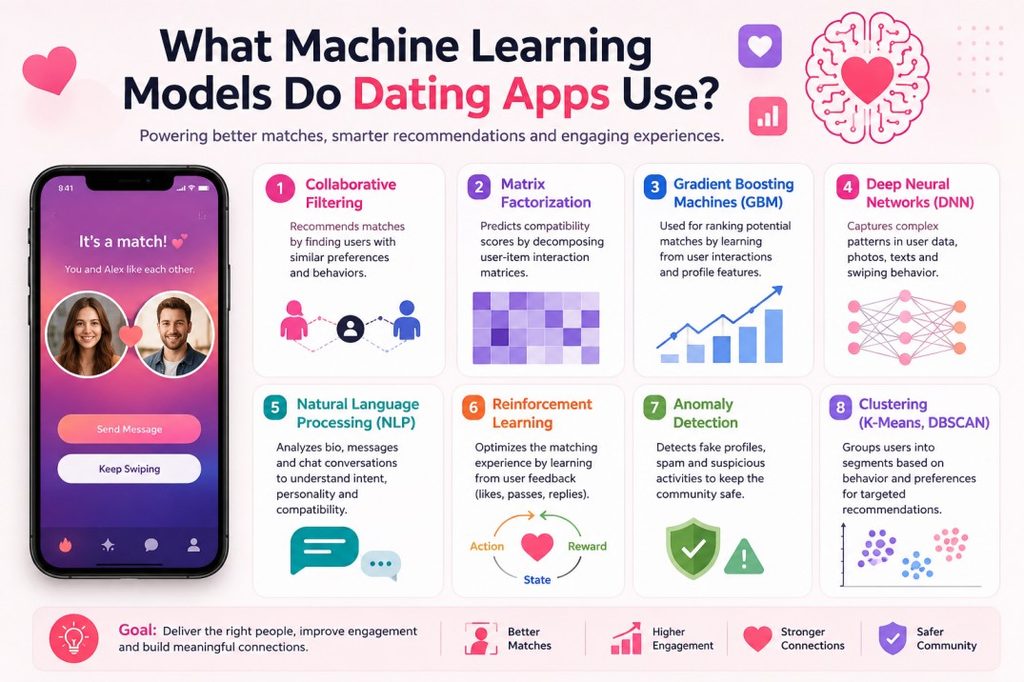
4. What Machine Learning Models Do Dating Apps Use?
Artificial intelligence and machine learning can help recommendation systems identify relationships within large datasets that would be difficult to manage using simple rules alone.
The following techniques are commonly used in recommendation-system engineering and may be adapted to dating platforms. Individual applications do not necessarily use every technique described here.
a. Collaborative Filtering
Collaborative filtering generates recommendations by identifying patterns in the behaviour of users.
Suppose two individuals frequently express interest in similar profiles. A collaborative recommendation system may use these shared interaction patterns to identify additional profiles that could interest either person.
The approach can uncover preferences that users have not explicitly mentioned.
However, collaborative filtering faces challenges when new users join a platform without any interaction history. This is commonly known as the cold-start problem.
Popularity bias can also arise if profiles receiving significant engagement are repeatedly recommended while less visible users receive fewer opportunities.
b. Content-Based Filtering
Content-based filtering recommends profiles according to their characteristics and the user’s known preferences.
A dating application might compare information such as interests, lifestyle descriptions and relationship intentions.
For example, if an individual expresses interest in profiles mentioning photography, travel and vegetarian cooking, a content-based recommendation system may identify other profiles containing related characteristics.
Unlike collaborative filtering, this method can generate some recommendations without relying extensively on the behaviour of other users.
However, it may become overly restrictive if the system continually recommends similar profiles without introducing opportunities to discover different personalities.
c. Hybrid Recommendation Systems
Hybrid recommendation systems combine multiple approaches to improve recommendation relevance.
A dating platform could use content-based filtering to assess profile characteristics, collaborative filtering to identify behavioural patterns and additional rules to enforce eligibility conditions.
A hypothetical hybrid recommendation process might follow these stages:
- Identify profiles satisfying essential preferences.
- Retrieve geographically relevant candidates.
- Analyse profile similarities and interaction history.
- Estimate the potential for mutual interest.
- Apply safety and eligibility restrictions.
- Rank the remaining recommendations.
Google’s publicly available recommendation-system documentation describes a comparable general architecture involving candidate generation, scoring and re-ranking.
Dating platforms can adapt these concepts to the more complex requirement of recommending people who may be interested in each other.
d. Supervised Learning and Predictive Models
Supervised machine learning involves training models using historical examples with known outcomes.
For a hypothetical dating recommendation system, training examples might include whether recommended profiles received likes, whether those likes became mutual matches and whether conversations subsequently started.
The model learns relationships between available input variables and the outcome it is designed to predict.
Possible modelling techniques include logistic regression, gradient-boosted decision trees and neural networks.
The choice of prediction target is particularly important. A model trained to predict likes is not necessarily optimised to predict meaningful conversations. Similarly, a model trained to predict conversations cannot automatically determine whether those conversations will develop into lasting relationships.
e. Embeddings and Similarity Search
Embeddings are numerical representations of information that allow machine learning systems to compare complex characteristics.
For example, profile descriptions containing references to hiking, camping and national parks may be represented in a way that reflects their conceptual similarities.
A recommendation system can compare these numerical representations using similarity measures such as cosine similarity or dot products.
Vector databases and nearest-neighbour search techniques can help retrieve relevant candidates from large collections of profiles.
Some modern architectures use separate neural network components to represent the individual receiving recommendations and the profiles being considered.
Hinge publicly disclosed that it introduced a deep-learning recommendation system in 2025. However, its complete production architecture and internal scoring methods are not publicly available.
Comparison of Machine Learning Techniques Used in Matchmaking
| Technique | Main purpose | Potential limitation |
| Collaborative filtering | Discover behavioural patterns | Limited history for new users |
| Content-based filtering | Compare profile attributes | Repetitive recommendations |
| Hybrid systems | Combine multiple data sources | Greater implementation complexity |
| Supervised learning | Predict defined interaction outcomes | Dependent on training data quality |
| Embeddings | Represent complex similarities | Difficult to interpret individual predictions |
| Reciprocal recommendation | Estimate mutual interest | Interest can change over time |
These technologies can improve the process of discovering potential connections, but none can fully capture the complexity of human relationships.
5. How Do Dating Apps Handle Mutual Matches?
Recommending a profile and establishing a mutual match are two different technical processes.
The recommendation system determines which profiles appear. The matchmaking backend handles the interactions that occur when individuals express interest in each other.
a. How the App Records a Like or Swipe
When a user likes another profile, the application sends information about the interaction to its backend server.
A simplified interaction record could contain:
| Data field | Example |
| Sender ID | USER_101 |
| Recipient ID | USER_205 |
| Interaction type | Like |
| Interaction time | 18:42:10 UTC |
| Interaction status | Active |
The server can validate the interaction and check whether the individuals are eligible to connect.
This may involve verifying account status, blocking restrictions and whether the same interaction has already been recorded.
The exact database structure differs between applications.
b. How the App Checks Whether the Other User Has Already Liked the Profile
Suppose Alex likes Emma’s profile.
The backend checks whether Emma has previously expressed interest in Alex.
If Emma has not liked Alex, the interaction remains a one-sided expression of interest.
If Emma has already liked Alex, the platform can proceed with establishing a mutual match.
This reciprocal interaction is fundamental to swipe-based dating applications because it allows communication to begin when both individuals have expressed interest.
c. How the Backend Confirms a Mutual Match
The backend must ensure that the connection satisfies the platform’s applicable matching rules.
In a simplified implementation, the system checks that both likes are valid, both accounts remain active and neither individual has blocked the other.
It then creates a unique match record.
Concurrency handling is important because two people may like each other’s profiles almost simultaneously. Database constraints and transaction controls can help prevent the creation of duplicate matches.
d. How Match Records Are Stored in a Database
A hypothetical database record for a mutual match might contain:
| Database field | Example |
| Match ID | MATCH_0051 |
| First user | USER_101 |
| Second user | USER_205 |
| Match status | Active |
| Conversation ID | CHAT_8821 |
This record allows the application to retrieve the match, associate conversations with it and update its status if either individual decides to unmatch.
Relational databases and other storage technologies can support these processes, depending on the platform’s scale and architecture.
e. How the App Creates a Chat and Sends Push Notifications
After confirming a match, the backend may create a conversation or enable the necessary messaging permissions.
The system can then trigger a notification event informing both individuals about their new connection, subject to their notification preferences.
Mobile applications may use technologies such as Firebase Cloud Messaging or Apple Push Notification Service to deliver notifications.
The overall process can be represented as follows:
User A likes User B → Backend records the interaction → System checks for reciprocal interest → Mutual match is confirmed → Conversation becomes available → Notifications are delivered.
This is an illustrative backend design. Commercial platforms may implement these operations differently or apply additional conversation rules.
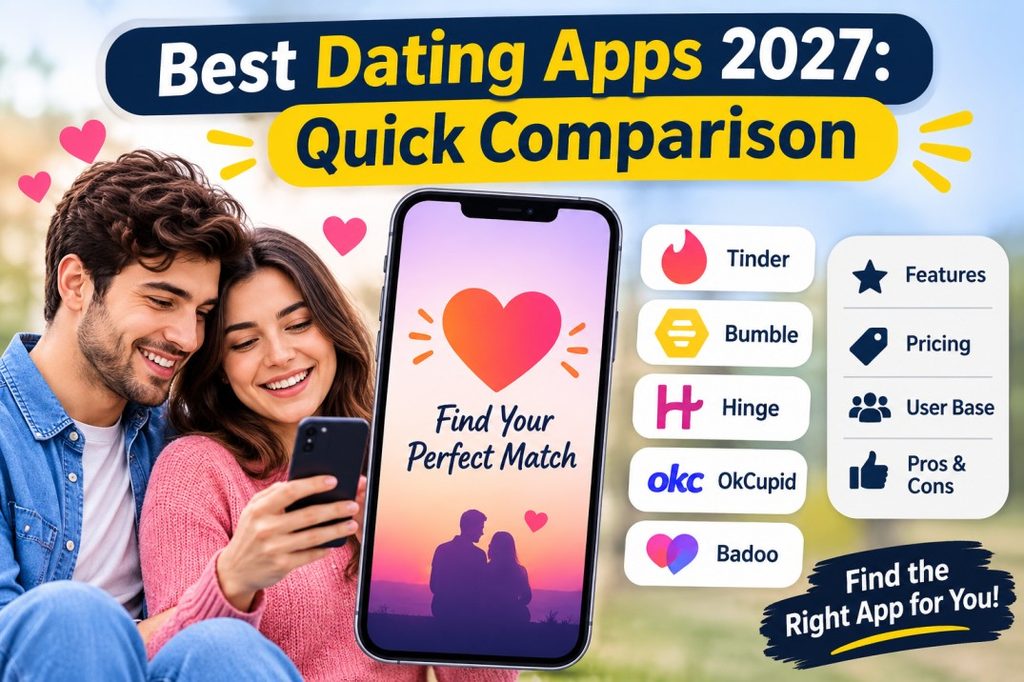
6. The Best Dating Apps for Serious Relationships in 2027
When comparing the best dating apps for serious relationships, it is worth looking beyond download numbers and promotional claims.
Relationship intentions, profile depth, free messaging features, recommendation methods, safety controls and local user availability are more useful considerations.
The following shortlist is an editorial assessment based on publicly documented platform features available in late 2026, rather than an independently measured 2027 success-rate ranking.
Best Dating Apps 2027: Quick Comparison
| Dating app | Best for | Free messaging | Matching approach |
| Hinge | Long-term relationships | Yes, with matches | Personalised recommendations |
| Bumble | Intentional dating | Yes, subject to chat rules | Preferences and personalised discovery |
| OkCupid | Values-based compatibility | Yes | Compatibility questions |
| eharmony | Detailed compatibility assessment | Limited | Compatibility questionnaire |
| Coffee Meets Bagel | Selective, less intensive dating | Yes, with suggested matches | Curated recommendations |
| Match | Established relationship seekers | Yes, with mutual matches under current terms | Profiles and preferences |
| Tinder | Wider dating opportunities | Yes, with matches | Behavioural and location-based recommendations |
Free features, subscriptions and availability may vary according to location and future platform updates.
1. Hinge: Best Overall for Serious Relationships
Best for: Singles who want meaningful conversations and long-term romantic connections.
Hinge encourages users to create profiles combining photographs, personal information and written prompts. Rather than relying entirely on a general profile swipe, individuals can express interest in specific profile elements.
This format provides natural opportunities to start conversations based on shared experiences or interests.
How Hinge’s Matching Algorithm Works
Hinge uses personalised recommendation technology to identify people who may be interested in each other.
In 2025, the company introduced a deep-learning recommendation system that considers signals associated with users’ preferences and potential reciprocal interest.
Its recommendations can develop as users interact with the application.
Free Features
- Profile creation and personal prompts.
- Limited likes.
- Matching and conversations.
- Basic discovery preferences.
Advantages
- Profiles provide more conversation context.
- Relationship intentions can be communicated clearly.
- Users can respond to specific photographs or prompts.
- Core matching and messaging are available without a subscription.
Disadvantages
- Free likes are limited.
- Certain filters and discovery features require payment.
- Local dating pools may be smaller in some regions.
Who Should Use Hinge?
Hinge is a strong starting point for individuals who prefer thoughtful introductions rather than browsing large numbers of minimally detailed profiles.
Official website: hinge.co
2. Bumble: Best for Intentional Dating and Mutual Conversations
Best for: Individuals seeking a balance between meaningful connections, personal preferences and a relatively straightforward dating experience.
Bumble allows users to create profiles describing their interests, lifestyle and relationship intentions.
Its discovery features help individuals identify people with potentially relevant preferences and shared characteristics.
How Bumble’s Matching Algorithm Works
Bumble’s Discover feature recommends profiles using factors that include similar interests, compatible dating goals and shared communities.
The platform’s broader recommendation system is proprietary.
Bumble has also updated its conversation-starting experience. Its latest support documentation describes a system in which both individuals can send an opening message before the full conversation becomes available, replacing its earlier Opening Moves feature.
Free Features
- Creating and browsing profiles.
- Sending likes within applicable limits.
- Establishing mutual matches.
- Communicating with matches under applicable chat rules.
Advantages
- Clear profile and relationship preference options.
- Accessible free dating experience.
- Personalised discovery features.
- Tools for reporting and blocking unwanted interactions.
Disadvantages
- Some advanced filters require payment.
- Match and conversation conditions may vary.
- Finding relationship-oriented individuals still requires personal screening.
Who Should Use Bumble?
Bumble is worth considering for singles who want a mainstream dating platform without relying entirely on appearance-based recommendations.
Official website: bumble.com
3. OkCupid: Best for Shared Values and Compatibility Questions
Best for: Individuals who want to understand potential partners’ beliefs, lifestyles and relationship expectations before meeting.
OkCupid differentiates itself through its compatibility questions.
Users can answer questions about their interests, values, preferences and views on various aspects of relationships. The platform uses these answers to help identify potentially compatible individuals.
How OkCupid’s Matching Algorithm Works
OkCupid calculates a match percentage using information obtained from compatibility questions and related user preferences.
The percentage gives users an indication of estimated alignment according to the platform’s methodology.
It can also help users identify topics they may wish to discuss with a potential partner.
Free Features
- Profile creation.
- Compatibility questions.
- Viewing suggested profiles.
- Matching and messaging.
Advantages
- More detailed opportunities to assess shared values.
- Visible compatibility percentages.
- Inclusive profile and identity options.
- Free messaging.
Disadvantages
- Completing numerous questions requires time.
- Compatibility percentages can create unrealistic expectations.
- Certain premium discovery features require payment.
Who Should Use OkCupid?
OkCupid is particularly suitable for people who prioritise intellectual compatibility, shared values and lifestyle alignment over immediate physical attraction alone.
Official website: okcupid.com
4. eharmony: Best for Detailed Compatibility Assessment
Best for: Singles interested in committed relationships who prefer a structured matchmaking experience.
Rather than concentrating primarily on rapid profile browsing, eharmony encourages members to complete a Compatibility Quiz.
The questionnaire helps collect information about personalities and relationship preferences.
How eharmony’s Matching Algorithm Works
The platform uses information from its compatibility assessment and user preferences to recommend potentially relevant individuals.
Its complete compatibility calculation is proprietary, and its assessments should not be interpreted as guarantees of relationship success.
Free Features
- Basic membership.
- Compatibility Quiz.
- Viewing recommended profiles.
- Limited introductory communication.
Advantages
- Structured matchmaking experience.
- Detailed compatibility assessment.
- Emphasis on relationship-oriented dating.
- Useful for individuals who prefer a more considered approach.
Disadvantages
- Full communication features generally require a subscription.
- Initial registration can take longer.
- Subscription terms should be reviewed carefully.
Who Should Use eharmony?
Individuals who are actively seeking long-term commitment and are comfortable evaluating paid matchmaking services may find eharmony appealing.
Official website: eharmony.com
5. Coffee Meets Bagel: Best for Selective Dating
Best for: Busy professionals and individuals who prefer reviewing a smaller selection of potential matches.
Coffee Meets Bagel focuses on curated recommendations instead of encouraging continuous profile browsing.
The platform positions itself as a service for people interested in serious romantic connections.
How Coffee Meets Bagel’s Matching Algorithm Works
The service provides suggested profiles using available preferences and recommendation information.
Its curated approach encourages users to spend more time evaluating individual profiles rather than continuously searching for alternatives.
The precise recommendation formula is not publicly disclosed.
Free Features
- Profile creation.
- Daily suggested profiles.
- Limited likes.
- Conversations with suggested matches.
Advantages
- Less emphasis on continuous swiping.
- Manageable selection of recommended profiles.
- Relationship-oriented positioning.
- Basic matching and conversations without mandatory payment.
Disadvantages
- Limited free recommendations.
- Additional discovery controls may require subscriptions.
- Local user availability can vary considerably.
Who Should Use Coffee Meets Bagel?
It may suit individuals who feel overwhelmed by conventional dating apps and prefer spending more time evaluating fewer potential connections.
Official website: coffeemeetsbagel.com
6. Match: Best for Established Relationship Seekers
Best for: Individuals who want a traditional online dating experience with detailed profiles and search preferences.
Match combines profile discovery, personalised recommendations and communication features.
Users can explore profiles based on available preferences and review information about interests, lifestyles and relationship expectations.
How Match’s Matching System Works
Match uses profile information and search preferences to help users identify relevant potential partners.
Its recommendation technology also supports personalised profile discovery, although its complete internal model is not publicly available.
Free Features
- Profile creation.
- Browsing and discovering profiles.
- Sending likes.
- Messaging mutual matches under its currently documented terms.
Advantages
- Detailed profile discovery.
- Established online dating service.
- Relationship-focused features.
- Free communication with mutual matches under current documented conditions.
Disadvantages
- Some discovery and communication enhancements require payment.
- Availability and activity differ across countries.
- The experience may feel less streamlined than newer applications.
Who Should Use Match?
Match is worth exploring for individuals who prefer detailed profiles and a more traditional approach to finding a long-term partner.
Official website: match.com
7. Tinder: Best for a Wider Range of Dating Opportunities
Best for: Individuals who want to explore a broader selection of potential connections and are comfortable screening for relationship intentions themselves.
Although Tinder is often associated with casual dating, users may also seek committed relationships through the platform.
Its straightforward matching process makes it accessible to people with different dating goals.
How Tinder’s Matching Algorithm Works
Tinder publicly identifies several factors that can influence profile recommendations, including application activity, location, preferences and interactions with other profiles.
Its system can adjust recommendations as individuals continue using the application.
However, Tinder does not publish its complete ranking formula.
Free Features
- Profile creation.
- Browsing profiles.
- Likes within applicable limits.
- Matching and chatting.
Advantages
- Straightforward matching experience.
- Free conversations with mutual matches.
- Suitable for different dating intentions.
- Widely established international presence.
Disadvantages
- Users may have significantly different relationship expectations.
- Screening for serious intentions requires additional effort.
- Certain visibility and discovery enhancements require payment.
Who Should Use Tinder?
Tinder may suit singles who want to explore more opportunities and are willing to communicate their relationship intentions clearly from the beginning.
Official website: tinder.com

Which Dating Apps Can You Use Without Paying?
People searching for free dating apps without payment should distinguish between applications that are free to download and platforms that provide meaningful dating functionality without a subscription.
An application may allow free registration while charging for unrestricted messaging, advanced filters or access to certain profiles.
| Dating app | Free registration | Free matching | Free communication |
| Hinge | Yes | Yes | Yes |
| Bumble | Yes | Yes | Yes, subject to chat rules |
| OkCupid | Yes | Yes | Yes |
| Tinder | Yes | Yes | Yes |
| Coffee Meets Bagel | Yes | Yes | Yes, with suggested matches |
| Match | Yes | Yes | Yes, with mutual matches under current terms |
| eharmony | Yes | Yes, basic recommendations | Limited |
For most individuals, starting with a free version is sensible. It allows them to assess the local dating pool, profile quality, recommendation relevance and communication experience before considering a subscription.
Premium features may provide additional convenience, but they cannot guarantee romantic compatibility or mutual attraction.
What Are the Best Dating Apps for Men in 2027?
Choosing the best dating apps for men depends on relationship goals, geographic location, preferred communication style and the number of relevant users available locally.
| Dating goal | Suggested starting point |
| Long-term relationship | Hinge |
| Shared beliefs and interests | OkCupid |
| Selective and intentional dating | Coffee Meets Bagel |
| Mainstream dating experience | Bumble |
| Exploring more connections | Tinder |
| Structured compatibility assessment | eharmony |
Men seeking meaningful relationships should focus on creating authentic profiles rather than attempting to manipulate recommendation algorithms.
Using clear photographs, writing personalised profile descriptions and communicating relationship intentions can help potential partners make informed decisions.
Sending thoughtful messages that relate to someone’s profile is generally a better starting point than repeatedly using generic introductions.
No application guarantees matches, and there is no universal evidence that one platform consistently produces the best romantic outcomes for all men.
Best Dating Apps 2026 vs 2027: How Is Dating Technology Changing?
When reviewing the best dating apps 2026, several technological developments provide an indication of how online matchmaking may continue evolving in 2027.
More Sophisticated AI Matchmaking
Dating platforms are developing recommendation systems capable of analysing more complex patterns than traditional age, location and interest filters.
Deep-learning systems may improve predictions of profile relevance and reciprocal interest.
Improved Profile Verification
Identity checks, photo verification and automated safety systems are becoming important components of online dating.
These tools may help identify suspicious activity, although verification badges cannot guarantee that every user is trustworthy.
Greater Focus on Relationship Intentions
Applications increasingly provide opportunities for users to communicate whether they are interested in marriage, committed relationships, casual dating or other connections.
Clear intentions can help individuals identify incompatible expectations earlier.
AI-Assisted Conversations
Some platforms are experimenting with artificial intelligence to help users create profile descriptions, develop conversation starters or identify relevant information about suggested matches.
These tools may make initial communication easier, but excessive reliance on generated messages can reduce authenticity.
More Personalised Recommendations
Dating platforms may increasingly combine stated preferences, behavioural signals and machine learning to provide recommendations adapted to individual users.
However, concerns involving privacy, algorithmic bias, transparency and personal autonomy will remain important.
These developments represent an outlook for 2027, not confirmation of future product releases.
Are Dating Apps Worth It for Serious Relationships?
Many singles wonder, are dating apps worth it when the ultimate goal is a meaningful and committed relationship?
Dating applications can be worthwhile because they introduce people who might otherwise never encounter each other through their existing social or professional networks.
They can be particularly useful for busy professionals, individuals who have relocated and people whose daily routines provide limited opportunities to meet new potential partners.
However, the experience varies considerably.
Advantages of Dating Apps
- Access to people outside existing social circles.
- Opportunities to communicate relationship preferences.
- Convenient introductions regardless of work schedules.
- Discovery of individuals with potentially compatible interests.
- Greater control over whom users initially interact with.
Disadvantages of Dating Apps
- Misleading or fraudulent profiles.
- Repeated rejection or unanswered messages.
- Subscription expenses.
- Dating fatigue from continuous profile browsing.
- Differences between stated and actual relationship intentions.
- Privacy and personal safety concerns.
Dating apps are most useful when treated as introduction services rather than complete solutions for finding love.
How to Improve Your Dating App Recommendations
Although users cannot fully control proprietary recommendation algorithms, they can provide clearer information and make more deliberate dating decisions.
Complete Your Profile Accurately
Include relevant interests, relationship intentions and lifestyle information. A detailed and authentic profile gives potential partners more information when deciding whether to connect.
Be Clear About Relationship Goals
If you are interested in marriage or a committed relationship, communicate that preference clearly rather than leaving others to make assumptions.
Use Recent and Representative Photographs
Choose images that accurately represent your current appearance and personality. Avoid misleading photographs or excessive digital alterations.
Review Profiles Before Sending Likes
Consider relationship intentions, interests and lifestyle compatibility rather than expressing interest in every available profile.
Have Meaningful Conversations
Ask relevant questions and discuss subjects that help you understand the other person’s values, expectations and communication style.
Set Realistic Geographic Preferences
Extremely restrictive distance settings may limit the available dating pool. However, avoid expanding preferences beyond distances you would realistically be willing to travel.
Evaluate Free Features Before Paying
Try the application without a subscription to determine whether the available profiles and communication tools meet your needs.
Avoid Chasing Algorithmic Shortcuts
There is no universally proven method for manipulating a dating app algorithm to guarantee matches. Authenticity and thoughtful communication are more useful than unverified algorithm hacks.
Dating App Privacy, Safety and Romance Scams
Dating applications process information that can be highly personal, including photographs, location details, preferences and relationship interests.
Users should understand how their chosen platform collects, stores and shares this information.
Financial fraud is another important consideration. According to the US Federal Trade Commission, consumers reported approximately US$1.14 billion in romance scam losses in 2023.
To reduce potential risks:
- Avoid sending money to someone you have only met online.
- Do not share financial information or identity documents unnecessarily.
- Review application permissions and location settings.
- Use video calls when appropriate before meeting.
- Arrange initial meetings in public places.
- Inform a trusted person about your plans.
- Report suspicious accounts and unwanted behaviour.
Be particularly cautious if a new romantic connection repeatedly requests money, promotes cryptocurrency investments or creates urgent financial emergencies.
A recommendation algorithm or profile verification badge is not a substitute for personal judgement and appropriate safety precautions.
Frequently Asked Questions
1. Which is the best dating app for serious relationships in 2027?
Hinge is a strong overall choice because of its profile prompts, relationship preferences and personalised recommendations. OkCupid, Bumble, eharmony and Coffee Meets Bagel are also worth considering depending on individual dating priorities.
2. Which dating app is completely free to use?
Tinder, Bumble, Hinge and OkCupid provide core dating features without requiring a subscription. However, all offer optional paid features, and certain likes, filters or discovery capabilities may have limitations.
3. Do dating apps actually use artificial intelligence?
Some dating platforms use artificial intelligence and machine learning to support profile recommendations, behavioural analysis, compatibility predictions and safety processes. Hinge has publicly documented its use of deep-learning recommendation technology.
4. How do dating apps decide which profiles to show first?
Platforms may consider location, stated preferences, previous interactions, profile characteristics, activity and predicted relevance. The precise ranking methods vary between applications and are generally proprietary.
5. Can dating app algorithms predict true love?
No algorithm can reliably guarantee love or a successful relationship. Dating technology can identify potential areas of compatibility, but relationship outcomes depend on attraction, communication, mutual respect and real-world circumstances.
6. Does paying for dating apps improve your chances?
Paid features may provide additional likes, advanced filters, profile visibility or other conveniences. However, purchasing a subscription does not guarantee more meaningful matches or successful relationships.
7. Which dating app has the best compatibility algorithm?
There is insufficient independent evidence to identify a universally superior algorithm. OkCupid provides visible compatibility percentages, eharmony uses structured questionnaires and Hinge uses personalised deep-learning recommendations.
8. Is Hinge better than Tinder for serious relationships?
Hinge may be a more suitable starting point for individuals who prefer detailed profiles and relationship-focused conversations. Tinder offers a broader dating experience, which can require more effort to identify people with compatible intentions.
9. What happens when two people swipe right on each other?
The application records both expressions of interest and checks whether a mutual match exists. If the connection satisfies applicable platform rules, it creates a match and enables the relevant communication features.
10. Do dating apps read your messages to improve recommendations?
Data processing practices vary between platforms. Some services may analyse interaction metadata or process message content for safety and moderation purposes. Users should consult the relevant privacy policy for details about matchmaking and other data uses.
11. What is the cold-start problem in dating apps?
The cold-start problem occurs when a recommendation system has insufficient information about a new user. Platforms can address it using initial preferences, profile information, questionnaires and early interaction feedback.
12. Which dating apps are best for people over 30?
Hinge, Match, OkCupid, Coffee Meets Bagel and eharmony are worth considering for adults over 30. The most suitable choice depends on relationship intentions, regional availability and the quality of relevant local profiles.
13. Can dating app recommendations change over time?
Yes. Recommendation systems may update their predictions as users change preferences, interact with new profiles and provide additional information.
14. Is a 90% compatibility score a guarantee of a successful relationship?
No. A compatibility percentage represents the platform’s estimated alignment across selected factors. It does not establish the probability of marriage, relationship satisfaction or long-term commitment.
15. How many dating apps should you use simultaneously?
Starting with one or two applications is often manageable. Using several platforms simultaneously may increase the number of introductions, but it can also create unnecessary distractions and dating fatigue.
Finding Meaningful Connections Beyond Algorithms
The technology behind online dating has evolved from straightforward preference-based searches to sophisticated recommendation systems incorporating machine learning, behavioural analysis and compatibility assessments.
Hinge, Bumble, OkCupid, eharmony, Coffee Meets Bagel, Match and Tinder offer different approaches to discovering potential partners. Selecting the right platform depends on personal preferences, relationship intentions, local availability and willingness to pay for additional features.
However, an algorithm can only introduce people who appear potentially compatible. Building a lasting relationship still requires genuine communication, mutual attraction, honesty, emotional maturity and shared commitment.
The most effective way to approach online dating in 2027 is to use technology as a starting point for meaningful human connections rather than expecting it to make every romantic decision on your behalf.