
Artificial intelligence is no longer limited to understanding text. Today, people can upload an image, attach a PDF, share a spreadsheet, record an audio clip, or even provide a video while asking AI to perform complex tasks. This major shift has made Multimodal Prompts, Multimodal AI, multimodal AI prompting, image and text AI prompts, multimodal large language models, AI that understands images, visual AI prompts, and how to use multimodal AI some of the fastest-growing search terms across the internet. Businesses, students, marketers, designers, and developers are all discovering that combining multiple forms of input produces more accurate, detailed, and context-aware responses than text alone ever could.
For many years, interacting with AI meant typing a question and waiting for a written answer. While that approach worked well for simple tasks, it had one obvious limitation—the AI could only understand what users described in words. If someone wanted feedback on a product design, they had to explain every visual detail. If they wanted help with a handwritten document, they first needed to convert it into text. Much of the context was either lost or left open to interpretation.
That has changed dramatically with the arrival of multimodal AI systems. Modern AI models can analyse photographs, screenshots, diagrams, scanned documents, presentations, voice recordings, videos, and written instructions together before generating a response. Instead of relying on imagination, the AI can interpret the actual content that users provide. This creates a much richer conversation and significantly improves the quality of the output.
The impact of this technology reaches far beyond casual AI users. A doctor can upload a medical report and request a simplified explanation for a patient. A software developer can share a screenshot of an error message instead of copying lines of code. A teacher can upload handwritten classroom notes and ask AI to prepare organised revision material. A business owner can combine sales reports with written instructions to generate actionable insights within minutes.
Learning how to write effective multimodal prompts is quickly becoming one of the most valuable digital skills. Just as knowing the right keywords once helped people find better results on search engines, understanding how to communicate with multimodal AI can dramatically improve the quality of AI-generated responses. The better the prompt and the richer the input, the better the outcome.
In this comprehensive guide, you’ll learn what multimodal prompts are, why they matter, how they work, and the practical techniques professionals use to unlock the full potential of modern AI systems.
What Are Multimodal Prompts?
At its core, a multimodal prompt is an instruction that combines two or more types of input instead of relying only on written text. While traditional AI prompts depended entirely on what users typed, Multimodal Prompts allow AI systems to understand photographs, documents, audio files, videos, charts, and other forms of media alongside written instructions. This combination provides much more context, enabling the AI to generate responses that are often more accurate, detailed, and relevant.
Imagine asking an AI assistant whether a living room looks spacious enough for a six-seater dining table. Describing the room in words might produce a general answer, but uploading an actual photograph gives the AI access to colours, furniture placement, lighting, available space, and room dimensions. When this visual information is combined with your written request, the response becomes far more practical and personalised.
The same principle applies across countless industries. Students upload handwritten notes for quick summaries, marketers share advertisements for campaign analysis, architects submit floor plans for design suggestions, and photographers request editing advice by attaching original images. Instead of working with assumptions, multimodal AI prompting enables AI to analyse real information from multiple sources before offering recommendations.
Another reason these prompts are becoming so popular is their simplicity. Users no longer need to describe every detail manually. A single screenshot, scanned invoice, spreadsheet, or diagram often communicates more information than several paragraphs of text. By reducing unnecessary explanations, multimodal prompts make AI interactions faster while improving the overall quality of responses.
As AI continues to evolve, this approach is expected to become the standard rather than the exception. Instead of thinking about AI as a chatbot that only understands words, people are beginning to see it as a digital assistant capable of interpreting information in much the same way humans naturally do—by combining what they see, hear, read, and observe.
Why Multimodal AI Is Transforming the Way We Communicate with Artificial Intelligence
One of the biggest challenges with earlier AI systems was the lack of context. A user could ask a question, but the AI had to rely entirely on the written description, even if the problem involved an image, graph, document, or audio recording. That often resulted in incomplete answers because important visual or contextual details were missing. With Multimodal AI, that limitation is rapidly disappearing.
Consider a small business owner reviewing monthly sales performance. Instead of manually explaining every figure from a spreadsheet, they can upload the actual report and ask AI to identify sales trends, seasonal changes, and areas that require improvement. The AI processes both the numerical data and the written instructions before generating insights that would have taken considerably longer to produce manually.
This capability is equally valuable for creative professionals. Graphic designers frequently share logo concepts, website mock-ups, or social media creatives while asking AI for feedback. Content creators upload thumbnails to improve click-through rates, photographers request editing suggestions based on lighting and composition, and video editors seek advice on storytelling by sharing selected frames. These image and text AI prompts allow AI to understand creative work in its original form instead of relying on written descriptions.
Education has also experienced a significant transformation. Students no longer need to type complex mathematical equations or scientific diagrams into an AI chatbot. They can simply upload photographs of textbook pages or handwritten notes and ask for simplified explanations, summaries, or practice questions. Teachers benefit in similar ways by creating quizzes, assignments, and classroom resources directly from uploaded study material.
Healthcare, finance, manufacturing, retail, architecture, legal services, and customer support are also finding new applications for multimodal prompting. Professionals in these industries regularly work with documents, reports, invoices, contracts, diagrams, and visual data that contain valuable information. By allowing AI to analyse these materials directly, businesses reduce manual work while improving efficiency and decision-making.
Perhaps the most exciting aspect of this technology is that it continues to evolve. Every new generation of multimodal large language models becomes better at understanding relationships between different types of information, making AI interactions feel increasingly natural. Instead of communicating with separate tools for images, documents, and text, users can solve complex problems through a single intelligent conversation.
How Do Multimodal Prompts Actually Work?
Many people assume that multimodal AI simply “looks” at an image and responds, but the process is much more advanced than that. Modern AI systems don’t treat text, images, audio, or documents as separate pieces of information. Instead, they analyse all the inputs together, identify relationships between them, and then generate a response based on the combined context. This ability to understand different types of information simultaneously is what makes Multimodal Prompts far more powerful than traditional text-only interactions.
Think about uploading a photograph of your living room and asking for interior design suggestions. The AI doesn’t just identify the sofa or the wall colour. It also considers room size, lighting, furniture arrangement, empty spaces, textures, and your written instructions about budget or preferred style. By combining visual information with your request, Multimodal AI can provide recommendations that feel personalised rather than generic.
The same approach applies to business documents. If you upload a sales report and ask which products performed best during the last quarter, the AI analyses tables, charts, numerical values, and written notes before preparing a summary. Instead of manually copying every figure into a prompt, users simply provide the original document and let the AI extract the important information automatically.
This layered understanding is the reason multimodal prompting is becoming the preferred way to interact with AI. The more useful information the system receives, the more confident and detailed its responses become. Rather than forcing users to explain everything in words, AI works directly with the information that already exists.
The Different Types of Multimodal Prompts You Should Know
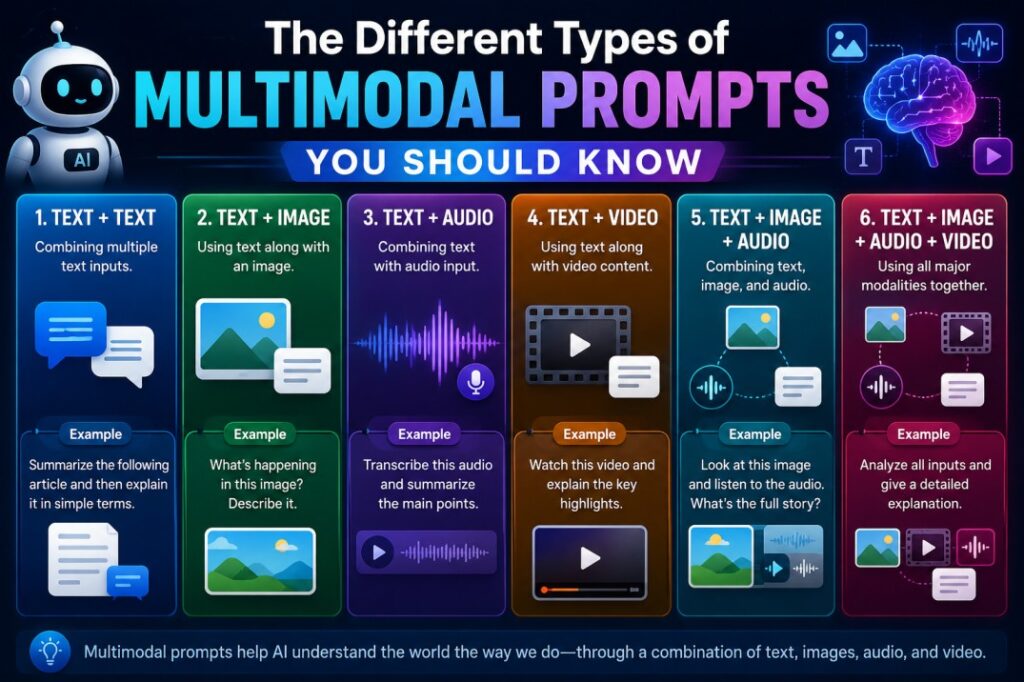
One of the biggest misconceptions about multimodal prompting is that it only refers to image-based AI. In reality, multimodal AI prompting covers several different combinations of inputs, each designed for a specific purpose. Understanding these categories helps users choose the right prompting method for different situations and achieve much better results.
The most common type is the combination of text and images. This is the format most people experience first because it’s incredibly practical. Users upload a product photograph, a screenshot, a design mock-up, or even a handwritten page and ask AI to explain, analyse, improve, or summarise what it sees. These image and text AI prompts have become extremely popular among students, designers, marketers, and business professionals because they eliminate the need for lengthy written descriptions.
Another increasingly popular format combines documents with written instructions. Users attach PDFs, Word files, PowerPoint presentations, invoices, contracts, spreadsheets, or research papers and ask AI to summarise key points, identify trends, compare information, or answer questions based on the uploaded content. Instead of spending hours reading lengthy reports, professionals can quickly identify the information that matters most.
Audio-based prompting is also gaining momentum. People upload recorded meetings, lectures, interviews, podcasts, or voice notes and ask AI to create summaries, extract action points, improve transcripts, or identify important topics. This capability is particularly useful for journalists, researchers, business teams, and students who regularly work with recorded conversations.
Video prompting represents another exciting development. Users can upload training videos, product demonstrations, educational lectures, or recorded presentations and ask AI to summarise important moments, explain visual demonstrations, or generate captions. As AI that understands images continues to improve, its ability to interpret moving visuals and spoken language together is opening entirely new possibilities for education, entertainment, and business.
The most advanced prompts often combine several formats at once. Imagine uploading a product catalogue, a sales spreadsheet, customer feedback screenshots, and written marketing goals in a single conversation. Instead of analysing each file separately, AI studies all the information together and produces recommendations based on the complete picture. This level of contextual understanding is one of the defining strengths of modern multimodal systems.
Why Better Context Leads to Better AI Responses
One of the simplest ways to improve AI-generated results is by giving the model more context. Earlier chatbots depended entirely on written instructions, which meant users had to explain every detail manually. With visual AI prompts, much of that effort disappears because the AI can analyse the actual material instead of relying on descriptions alone.
Imagine asking AI to improve a website without sharing any screenshots. The response will probably contain general design advice because the system has no idea what your website looks like. Now compare that with uploading your homepage and asking for suggestions to improve readability, user experience, and conversions. The AI immediately understands the layout, colours, typography, navigation, and content structure before offering practical recommendations.
The same principle applies to education. A student struggling with mathematics can simply photograph a difficult equation and ask for a step-by-step explanation instead of typing complex symbols into a chatbot. A teacher preparing classroom material can upload handwritten notes and request professionally formatted study guides. By working directly with the original material, how to use multimodal AI becomes much easier for beginners as well as experienced users.
Businesses are perhaps benefiting the most from this richer context. Marketing teams analyse advertisements before launching campaigns, HR departments review resumes more efficiently, finance professionals summarise lengthy reports, and customer support teams interpret screenshots submitted by users experiencing technical problems. These workflows save time because AI spends less effort trying to understand the problem and more effort solving it.
As AI models continue to improve, context will become even more important than prompt length. A short instruction supported by relevant images, documents, or audio often produces far better results than several paragraphs of text without supporting material. That’s why experienced AI users focus not only on writing better prompts but also on providing the right information alongside them.
Writing Effective Multimodal Prompts: Simple Techniques That Make a Big Difference
Using multimodal AI isn’t just about uploading files and hoping for the best. The quality of the response depends heavily on how clearly the task is explained. While AI can analyse photographs, documents, and audio recordings, it still performs much better when users provide specific instructions about what they want to achieve. Well-written Multimodal Prompts remove ambiguity and help the model focus on the most important aspects of the uploaded content.
One effective technique is to clearly define the objective before asking the question. Instead of uploading a product image and simply writing, “Analyse this,” explain exactly what kind of analysis you need. You might ask the AI to review the product design, identify branding opportunities, suggest packaging improvements, or evaluate the image from a marketing perspective. This extra context helps Multimodal AI produce responses that are relevant to your goals rather than offering broad observations.
It also helps to describe the audience. A report written for senior executives will look very different from one intended for school students. Mentioning whether the output should be technical, beginner-friendly, formal, conversational, or persuasive allows the AI to tailor its response accordingly. This simple habit dramatically improves the quality of AI-generated content across almost every industry.
Another useful strategy is to request structured output. Instead of asking for general feedback, ask for numbered recommendations, comparison tables, summaries, checklists, or action plans. Structured responses are easier to read, easier to implement, and often require much less editing afterward. Experienced users rely on these techniques because they consistently produce better results without making the prompts unnecessarily long.
Finally, don’t hesitate to refine the conversation. One of the biggest advantages of multimodal AI is that prompting is interactive. If the first response isn’t exactly what you expected, ask follow-up questions, request additional examples, simplify the explanation, or change the tone. Each follow-up gives the AI more context, leading to increasingly accurate and personalised answers.
Real-World Applications of Multimodal Prompts Across Different Industries
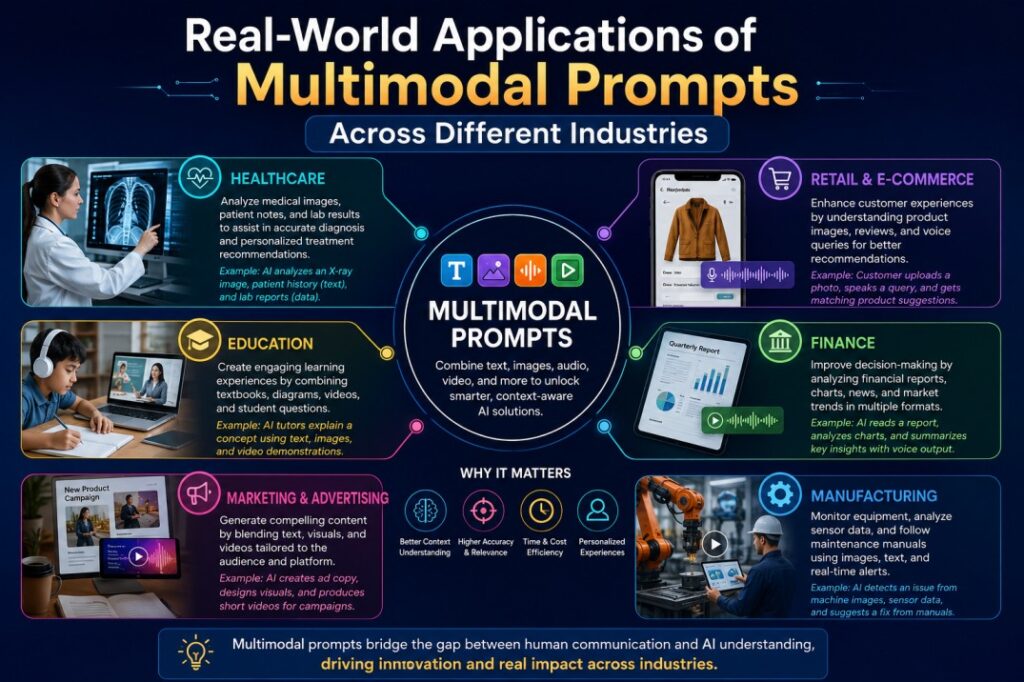
The true value of Multimodal Prompts becomes clear when you see how they’re being used in everyday work. While many people associate AI with writing articles or answering questions, businesses and professionals are now relying on multimodal AI to solve problems that previously required several different software tools. By combining text with images, documents, spreadsheets, videos, and audio recordings, organisations are improving productivity while reducing manual effort across multiple departments.
In education, teachers are using Multimodal AI to prepare engaging classroom material from handwritten notes, textbook pages, and presentation slides. Instead of rewriting content manually, they upload existing study material and ask AI to create quizzes, summaries, worksheets, and revision guides. Students benefit in similar ways by uploading classroom notes, difficult diagrams, or scanned assignments and requesting simplified explanations that match their learning level. This personalised approach helps learners understand concepts much faster than traditional study methods.
The healthcare industry has also embraced multimodal prompting in practical ways. Doctors and medical professionals use AI to organise patient records, summarise lengthy medical reports, interpret laboratory results, and explain complex medical terminology in language that patients can understand. While AI does not replace professional medical judgment, it significantly reduces administrative work and allows healthcare providers to spend more time focusing on patient care.
Marketing teams are discovering equally impressive applications. A marketing manager can upload advertising creatives, campaign reports, audience analytics, and written campaign goals in a single conversation. The AI studies all these inputs together before recommending improvements for messaging, design, targeting, and customer engagement. These image and text AI prompts help marketers make faster decisions while ensuring their campaigns remain consistent across different platforms.
Businesses involved in manufacturing, architecture, finance, retail, customer support, and legal services are finding similar advantages. From analysing engineering drawings and legal contracts to reviewing invoices, dashboards, and customer complaints, multimodal AI reduces repetitive work and enables professionals to focus on higher-value tasks that require human expertise.
Content Creators Are Unlocking New Creative Possibilities
Few industries have adopted multimodal prompting as quickly as content creation. Bloggers, YouTubers, social media managers, graphic designers, photographers, and video editors constantly work with different forms of media, making visual AI prompts a natural fit for their creative workflows.
Imagine preparing a YouTube video. Instead of asking AI to write a script without context, a creator can upload the video thumbnail, outline, audience research, and previous video performance before requesting improvements. AI analyses each input collectively and suggests stronger titles, engaging hooks, improved storytelling, and thumbnail enhancements that are tailored to the creator’s niche.
Graphic designers are using multimodal AI in equally creative ways. They upload brand guidelines, existing logos, colour palettes, website screenshots, and competitor designs before asking AI for suggestions. Rather than generating completely unrelated ideas, AI that understands images works within the provided context, making recommendations that align with the existing brand identity while introducing fresh creative directions.
Photographers and video editors are also benefiting from this technology. They upload original photographs and ask for composition advice, colour correction suggestions, or editing techniques. Video creators can share selected frames and request feedback on pacing, transitions, subtitles, and visual storytelling. These conversations help creators refine their work before publishing it to a wider audience.
Even authors and bloggers are embracing multimodal prompting. Instead of relying solely on written outlines, they combine research papers, charts, infographics, and handwritten notes while asking AI to organise information into engaging articles. This workflow produces richer content because the AI understands the complete research context rather than isolated pieces of information.
Common Mistakes People Make While Using Multimodal Prompts
Although multimodal AI is remarkably capable, many users fail to get the best results because of avoidable prompting mistakes. Understanding these common errors can significantly improve the quality of responses while making AI interactions much more efficient.
One of the biggest mistakes is uploading files without explaining the objective. Simply attaching an image and writing “Tell me about this” leaves far too much room for interpretation. The AI might describe the image when you actually wanted marketing suggestions or design improvements. Effective multimodal AI prompting always combines relevant files with clear instructions that define the expected outcome.
Another common issue is providing poor-quality inputs. Blurry photographs, cropped screenshots, incomplete documents, low-resolution diagrams, or distorted audio recordings reduce the AI’s ability to analyse information accurately. Since the quality of the output depends heavily on the quality of the input, users should always upload the clearest version available whenever possible.
Many people also try to solve several unrelated problems in a single prompt. For example, they may upload a business report, a product image, and a legal contract while asking completely unrelated questions about each one. Although AI can process multiple files, separating different objectives into individual conversations usually produces more focused and accurate responses.
Skipping follow-up questions is another missed opportunity. The first response is rarely the final answer. Experienced users refine AI outputs by requesting additional examples, simpler explanations, different writing styles, or more detailed recommendations. Since multimodal conversations are interactive, each follow-up improves the AI’s understanding and often leads to significantly better results.
Finally, some users assume that AI-generated information never requires verification. While modern multimodal large language models are highly capable, important business decisions, medical advice, legal matters, financial reports, and research findings should always be reviewed by qualified professionals before acting on them.
The Future of Multimodal AI Looks More Intelligent Than Ever
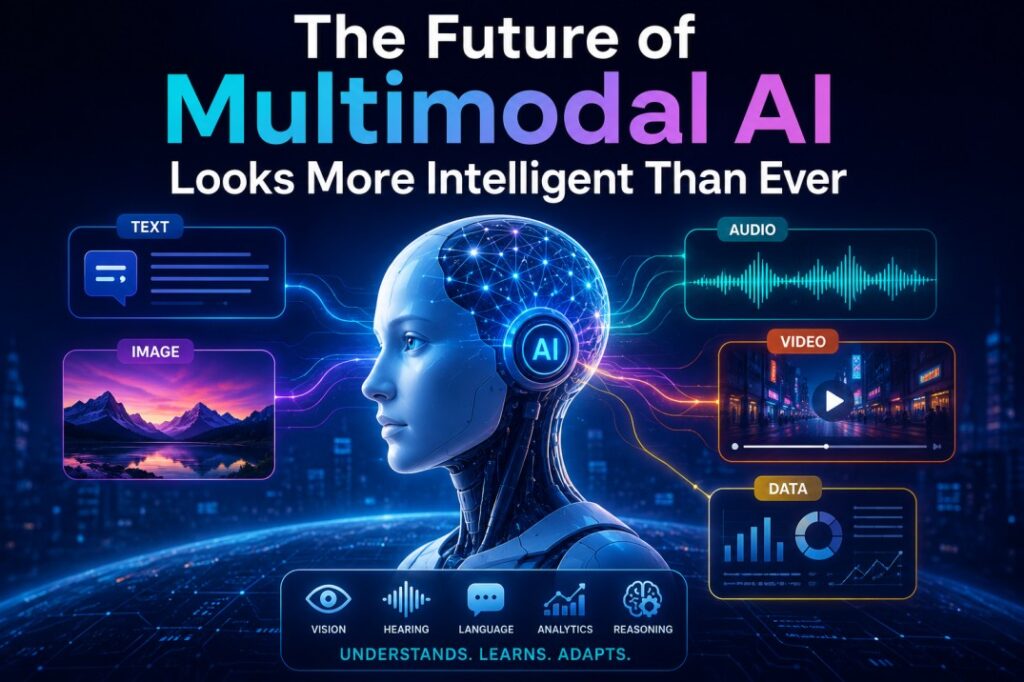
Artificial intelligence has already transformed the way people search for information, write content, analyse data, and automate repetitive tasks. Yet many experts believe that multimodal AI represents only the beginning of a much larger technological shift. As models become more capable of understanding relationships between text, images, audio, video, and real-world environments, interactions with AI will become increasingly natural and intuitive.
Future Multimodal Prompts are expected to move beyond analysing existing content. AI systems may assist users in real time by interpreting live camera feeds, understanding spoken conversations, analysing workplace environments, and responding instantly to changing situations. Instead of uploading a photograph after a problem occurs, users may simply point a camera toward an object and receive immediate guidance.
Businesses are already preparing for these advancements. Retail companies are exploring AI-powered shopping assistants that understand customer preferences through conversations and product images. Manufacturers are testing AI systems capable of identifying equipment failures through live visual inspections. Educational platforms are developing interactive tutors that combine speech recognition, document analysis, and visual demonstrations to create highly personalised learning experiences.
The rapid development of how to use multimodal AI is also encouraging software developers to build smarter applications that combine several AI capabilities within a single workflow. Rather than switching between separate tools for transcription, image recognition, document analysis, and text generation, users will increasingly rely on one intelligent assistant capable of handling every task within a unified conversation.
For individuals, this means learning multimodal prompting is becoming more than just a useful technical skill. It is gradually evolving into a core digital competency, much like using search engines, spreadsheets, or presentation software became essential in previous decades. Those who understand how to communicate effectively with AI today will likely adapt much faster as these technologies become part of everyday work and life.
Frequently Asked Questions About Multimodal Prompts
Can multimodal prompts improve AI accuracy?
Yes, in many situations they can. Traditional AI systems rely only on written instructions, which means they have to guess many details based on the text provided. Multimodal Prompts reduce this uncertainty by allowing users to upload supporting material such as images, PDFs, spreadsheets, screenshots, audio recordings, or videos. The additional context helps AI understand the task more clearly, resulting in responses that are generally more relevant, detailed, and practical.
Which AI tools support multimodal prompting?
Several modern AI platforms now support Multimodal AI capabilities. These tools allow users to combine text with images, documents, audio files, and other forms of content during a conversation. Although the exact features vary between platforms, the overall goal remains the same—helping AI understand different types of information together instead of processing text alone. As AI technology continues to advance, multimodal capabilities are becoming a standard feature rather than a premium addition.
Can beginners use multimodal prompts?
Absolutely. One of the biggest advantages of multimodal AI is that it reduces the need for complicated prompt writing. Instead of describing every detail, beginners can simply upload the actual file and explain what they want. Whether it’s a photograph, presentation, scanned document, or spreadsheet, the AI already has much of the required context. This makes multimodal AI prompting easier to learn than many people initially expect.
What types of files work best with multimodal AI?
Modern AI systems can work with a wide variety of files, including photographs, screenshots, PDF documents, Word files, PowerPoint presentations, spreadsheets, diagrams, handwritten notes, audio recordings, and videos. The quality of these files matters significantly because clear, high-resolution inputs allow AI that understands images and other media formats to identify details more accurately. Whenever possible, users should upload complete and readable files rather than cropped or blurry versions.
How can I write better multimodal prompts?
The most effective prompts usually begin with a clear objective. Instead of writing vague requests such as “Analyse this document,” explain exactly what you want the AI to do. Mention the desired outcome, target audience, preferred format, and any specific points that should receive extra attention. Combining detailed instructions with relevant files allows visual AI prompts to produce much richer and more useful responses than generic requests.
Will multimodal AI replace human expertise?
Not entirely, and it shouldn’t. While multimodal AI is excellent at analysing information, generating ideas, identifying patterns, and automating repetitive tasks, human judgment remains essential for decision-making. Professionals in healthcare, law, finance, engineering, education, and many other industries should continue reviewing AI-generated results before acting on them. The most successful approach is to use AI as an intelligent assistant that enhances human productivity rather than replacing human expertise.
Final Thoughts
Artificial intelligence is entering a completely new phase where understanding text alone is no longer enough. Modern AI systems can now analyse images, documents, spreadsheets, audio recordings, videos, and written instructions simultaneously, creating interactions that feel far more natural than traditional chatbots. This evolution has made Multimodal Prompts one of the most important skills for anyone who regularly works with AI.
The biggest advantage of multimodal prompting is context. Instead of forcing users to describe every visual detail or manually rewrite information from documents, AI can work directly with the original content. Whether someone is analysing financial reports, reviewing product designs, preparing classroom material, summarising research papers, or generating marketing campaigns, multimodal AI produces responses that are often faster, more detailed, and significantly more relevant.
Businesses are already using multimodal AI to improve customer service, automate document processing, enhance marketing strategies, streamline software development, and support better decision-making. Students are learning more efficiently, designers are receiving creative feedback, researchers are analysing complex data, and content creators are developing richer digital experiences. These examples demonstrate that multimodal prompting is no longer a niche technology—it has become a practical tool across almost every industry.
Looking ahead, the role of multimodal AI will continue to expand. Future systems are expected to understand live environments, interpret real-time conversations, analyse complex workflows, and interact seamlessly across multiple devices. As these capabilities improve, learning how to use multimodal AI effectively will become just as valuable as learning how to search the web or use productivity software.
The people who benefit the most from AI won’t necessarily be those using the most advanced models. They’ll be the ones who know how to provide clear instructions, meaningful context, and well-structured multimodal prompts. Mastering this skill today will help individuals and businesses stay ahead as artificial intelligence becomes an even more integral part of everyday life.