
Every startup begins with uncertainty. Founders start with a problem, a rough idea, and many unanswered questions. As soon as the journey begins, one question appears early and often. Where should I get support?
This is where the debate around startup accelerator vs incubator becomes relevant. Both options are designed to support startups, but they serve very different purposes. Choosing the wrong one can slow progress, dilute focus, or delay growth. Choosing the right one can save months of effort and sharpen decision-making.
This blog breaks down the real differences between accelerators and incubators, how they fit into a startup’s lifecycle, and how founders should decide which path makes sense for them.
Why Early Support Matters for Founders
The earliest stage of a startup is the most fragile. Founders are making decisions with limited data while juggling product, customers, and personal risk. Without guidance, it is easy to build in the wrong direction or waste time on non-essential tasks.
Support systems exist to reduce this risk. They provide feedback, structure, and access to people who have seen similar challenges before. However, not all support systems are designed for the same stage or outcome.
Understanding the purpose behind each option helps founders avoid mismatched expectations.
What an Incubator Is Designed to Do
An incubator typically supports startups at the idea or concept stage. At this point, founders may not have a product, customers, or even a clearly defined market.
Incubators focus on nurturing ideas. They provide a safe environment where founders can experiment, learn, and shape their thinking. Support often includes basic mentorship, office space, academic resources, or access to workshops.
Incubators are usually long-term and flexible. Founders may stay for several months or even years. The emphasis is on learning and exploration rather than speed or outcomes.
For founders who are still validating whether their idea is worth pursuing, incubators can be a good starting point.
What a Startup Accelerator Is Designed to Do
Accelerators operate very differently. They are built for speed and execution. Founders entering an accelerator usually have a defined problem, a basic product, or early validation.
Accelerators run for fixed durations, often three to six months. During this time, founders are pushed to hit specific milestones. This could include refining the product, talking to customers, or preparing for investor conversations.
The focus is not on protecting ideas, but on testing them aggressively. Feedback is frequent and direct. Founders are expected to act quickly and show progress.
This environment suits founders who are ready to move fast and make hard decisions.
Startup Accelerator vs Incubator in Real Terms
When founders compare a startup accelerator vs. an incubator, the key difference is intent.
Incubators help founders figure out what to build. Accelerators help founders figure out how to build it well and fast.
Incubators prioritize learning and safety. Accelerators prioritize execution and outcomes.
Neither is better by default. Each serves a specific purpose depending on where the founder is in their journey.
Time Commitment and Structure
Incubators are typically open-ended. Founders may attend sessions occasionally and work at their own pace. There is room to pause, pivot, or rethink the idea entirely.
Accelerators are intense and structured. Weekly goals, regular check-ins, and clear deadlines are common. Founders are expected to commit fully to the duration of the program.
This difference in structure influences the mindset that the founders develop. Incubators encourage reflection. Accelerators encourage action.
Mentorship and Feedback Style
In incubators, mentorship is often advisory. Founders receive suggestions, frameworks, and guidance, but are rarely pushed aggressively.
In accelerators, mentorship is more hands-on. Mentors challenge assumptions, question decisions, and expect founders to justify their choices. Feedback is designed to provoke action, not comfort.
This difference can feel uncomfortable for some founders, especially those new to external critique. However, it often accelerates learning.
Access to Capital and Networks
Incubators do not usually focus on fundraising. Their goal is to help founders reach clarity, not necessarily investment readiness.
Accelerators often sit closer to the funding ecosystem. While not all accelerators invest directly, many help founders prepare for investor interactions. Demo days, pitch sessions, and curated introductions are common.
Programs like PedalStart focus on preparing founders through execution milestones before facilitating investor access, which reduces premature fundraising attempts.
Which Option Suits First-Time Founders
First-time founders often benefit from incubators if they are still shaping their idea or are unsure about the problem they want to solve. The slower pace allows them to learn without pressure.
However, once the idea is clear and the founder is committed full-time, accelerators tend to offer more value. The structure and accountability help founders avoid overthinking and start building.
The key is honest self-assessment. Founders must evaluate whether they need clarity or momentum.
Common Misconceptions Among Founders
One common misconception is that incubators are for weaker ideas and accelerators are for stronger ones. This is not accurate. Each serves a different stage, not a different quality level.
Another misconception is that joining an accelerator guarantees funding. In reality, accelerators increase readiness and exposure, not entitlement.
Founders who understand these realities make better choices and avoid disappointment.
The Cost of Choosing the Wrong Path
Choosing the wrong support system has real consequences. A founder who joins an accelerator too early may feel overwhelmed and discouraged. A founder who stays in an incubator too long may lose momentum.
Time is the most valuable resource in a startup journey. Misalignment wastes time and energy.
This is why understanding the difference between a startup accelerator and an incubator is not academic. It is practical and urgent.
How Founder Goals Should Shape the Decision
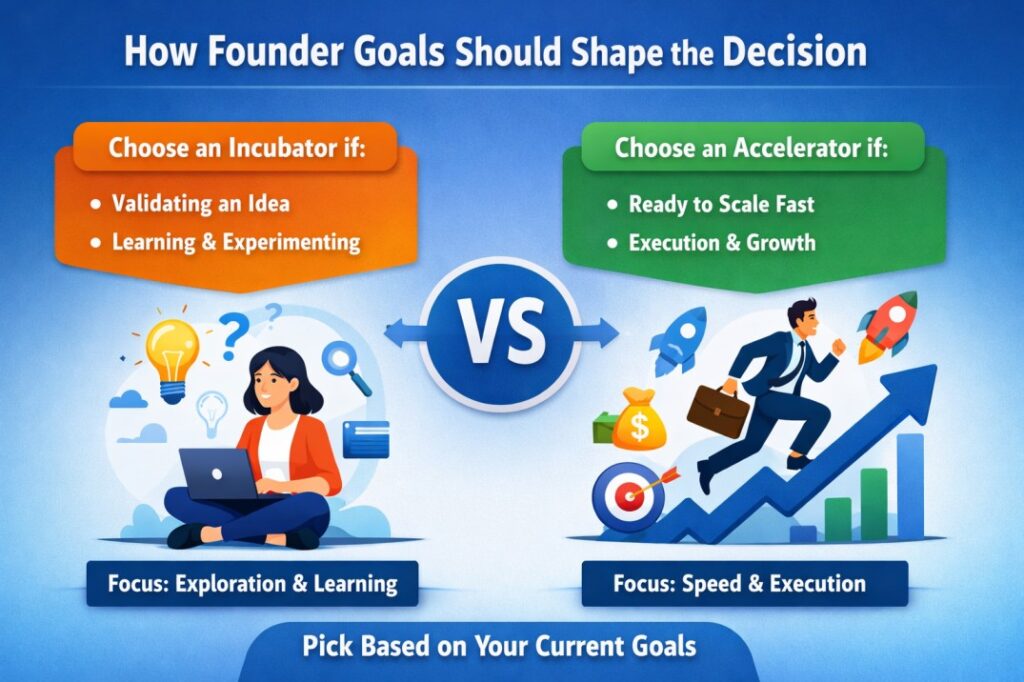
Founders should choose based on what they need now, not what sounds impressive.
If the goal is learning and experimentation, incubators make sense. If the goal is execution and readiness for scale, accelerators are more appropriate.
Some founders move through both, starting with incubation and later joining an accelerator. This progression often works well when timed correctly.
How Modern Accelerators Are Evolving
Accelerators today are more founder-centric than before. Many focus less on generic mentorship and more on tailored execution support.
PedalStart is one example of this evolution, emphasizing real progress, honest feedback, and long-term founder alignment rather than short-term hype.
This shift has made accelerators more effective for founders who want substance over visibility.
What Founders Should Look for Before Joining
Before joining any program, founders should ask a few questions. At what stage do most startups enter? How much execution is expected? What happens after the program ends?
Talking to alumni often provides the clearest answers. Their experiences reveal whether the program delivers real value or just surface-level support.
Making this decision thoughtfully can shape the entire startup journey.
Conclusion
Choosing between an incubator and an accelerator is about timing, not status. Understanding startup accelerator vs incubator helps founders align support with their real needs.
Incubators provide space to think. Accelerators provide pressure to act. Both are valuable when used at the right moment.
Founders who make this choice deliberately, with clarity and self-awareness, are better positioned to build resilient and scalable startups. With the right support system and a focus on execution, early decisions turn into long-term advantages.