
Security teams are drowning in findings.
Not risk. Findings.
That distinction matters more than people admit. A company can have 47,000 vulnerability alerts, 11 dashboards, three exposure scanners, a breach and attack simulation tool nobody fully trusts, and still not know which two things are most likely to get them wrecked next quarter. That is not a tooling problem alone. It is a prioritization failure wearing a very expensive hoodie.
This is exactly why CTEM, or Continuous Threat Exposure Management, has started getting real traction. Not because security needed another acronym. God knows it did not. It got traction because too many organizations built security programs around collecting signals rather than reducing exposure. They scan, classify, ticket, delay, rescan, repeat. The machine hums. The danger remains.
And the older model is starting to look a little absurd.
A security team at a decent-sized company might know about missing patches on internal servers, weak configurations in cloud accounts, internet-exposed assets someone forgot existed, stale identity permissions, vulnerable third-party software, expired certificates, and a partner connection held together with what feels like string and deadline panic. They know all that. But they often do not know how those issues combine into reachable attack paths, or which ones actually matter to the business, or which problems attackers would laugh and exploit in ten minutes while the team is still debating CVSS severity in a meeting that smells like burnt coffee and cheap carpet glue.
That is where Continuous Threat Exposure Management comes in.
At its best, CTEM is not just another dashboard category. It is a shift in posture. Less “what did we detect?” More “what are we meaningfully exposed to right now, how would it be exploited, and what should we fix first if we live in the real world and not inside a compliance spreadsheet?”
That last bit is the whole game.
Because a lot of security practice still revolves around theoretical badness. Severity scores. Asset lists. Findings volume. Framework alignment. Useful, sure. But attackers do not care about your reporting neatness. They care about exploitability, reachability, privilege, misconfiguration chains, exposed services, weak identities, and operational laziness. Basically the soft joints in the machine.
A while back I heard someone on a security podcast say that most organizations are not under-defended so much as under-focused. That stuck with me. It sounds almost rude, but it is right. Many teams already have enough information to improve risk meaningfully. They just cannot convert scattered signal into exposure decisions fast enough.
So if you strip away the vendor gloss, CTEM is about making security less ceremonial and more mechanical. Find the pressure points. See what is reachable. Validate what is exploitable. Prioritize what matters. Fix the stuff that changes outcomes, not just the stuff that makes the weekly report look active.
Simple idea. Brutal execution.
Why traditional vulnerability management is not enough anymore
A lot of vulnerability programs still behave like it is 2014.
Scan infrastructure. Rank by severity. Open tickets. Wait for owners. Chase remediation. Measure closure rates. Present charts with colorful arrows and pretend the process equals risk reduction. Sometimes it does. Often it just creates motion.
The problem is not that vulnerability management is useless. It is that it is too narrow on its own. Modern exposure lives across cloud misconfigurations, identity sprawl, shadow IT, SaaS drift, third-party access, weak segmentation, internet-facing services, secrets leakage, unpatched systems, insecure APIs, and that one forgotten admin account nobody disabled after a reorg six months ago.
Attackers chain weaknesses. Security teams still tend to manage them one by one.
That mismatch is where the argument for CTEM starts getting sharp. Continuous Threat Exposure Management looks beyond isolated findings and asks how exposures interact in the environment. Which ones are externally reachable? Which ones touch crown-jewel systems? Which ones create real attack paths? Which ones can be validated instead of merely guessed at?
That is a better question set. More annoying, too.
What CTEM actually means
Let’s keep it plain.
CTEM stands for Continuous Threat Exposure Management. It is an ongoing approach to identifying, assessing, validating, prioritizing, and reducing exposures across an organization’s environment based on how attackers could actually exploit them.
That is different from just scanning for vulnerabilities.
Continuous Threat Exposure Management is broader. It pulls in attack surface visibility, vulnerability context, misconfiguration analysis, identity risk, cloud exposure, asset criticality, exploitability, threat-informed validation, and business relevance. The point is not to know more things. The point is to know which things matter enough to act on first.
If you miss that part, the whole idea collapses into another noisy security category.
The word “continuous” is doing a lot of work here
Plenty of security programs are periodic, even when teams pretend otherwise.
Quarterly reviews. Monthly scans. Annual pentests. Occasional red-team exercises. Burst activity before audits. Reactive cleanups after incidents. This rhythm made more sense when environments changed more slowly. That world is gone. Cloud resources spin up and disappear. Identities proliferate. SaaS access shifts. Configurations drift. New apps hit production faster than governance teams can keep their notes straight.
So Continuous Threat Exposure Management is continuous for a reason. Exposure changes too fast for snapshot security to hold up.
And no, “continuous” does not mean staring at dashboards all day like a raccoon in a server room. It means building a process where discovery, validation, prioritization, and remediation feedback happen often enough to match the pace of operational change.
Otherwise you are protecting yesterday’s architecture.
The real point of CTEM is prioritization with teeth
Every security vendor says they help prioritize. Most of them mean they sort.
That is not the same thing.
Sorting tells you which items are high severity on paper. Prioritization tells you which issues create the most meaningful exposure in your actual environment, against your actual business, with your actual attackers and your actual constraints. Much harder. Much more useful.
A company with ten critical CVEs and one exposed identity path into production does not have eleven equal problems. A hospital with vulnerable systems in isolated labs may face lower immediate risk than one internet-facing VPN appliance with active exploitation and weak MFA coverage. A retailer with moderate cloud findings and one toxic S3 bucket tied to customer records should not pretend those are comparable just because they all landed in the same dashboard.
CTEM pushes teams toward this kind of reality-based judgment. It does not worship raw volume. It asks what changes the attack surface in a serious way.
That alone makes some teams uncomfortable, because it forces them to stop hiding behind counts.
Exposure is not the same as vulnerability
This sounds obvious until you look at how many programs still confuse the two.
A vulnerability is a weakness. An exposure is a weakness in context. Reachable. Relevant. Actionable. Potentially chainable. Positioned inside a real environment with real identities, assets, and pathways.
That difference matters.
A severe vulnerability on an isolated system with strong controls around it may be less urgent than a medium-severity issue on an internet-facing asset tied to weak authentication and over-permissioned service accounts. Same with cloud exposures. Same with SaaS misconfigurations. Same with identity drift.
Continuous Threat Exposure Management is built around that contextual lens. It is not enough to know the weakness exists. You need to know whether it can be used, how, by whom, and what it touches.
That is where the signal starts to separate from the sludge.
Validation is where CTEM stops being theater
Here is the part I like most, frankly. CTEM tends to push organizations toward validation.
Not just “we found a thing.” More “can this be reached, exploited, chained, or abused in practice?”
That may involve attack path mapping, breach and attack simulation, purple-team testing, adversary emulation, exposure validation tooling, manual verification, or focused red-team exercises. However you do it, validation matters because security teams are flooded with theoretical risk. Theoretical risk has its place. It also burns time like dry brush.
When Continuous Threat Exposure Management is done well, it reduces the gap between possible weakness and meaningful exploitability. That is a big shift. It helps teams spend more time fixing what attackers could really use and less time performing administrative penance for issues that look dramatic but go nowhere.
There is a tension here, though. Validation takes effort. Some teams want perfect proof before acting, and that instinct can slow everything down. You do not need courtroom-grade certainty for every ticket. You do need more realism than a spreadsheet severity field.
CTEM is as much about business context as technical context
Security people sometimes get annoyed when business stakeholders ask, “Yes, but what does this affect?” Fair question. Necessary question.
A good CTEM program does not just rank exposures by technical badness. It maps them to business importance. Revenue systems. Customer data stores. Core operations. Identity infrastructure. Critical vendor links. Production environments. Intellectual property. The systems that would actually hurt if something went sideways.
Picture two issues. One affects a low-value internal lab app. Another affects a customer identity system tied to billing and access control. Same CVSS maybe. Completely different consequences.
Continuous Threat Exposure Management forces that distinction. And that is healthy, because security teams sometimes act like all exposures are born equal under the cold gaze of the scanner. They are not.
Identity is one of the biggest CTEM blind spots
Or maybe not a blind spot anymore, but still underweighted in a lot of programs.
When people hear exposure management, they often picture servers, endpoints, cloud instances, maybe web apps. Fine. But identity is where so many attacks get traction now. Weak MFA deployment. Over-permissioned roles. Dormant privileged accounts. Broken trust relationships. Service accounts nobody monitors properly. SaaS admins with absurd rights. Federation mistakes. Token exposure. Conditional access holes. Local admin sprawl.
That is exposure. Pure exposure.
A company can patch aggressively and still be wide open through identity pathways that make lateral movement feel almost impolite in how easy it is. CTEM works better when identity is treated as a first-class exposure domain, not an adjacent IAM problem somebody else can handle after lunch.
Look, attackers do not care which internal team owns the problem.
Attack surface management and CTEM are cousins, not twins
These terms get mashed together a lot.
Attack surface management is mainly about visibility into exposed assets, internet-facing systems, shadow IT, forgotten domains, cloud resources, and external footprints. Useful. Necessary, even. But CTEM goes further. It takes that visibility and pulls it into a broader cycle of contextual analysis, validation, prioritization, and remediation.
So yes, attack surface management can feed Continuous Threat Exposure Management. It is not the whole thing.
Same goes for vulnerability management. Same for BAS. Same for pentesting. Same for exposure analytics tools. CTEM is the operating model that tries to make those activities cohere instead of living like disconnected organs in a jar.
Grim image. Still works.
What a CTEM workflow should actually look like
Not beautiful. Useful.
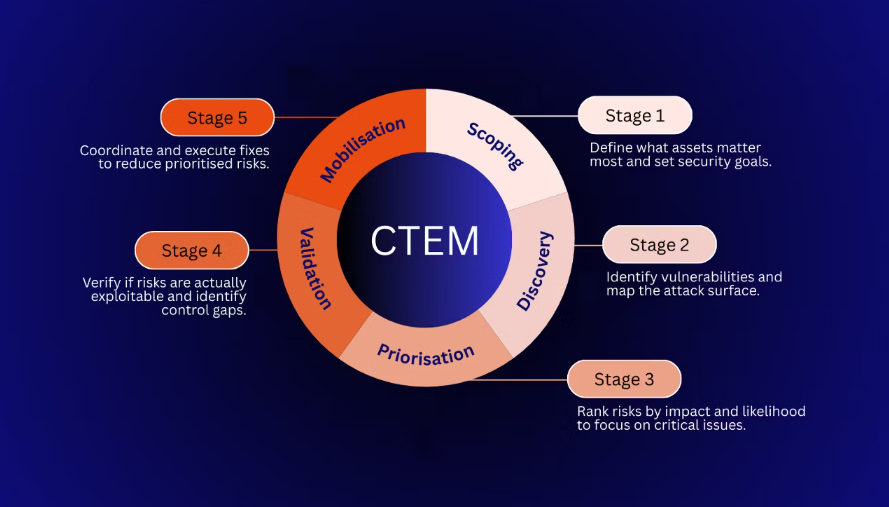
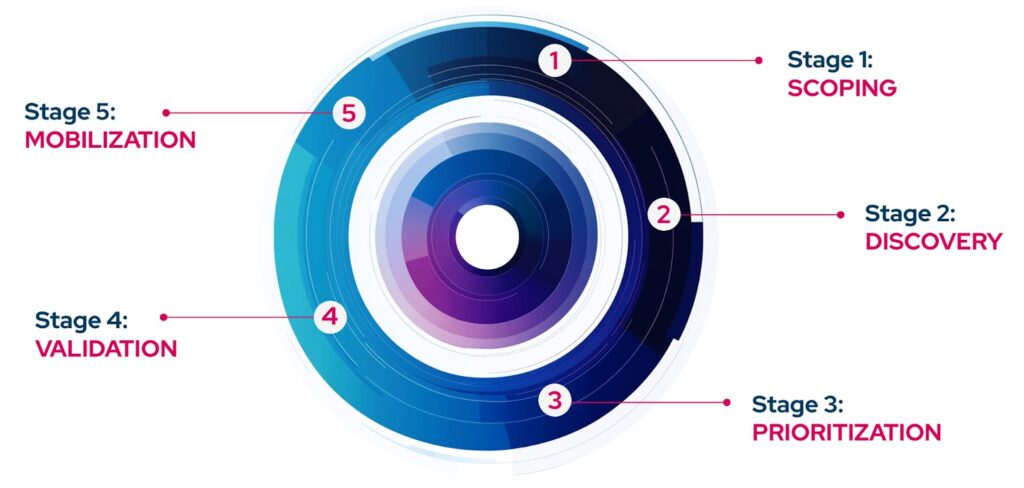
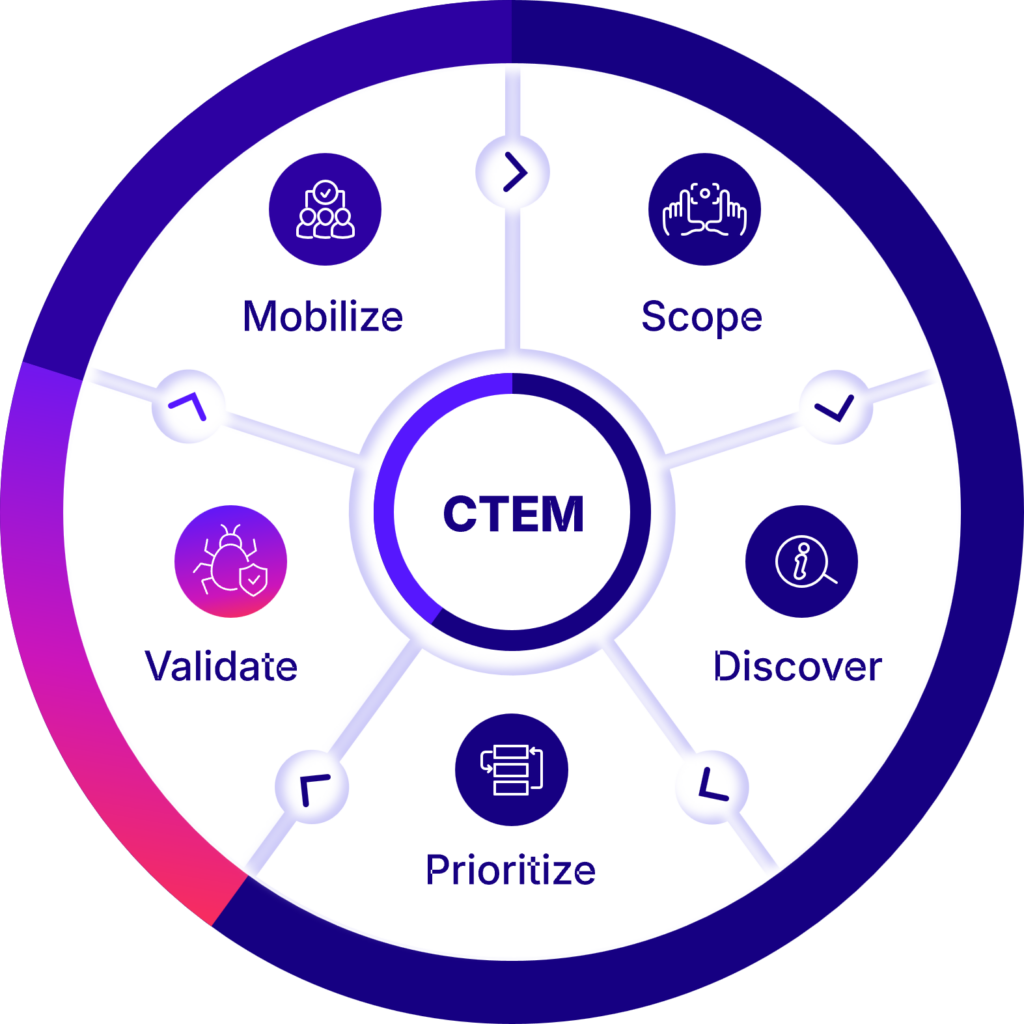
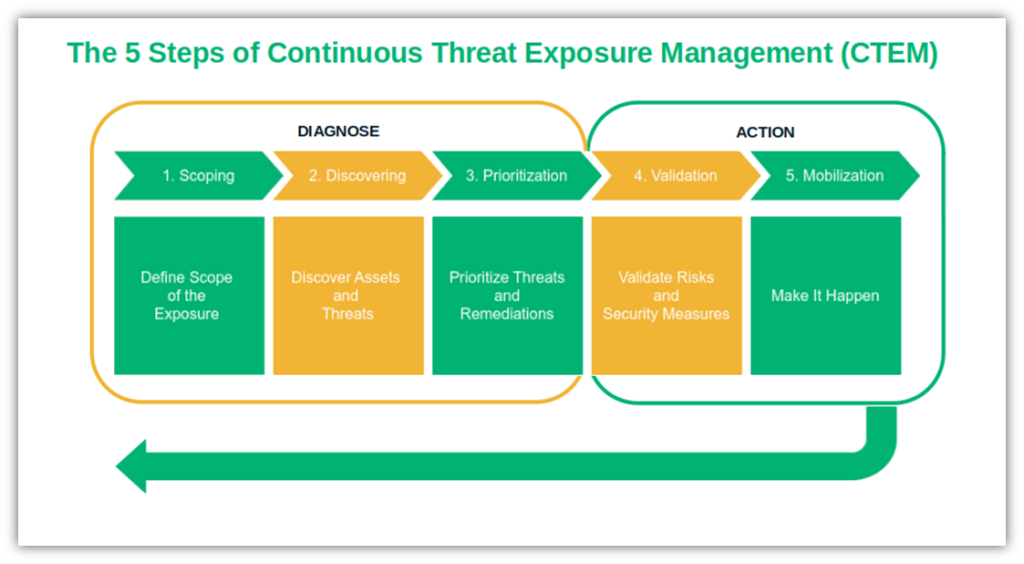
A strong CTEM cycle usually starts with scoping. What parts of the business matter most right now? Internet-facing assets? Identity systems? Cloud control planes? Critical applications? Then comes discovery, finding assets, weaknesses, misconfigurations, identities, and pathways across that scope.
After that, assessment. Which exposures matter in context? What is reachable? What is tied to valuable systems? What has known exploit paths? What lines up with active threat behavior?
Then validation. Simulate, test, emulate, verify. Not for everything, but enough to stop fooling yourself.
Then prioritization and remediation. Fix the exposures that materially reduce risk. Measure outcome, not just activity. Then repeat, because environments drift and attackers are not taking the quarter off.
That is the core rhythm of Continuous Threat Exposure Management. Not magical. Just disciplined.
The hardest part is not technology, it is ownership
This happens in almost every security program. Findings land. Everyone agrees they matter. Then the air goes weird.
Infrastructure says cloud owns that. Cloud says app team owns it. App team says platform engineering changed the policy. IAM says security architecture approved the role. Security says they only report the issue. Risk says it goes on the register. The register goes into a folder. The folder goes into the swamp.
Meanwhile the exposure stays live.
A CTEM program without clear ownership becomes another observation engine. Interesting, busy, ineffective. To make Continuous Threat Exposure Management work, organizations need exposure owners, remediation pathways, escalation logic, and some tolerance for friction. Because reducing exposure often means pushing operational teams to change how they work, not just what they patch.
That is why this is not purely a tooling category. It is governance disguised as security operations.
Metrics for CTEM should measure reduction, not performance art
Some security metrics are basically theater props.
Number of findings closed. Number of scans completed. Number of dashboards reviewed. Mean time to acknowledge. Ticket aging charts. These are not worthless, but they can become a substitute for exposure reduction instead of evidence of it.
A good CTEM program should care about metrics like reduction in exploitable paths, decrease in external exposure for critical assets, closure of validated high-risk findings, improvement in privileged identity posture, time to remediate exposures tied to crown-jewel systems, or decline in attack path reachability over time.
See the difference?
The metric should tell you whether the machine is safer, not whether the meeting was held.
Why CTEM works better than annual security rituals
Because annual rituals are too slow and too ceremonial.
An annual penetration test may catch some useful things. Great. But by the time the report lands, half the environment may have changed. New assets, new identities, new cloud projects, new SaaS connections, new mistakes. Same with once-a-year attack surface reviews or quarterly vulnerability sweeps treated like sacred events.
Modern environments are too fluid for ritualized security alone.
Continuous Threat Exposure Management is stronger because it builds a loop instead of an event. Discover. Validate. Prioritize. Fix. Reassess. That cycle fits the actual motion of digital systems better than static review windows ever did.
That does not mean pentests and audits stop mattering. It means they should feed a living process, not sit in a PDF graveyard until next year.
CTEM can get overcomplicated fast if you let vendors drive the story
A little bluntness here. Some vendors are already turning CTEM into a bloated shopping list. Buy this platform, that module, this connector, that data lake, this simulation engine, this exposure graph, and suddenly you will have clarity.
Maybe. Or maybe you will have a more expensive version of your current confusion.
The point of Continuous Threat Exposure Management is not maximum platform accumulation. It is better decisions about real exposure. Some organizations can do a lot with tools they already have if they improve scoping, validation, ownership, and prioritization logic. Others do need new platforms. Fine. But the operating model comes first.
Otherwise you are just decorating the same blind spots.
A practical example of CTEM in the real world
Take a retail company with hundreds of stores, cloud-hosted applications, corporate identities, third-party marketing tools, VPN access for support vendors, and an e-commerce platform tied to customer accounts. Traditional vulnerability management finds thousands of issues. Noise everywhere.
A CTEM approach narrows the lens. Focus on customer-facing systems, identity infrastructure, and externally exposed assets. Discovery finds a misconfigured cloud storage bucket, stale privileged roles in IAM, an exposed test subdomain tied to an old app stack, and a vendor VPN path with weak authentication controls. Validation shows the subdomain plus the role misconfiguration can create a real path toward sensitive customer data. Suddenly the priority stack changes.
Not because the other findings disappeared. Because the meaningful exposure became visible.
That is Continuous Threat Exposure Management doing its job.
Why CTEM matters now
Because security environments are more fragmented, more dynamic, and more interconnected than the old models can comfortably handle. Cloud change is constant. Identities multiply. Vendors connect into core workflows. Attackers move fast. Business leaders want clearer answers. And security teams cannot keep pretending the answer lies in collecting more raw findings.
They need better exposure judgment.
That is what CTEM offers when it is done seriously. Not perfection. Not total visibility. Not some fantasy of predictive control. Just a better way to decide what matters, validate what is dangerous, and focus remediation where it changes the odds.
Which, honestly, is already a lot.
Final thoughts
CTEM, or Continuous Threat Exposure Management, matters because modern security failure rarely comes from a total lack of data. It comes from too much disconnected data and not enough exposure clarity. The teams that improve fastest are usually the ones that stop chasing every finding equally and start focusing on reachable, validated, business-relevant exposure. That means looking beyond isolated vulnerabilities into attack paths, identity risk, cloud drift, external footprints, and real exploitability. Less ceremony. More consequence. That is the shift.
FAQs
1. What is CTEM in simple terms?
CTEM stands for Continuous Threat Exposure Management. It is a security approach that helps organizations identify, validate, prioritize, and reduce the exposures attackers could actually use, rather than just collecting long lists of technical findings.
2. How is CTEM different from vulnerability management?
Vulnerability management focuses mainly on finding and fixing weaknesses. Continuous Threat Exposure Management goes further by adding business context, exploitability, identity risk, attack path analysis, and validation, so teams can focus on the exposures that matter most.
3. Why does CTEM matter for cloud and identity security?
Because a lot of modern exposure now lives in cloud drift, misconfigurations, excessive permissions, and weak identity controls. CTEM helps connect those pieces so teams can see how attackers might chain them into real access or compromise paths.
4. Does CTEM replace penetration testing?
No. It works better alongside it. Penetration testing can validate risks and uncover weaknesses, while CTEM provides an ongoing process for discovery, prioritization, remediation, and reassessment instead of relying only on periodic security exercises.
5. What is the biggest challenge in implementing CTEM?
Usually ownership and prioritization. Many organizations already have plenty of security data, but they struggle to assign remediation responsibility and focus on the most meaningful exposure instead of trying to treat every finding as equally urgent.
6. What should a company do first if it wants to start CTEM?
Start by scoping critical assets and exposure domains, then improve discovery across those areas. After that, add validation and business context so remediation focuses on reachable, high-impact exposures rather than a flat list of noisy alerts.