
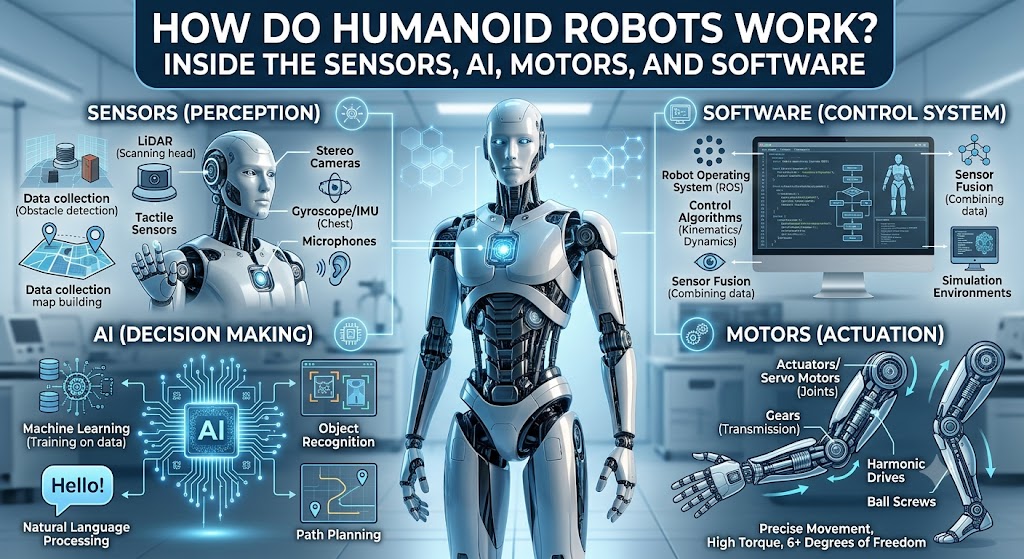
A humanoid robot can walk, turn its head, recognise an object and reach for it, making the entire process look deceptively simple. The movement may resemble something familiar, but underneath that movement is a tightly connected system of motors, sensors, processors, control algorithms and artificial intelligence. A robot does not simply “decide to walk” and then move its legs. It continuously measures its position, interprets its surroundings, calculates how its body should move and adjusts thousands of tiny variables while the movement is happening.
The recent progress in humanoid robotics makes that underlying technology easier to see. Robots competing in the 2026 World Humanoid Robot Games demonstrated increasingly athletic movements, while companies are simultaneously working toward machines capable of factory work, logistics and other practical tasks. Some current designs have dozens of independently controlled joints, combining mechanical systems with increasingly capable AI and onboard computing.
That leads to a useful way of looking at how humanoid robots work. They are not simply walking machines with an AI model attached to them. They are integrated systems in which the body, sensors, software and AI constantly exchange information. The better those pieces work together, the more naturally and safely the robot can operate.
A Humanoid Robot Has a Body, a Brain and a Nervous System
A useful starting point is to divide humanoid robot technology into three broad layers: the physical body, the intelligence layer and the control system connecting the two.
The body includes the frame, motors, joints, hands, batteries and other mechanical components. These parts determine how much force the robot can produce, how quickly it can move, how much weight it can carry and how efficiently it uses energy.
The intelligence layer handles perception and decision-making. It includes processors and AI systems that can interpret images, understand instructions, identify objects and determine an appropriate sequence of actions.
Between them is the control system. This is what converts decisions into carefully timed physical movements while constantly checking whether those movements are actually working.
A simplified version looks like this:
Sensors → Perception → AI decision → Motion planning → Motor control → Movement → New sensor data
The final step is important because the process never really ends. The robot moves, its sensors observe what happened, the software updates its understanding and the control system adjusts the next movement.
That feedback loop is at the heart of modern humanoid robotics.
The Mechanical Body: Where Software Becomes Movement
The hardware determines what a robot is physically capable of doing.
A humanoid robot needs a strong but relatively lightweight structure because every additional kilogram affects energy consumption and movement. Its joints have to support loads while also allowing controlled movement. The design may involve electric motors, gearboxes, encoders and torque or force sensing.
The number of independently controlled movements is often described using degrees of freedom, or DoF. A robot with more degrees of freedom can potentially perform more complex movements, although having more joints does not automatically make the robot more capable.
Hands present a particularly difficult engineering challenge. Walking mainly involves large joints with relatively predictable movement patterns. Manipulating an unfamiliar object requires much finer control.
A human hand can adjust its grip almost unconsciously when an object starts slipping. A robot needs sensors and software capable of detecting that change and responding appropriately.
That is why humanoid robotics is not simply about building something that looks human.
The challenge is reproducing enough useful movement and sensory feedback to function in environments originally designed for people.
What Are Humanoid Robot Sensors Used For?
The robot’s sensors provide the information needed to understand both its surroundings and its own physical condition.
A human has eyes, ears, skin, muscles and a sense of balance. A robot uses a collection of electronic and computational systems to perform comparable functions.
Common humanoid robot sensors can include:
- Cameras for visual information
- Depth sensors for spatial measurements
- Inertial measurement units for acceleration and orientation
- Joint encoders for measuring movement
- Force and torque sensors for detecting physical interaction
- Tactile sensors for detecting contact
- Microphones for capturing sound
- Temperature and other environmental sensors in specialised systems
The important part is not simply having many sensors. It is combining their information effectively.
A camera may tell the robot that a hand is near a table. A joint encoder tells it where the arm is positioned. A force sensor can tell it when the hand touches the object. Together, these signals provide a much richer understanding than any one sensor could provide.
Computer Vision Gives the Robot a View of the World
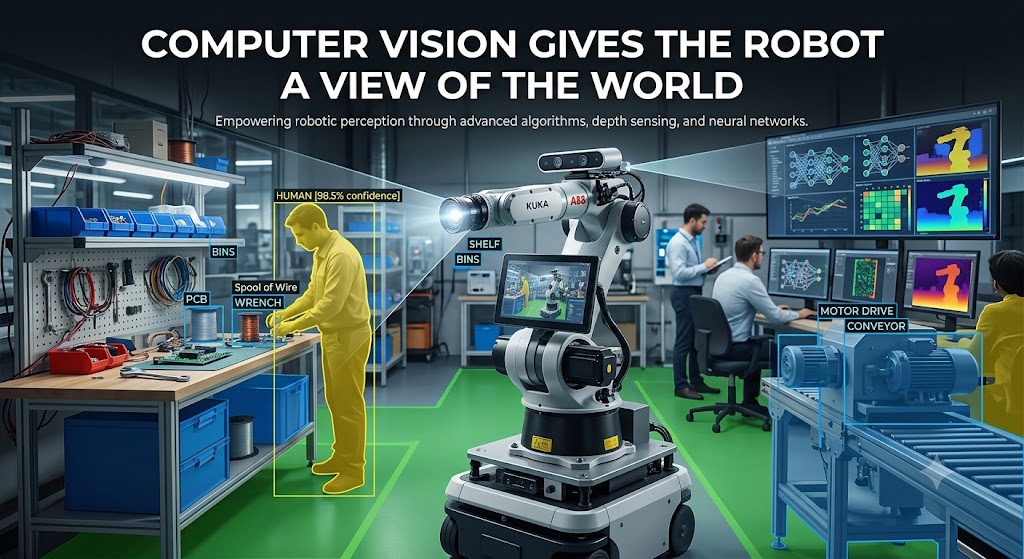
Vision is one of the most important capabilities in a modern humanoid system.
A camera produces an image, but an image by itself does not tell a robot what it should do. Software must extract useful information from the visual data.
A robot may need to identify objects, estimate their positions, distinguish people from furniture, recognise available pathways and determine how objects are changing over time.
This is where computer vision and AI models become important.
Consider a simple instruction:
“Pick up the blue bottle.”
A human can complete that task almost automatically. A robot needs to solve several problems first:
- Identify which objects are bottles.
- Determine which one is blue.
- Estimate where it is located.
- Calculate whether its arm can reach it.
- Determine how to approach it.
- Select an appropriate grip.
- Apply enough force to hold it without crushing or dropping it.
None of these problems exists independently.
Visual information influences movement. Movement changes the camera’s viewpoint. Contact with the object produces new sensory information. The control system then uses that information to adjust the action.
This is why humanoid robot AI is increasingly focused on multimodal and embodied intelligence rather than treating vision, language and movement as completely separate problems.
The Robot Needs to Understand Its Own Body
Seeing the environment is only half the problem.
A humanoid robot also needs to know where its own body is.
Imagine trying to pick up a cup while keeping your eyes closed. The task becomes dramatically harder because you lose information about the position of your hand and arm.
Robots deal with a similar problem computationally.
Joint encoders can measure the positions of different joints. Inertial sensors can help determine orientation and acceleration. Force and torque sensors can provide information about contact and load.
This information allows the control system to estimate the robot’s current physical state.
That state might include:
- Joint positions
- Joint velocities
- Body orientation
- Balance
- Contact with the ground
- Applied forces
- Motor conditions
The robot then uses this information to calculate its next action.
This is particularly important for walking. A bipedal robot cannot simply execute a fixed sequence of movements forever because small differences in terrain, balance and body position accumulate quickly.
It needs continuous correction.
How Does a Humanoid Robot Walk?
Walking is essentially a controlled process of repeatedly managing balance.
A human walker naturally shifts weight from one foot to another. A humanoid robot has to reproduce that behaviour through carefully coordinated motion.
The system needs to determine where each foot should go, how the body should move above those feet and how much force should be generated by individual joints.
A typical walking cycle involves:
Perception → balance estimation → foot placement → trajectory planning → joint control → feedback
The process repeats continuously.
If the robot’s foot lands slightly differently than expected, sensor data can reveal that change. The control system then adjusts subsequent movements.
This is one reason a humanoid robot that can walk smoothly is demonstrating much more than a collection of motors moving in sequence. It is demonstrating a successful real-time feedback system.
What Is the Role of Motors and Actuators?
AI may receive most of the attention in discussions about robots, but the machine still needs a physical mechanism to turn a decision into movement.
That job belongs largely to motors and actuators.
A motor generates mechanical motion. An actuator is the broader system responsible for producing controlled movement, often combining a motor with mechanical transmission and sensing components.
In a humanoid robot, actuators operate the:
- Hips
- Knees
- Ankles
- Shoulders
- Elbows
- Wrists
- Hands
- Other joints
Different joints have different requirements. A hip actuator may need substantial power to support the body, while a finger actuator requires much finer control.
This is where engineering trade-offs appear.
A more powerful actuator may increase weight and energy consumption. A lighter system may improve agility but reduce strength. A highly precise actuator can increase complexity and cost.
Building a capable robot therefore involves balancing strength, speed, precision, efficiency and reliability.
The Robot’s Brain Is Not Just One AI Model
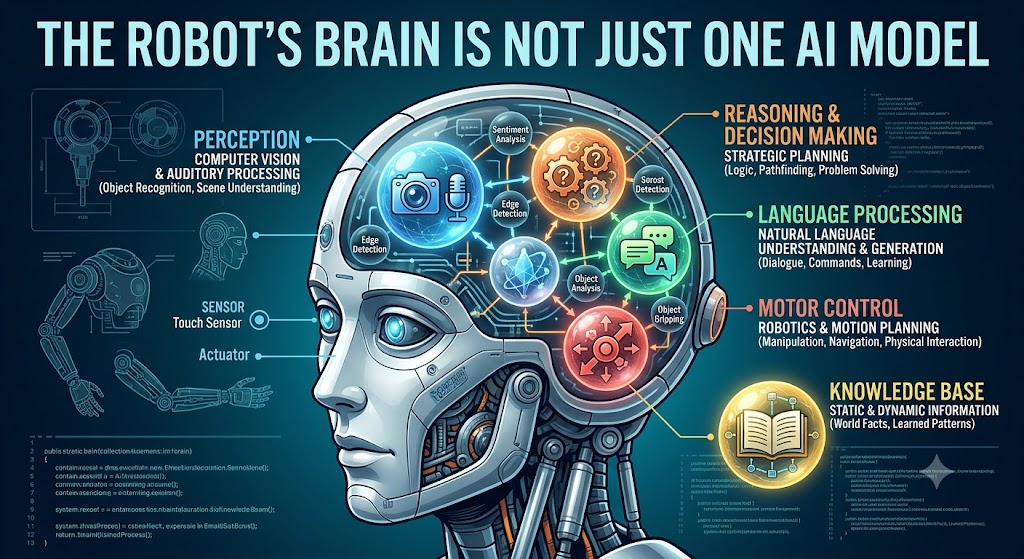
One of the biggest misconceptions about how humanoid robots work is that there is a single AI model inside the machine making every decision.
In reality, a capable system may involve several layers of software.
One component can process visual information. Another can interpret language. Another can generate a task plan. A motion-planning system can determine how the robot should move, while a low-level controller manages individual joints.
Modern systems are increasingly using vision-language-action models, often called VLA models, which connect visual perception, language and physical actions.
The concept is relatively simple:
See → understand → decide → act
But implementing it reliably is extremely difficult.
The AI has to operate within the physical constraints of the machine. It cannot simply produce an interesting answer like a chatbot. Its output has to correspond to an action that the hardware can safely execute.
That is the fundamental difference between ordinary AI and embodied AI.
Why Real-Time Computing Matters
A robot cannot wait several seconds to decide what to do every time its environment changes.
If an obstacle appears in its path, the system needs to respond rapidly.
This creates a strong requirement for real-time processing.
Modern humanoid robots may use CPUs, GPUs and specialised AI accelerators to process large amounts of sensor data. Increasingly, some AI inference takes place directly on the robot rather than relying entirely on remote cloud systems.
This is where edge AI becomes important.
Local processing can reduce latency, lower network dependence and allow time-critical decisions to happen closer to the physical machine.
Cloud infrastructure still has a role, particularly for model training, fleet management, long-term analytics and large computational workloads. The practical architecture is therefore likely to combine local computing with cloud services rather than relying completely on either one.
How Does a Robot Learn to Perform a Task?
A robot does not necessarily learn in exactly the same way a human does.
Several approaches can be combined.
Imitation Learning
The robot can learn from demonstrations of a task performed by humans or other systems. This can help teach movement patterns without requiring the robot to discover everything independently.
Reinforcement Learning
The system can learn through trial and error, receiving rewards or penalties based on the outcome of actions.
This approach is particularly useful when the objective can be clearly defined.
Simulation
Robots can also be trained in virtual environments.
Simulation makes it possible to repeat tasks thousands or millions of times without physically wearing out the hardware. Once a behaviour is sufficiently reliable in simulation, it can be transferred to a physical machine and refined further.
This combination is becoming increasingly important because collecting physical-world training data is expensive.
Real-World Data
A deployed robot can also generate valuable data about how people interact with machines, where failures occur and which behaviours need improvement.
That creates an ongoing cycle:
Simulation → training → physical deployment → data → improvement → new deployment
Why Hands Are Harder Than Legs
A robot walking down a corridor looks impressive, but manipulating objects may be a much harder test of useful intelligence.
Walking mostly requires controlling a limited number of large joint movements in a predictable sequence.
A hand interacts with objects that can vary enormously in shape, weight, texture, rigidity and fragility.
Consider picking up a glass.
The robot needs to identify the object, estimate its position, approach it from an appropriate angle, determine how tightly to grip it and adjust its force if the glass moves.
A rigid industrial gripper can perform the same action very efficiently when the object and environment are controlled.
The advantage of a humanoid hand is flexibility.
The disadvantage is complexity.
Researchers are therefore working on increasingly sophisticated tactile sensing, including systems designed to provide detailed information about touch and contact across larger surfaces. Recent research has demonstrated vision-based tactile sensing approaches intended to give humanoid forearms more comprehensive physical awareness.
This illustrates an important principle in robotics:
Dexterity requires information.
A robot cannot safely manipulate an unfamiliar object if it has no useful way of sensing what its fingers are touching.
Why Balance Is Such a Difficult Problem
Humanoid robots have one major disadvantage compared with wheeled robots: they are inherently unstable.
A four-wheel machine can remain upright while stationary. A humanoid standing on two narrow feet has a much smaller margin for error.
Balance therefore becomes a continuous software problem.
The robot needs to monitor its body orientation and movement, detect changes in foot contact and coordinate multiple joints to keep itself upright.
This becomes even harder when the robot:
- Carries an object
- Walks on uneven ground
- Changes direction
- Pushes or pulls something
- Encounters an obstacle
- Moves quickly
A system that can sprint on a controlled track is demonstrating excellent balance and motion control. A system that can maintain balance while performing unpredictable tasks in a crowded environment faces a much harder challenge.
What Happens When Sensors Disagree?
Real-world sensors are not perfect.
A camera may be affected by glare. A depth sensor may struggle with particular surfaces. A force sensor may produce noisy readings. Wireless systems can lose data.
The robot therefore needs to operate despite incomplete or imperfect information.
This is another reason sensor fusion matters.
Instead of trusting one input completely, the system can combine multiple observations and estimate the most likely state of its environment.
That introduces another important AI concept:
uncertainty.
A robot should not behave as though every perception is guaranteed to be correct.
If the system is uncertain whether an object is a person or an obstacle, the safest response may be to slow down rather than proceed at full speed.
For genuinely autonomous robots, knowing when not to act can be as important as knowing what action to take.
Why Humanoid Robots Need Software Architecture, Not Just AI
As robots become more capable, the software controlling them becomes increasingly complex.
There may be separate systems for:
- Perception
- Localisation
- Mapping
- Planning
- AI inference
- Motion control
- Navigation
- Hardware management
- Communications
- Safety
- Diagnostics
These components must exchange information without creating unpredictable behaviour.
This is where traditional software-engineering principles become relevant.
Version control, testing, logging, monitoring, fault handling and secure deployment are all important.
A humanoid robot may ultimately resemble a distributed computing platform as much as a conventional machine.
The difference is that its software has a physical output.
A bug is not necessarily just a broken screen or failed API response. It could influence movement.
How Humanoid Robots Connect to the Cloud
A connected robot can benefit from cloud infrastructure in several ways.
Large AI models may require substantial computing resources during training. Cloud platforms can provide that infrastructure without putting all the computational burden on the physical machine.
Cloud systems can also collect telemetry from fleets of robots.
That data can reveal:
- Battery performance
- Motor temperature
- Error frequency
- Task completion rates
- Maintenance needs
- Navigation problems
- Software failures
A company operating thousands of robots could use aggregated data to identify patterns that would be difficult to see from a single machine.
But connectivity should not be treated as a permanent assumption.
A useful humanoid should still be capable of handling essential functions when the network becomes unavailable. Local autonomy is therefore likely to remain important even as cloud robotics expands.
What Does Robotics Software Need to Handle?
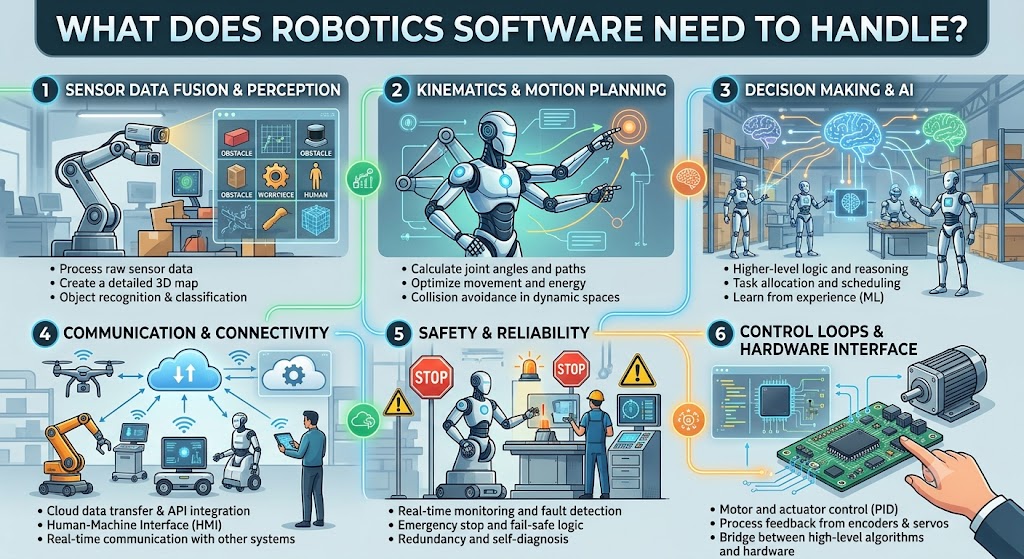
The software stack has to solve two very different classes of problems.
The first concerns intelligence:
What is happening?
What does the instruction mean?
Which object should be picked up?
What should happen next?
The second concerns control:
How far should the joint move?
How quickly?
With how much force?
Is the robot balanced?
Did the movement actually happen?
These layers need to cooperate without becoming tangled.
A high-level AI system might decide:
“Pick up the box.”
The lower-level control system then has to determine how the robot should bend, where the hand should move, how the fingers should close and what forces should be applied.
This separation between high-level planning and low-level control is one of the reasons humanoid robot software is so technically demanding.
The Difference Between a Demonstration and a Useful Robot
A robot performing a spectacular task tells only part of the story.
The real test begins when the conditions change.
A useful humanoid robot needs to function repeatedly rather than once.
It needs to deal with small differences in objects and environments without requiring a human operator to constantly correct it.
It needs to recover from failures.
It needs to operate safely around people.
And it needs to do all of that at a cost that makes economic sense.
This is why commercial robotics is moving toward a broader set of performance measures rather than focusing entirely on impressive demonstrations.
A practical evaluation might consider:
| Capability | Why It Matters |
| Speed | Determines throughput |
| Dexterity | Determines how many tasks are possible |
| Reliability | Determines whether the machine can work consistently |
| Energy efficiency | Affects operating cost |
| Autonomy | Reduces human intervention |
| Safety | Determines whether humans can work alongside it |
| Recovery | Determines how well it handles unexpected problems |
| Cost | Determines whether deployment makes business sense |
| Maintainability | Affects long-term ownership |
| Cybersecurity | Protects the machine and connected systems |
A robot that performs one impressive trick may be valuable for research.
A robot that reliably completes thousands of ordinary tasks can become a business.
Why the Future of Humanoid Robots Is Also an IT Story
The development of humanoid robots is often presented as a race between hardware companies, AI laboratories and manufacturers. But many of the hardest problems sit at the intersection of those fields.
A robot needs accurate sensors.
Those sensors generate enormous amounts of data.
That data needs computing.
Computing requires software.
Software requires reliable control systems.
Connected systems need networks.
Networks expose machines to cybersecurity risks.
And once robots interact with businesses, they need APIs, authentication, databases and enterprise software.
This creates a technology stack that looks remarkably familiar to IT professionals.
The difference is that the endpoint is physical.
A web application can return data.
A humanoid robot can take that data and pick something up.
That is where the concept of physical AI becomes especially important. AI is no longer limited to generating text, images or predictions. Increasingly, the objective is to connect intelligence with machines that can affect the physical world.
The Biggest Challenge May Not Be Making Robots Smarter
It is tempting to think the solution to every robotics problem is a better AI model.
Better AI certainly matters, but intelligence alone cannot solve every problem.
A robot may correctly identify a cup and still fail to pick it up because its hand cannot reach the correct position.
It may plan the perfect route but lack sufficient battery power to complete it.
It may understand an instruction but encounter a network failure halfway through the task.
It may perform perfectly in a laboratory but struggle when lighting, floor surfaces and objects change.
The future therefore depends on co-design.
Hardware, AI, sensors, software, energy systems and computing infrastructure have to be developed together.
That is why advances in actuators, tactile sensors, onboard processors and control software can be just as important as advances in AI models.
What Will Make a Humanoid Robot Truly Useful?
The most useful robot of the future may not be the one with the most human-like appearance or the fastest sprinting time.
It may be the one that quietly completes ordinary work without requiring constant supervision.
Imagine a warehouse robot that begins every shift by checking its battery, receiving a digital task list, navigating through the facility, identifying the correct packages, updating inventory through an API and returning to its charging station when required.
No viral video is necessary.
The value comes from reliability.
The same principle applies to hospitals, factories, logistics centres and eventually homes. Humanoid form becomes useful when the environment has already been designed around human bodies and the robot can exploit that existing infrastructure.
The hard part is making the entire system dependable enough to operate in it.
Frequently Asked Questions
How do humanoid robots work?
Humanoid robots combine mechanical hardware, sensors, computing, AI and control software. Sensors collect information about the robot and its surroundings, AI and software interpret that information, and control systems convert decisions into physical movement.
What technology is used in humanoid robots?
Common technologies include electric motors, actuators, cameras, depth sensors, force sensors, joint encoders, inertial sensors, computer vision, AI models, real-time control systems, onboard processors, wireless communication and cloud platforms.
What are humanoid robot sensors used for?
Sensors help robots understand both their environment and their own physical condition. They can provide information about objects, movement, orientation, touch, force, distance and other environmental factors.
What is humanoid robot AI?
Humanoid robot AI refers to artificial intelligence used for capabilities such as perception, object recognition, language understanding, task planning, navigation and physical action. AI is one layer of the complete robotic system rather than the entire system itself.
How does a humanoid robot maintain balance?
It continuously uses information from sensors such as inertial measurement units, joint encoders and force sensors to estimate its physical state. Control software then adjusts joint movements to maintain balance as the robot walks or interacts with its environment.
How do humanoid robots see?
Most use cameras and other sensing technologies to capture information about their surroundings. Computer-vision and AI systems process that information to identify objects, estimate positions and understand aspects of the environment.
Do humanoid robots use cloud computing?
They can. Cloud systems may be used for AI training, data storage, fleet management, analytics and software distribution. Time-sensitive processing can also happen locally on the robot to reduce latency and dependence on network connectivity.
Why is edge computing important for humanoid robots?
Edge computing allows certain processing tasks to happen close to the physical machine. This can reduce latency and make it possible for robots to respond quickly to their environment without sending every decision to a remote cloud server.
How do humanoid robots learn?
Robots can learn through imitation learning, reinforcement learning, simulation, supervised training and real-world data. Several approaches can be combined to improve physical skills and task performance.
Why are robot hands so difficult to build?
Hands require many degrees of freedom, precise control and detailed sensory feedback. Manipulating unfamiliar objects also requires the robot to adjust grip, force and movement based on what it senses.
What is embodied AI?
Embodied AI refers to artificial intelligence operating through a physical system that can perceive and interact with the real world. Humanoid robots are one example of embodied AI because their software intelligence is connected directly to physical sensors and actuators.
What is a vision-language-action model?
A vision-language-action model connects visual perception and language understanding with physical actions. It helps a robot interpret an environment or instruction and translate that understanding into an appropriate action.
Can humanoid robots operate without the internet?
Some functions can operate locally without continuous internet access. For safety and real-time control, local processing is particularly important. Network connections can still provide access to cloud services, updates, data and enterprise systems.
Why do humanoid robots need APIs?
APIs allow robots to communicate with external software. A connected robot may use APIs to retrieve inventory information, receive tasks, report completed work or interact with other digital systems.
Are humanoid robots safe around people?
Safety depends on the robot’s hardware, software, sensors, control systems and operating environment. Robots designed to work around people need mechanisms for detecting hazards, limiting force and responding safely to unexpected situations.
What is the biggest challenge in humanoid robotics?
There is no single challenge. Reliable perception, dexterity, energy efficiency, autonomy, safety, computing, cost and real-world adaptability all remain important. The difficulty comes from making these systems work together consistently.
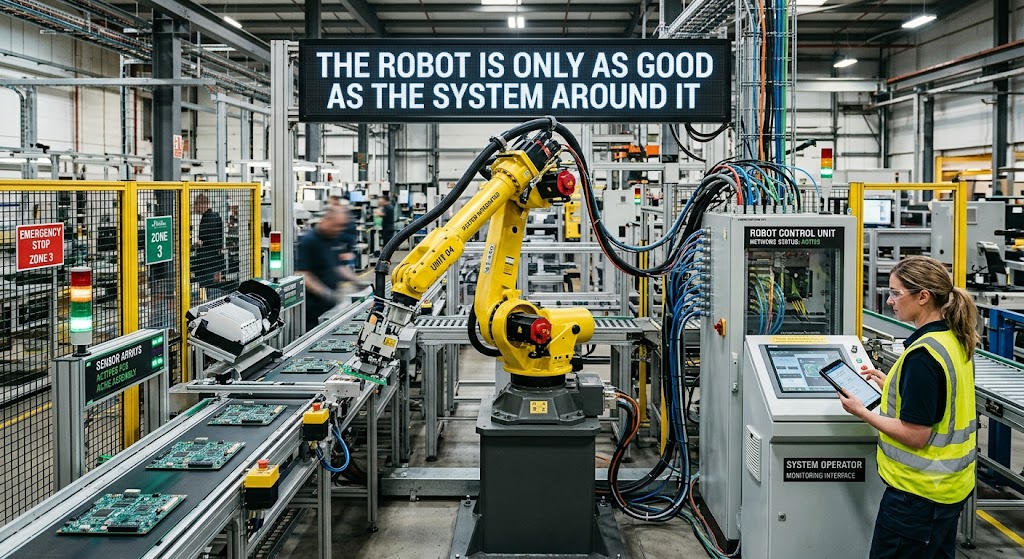
The Robot Is Only as Good as the System Around It
The most impressive part of a humanoid robot is often the part people can see: walking, running, lifting or manipulating an object. The more important technology is hidden underneath.
Every movement depends on sensors providing useful information, processors interpreting it, AI helping with perception and planning, control software translating decisions into motion, and actuators physically carrying out those commands. When the machine is connected to the wider digital world, another layer appears: networks, APIs, cloud platforms, identity systems and cybersecurity.
That is why the future of humanoid robotics will not be determined by AI alone. The winning systems will be the ones where mechanical engineering, sensing, computing and software operate as one coherent system.
A robot does not become useful when it looks human.
It becomes useful when it can understand its surroundings, control its body, communicate with other systems and reliably complete work in the real world.