
A humanoid robot can have powerful motors, advanced cameras and an impressive AI model, but none of that guarantees that it can react correctly when the real world changes in front of it. A person can see a box falling from a shelf and move out of the way almost instinctively. A robot has to capture that event through sensors, process the incoming data, determine what is happening, decide what to do and then move its body accordingly.
That sequence becomes much harder when every decision depends on a remote server.
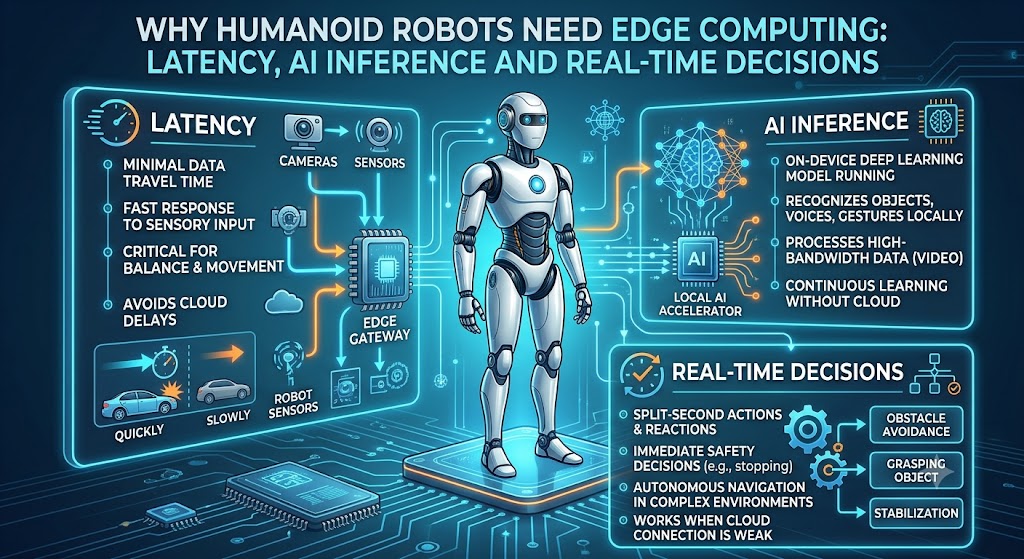
This is where edge computing robotics becomes important. Instead of sending every sensor reading to a distant data centre, some of the computation can happen directly on the robot or very close to it. The result is lower latency, faster local decision-making and less dependence on a continuous cloud connection.
The idea is not to replace cloud computing. Cloud infrastructure remains valuable for model training, fleet management, analytics, storage and large-scale workloads. The more practical architecture is a combination of local processing and cloud systems, where each layer handles the work it is best suited to perform.
For humanoid robots, that division matters because time is not just a performance metric. In some situations, a few hundred milliseconds can determine whether a robot completes a task smoothly or makes a dangerous mistake.
Why Humanoid Robots Cannot Depend Entirely on the Cloud
Cloud computing works by moving processing from a local device to a remote computing environment. For many applications, that model is highly effective.
A photo-editing application can upload an image, perform a complex operation on a server and return the result. A business dashboard can request information from a cloud database. A streaming service can continuously deliver video from a data centre.
Robotics is different because the system is interacting with a physical environment that can change much faster than a typical human-facing application.
Consider a humanoid robot moving through a factory. Its cameras continuously capture images. Its inertial sensors monitor movement. Its joint sensors track the position of its limbs. Its force sensors detect contact with objects and surfaces.
That data is constantly changing.
Now imagine the robot needs to react because:
- A worker walks into its path.
- A package falls from a shelf.
- Its foot lands slightly differently than expected.
- A machine blocks a previously clear route.
- An object slips while being picked up.
If every perception and control decision has to travel to a distant cloud server and return, network conditions become part of the robot’s behaviour.
That introduces an undesirable dependency.
A robot that must maintain balance should not have its basic stability determined by internet quality.
What Is Edge Computing in Robotics?
Edge computing moves computing resources closer to the place where data is generated.
In a traditional cloud-heavy model, the flow might look like:
Robot sensors → Internet → Cloud server → AI processing → Internet → Robot
With an edge architecture, more of the work can happen locally:
Robot sensors → Onboard processor → AI inference → Motor control
The second architecture can dramatically reduce the distance that critical data has to travel.
The “edge” may be the robot itself, an onboard computer, a local gateway or a nearby edge server. The exact architecture depends on the application’s requirements.
For robotics, the important principle is simple:
The closer critical computation is to the physical machine, the less the system depends on network round trips for immediate decisions.
This is one reason robotics computing increasingly combines high-performance processors, specialised AI accelerators and local software with cloud infrastructure.
What Is Robot Latency and Why Does It Matter?
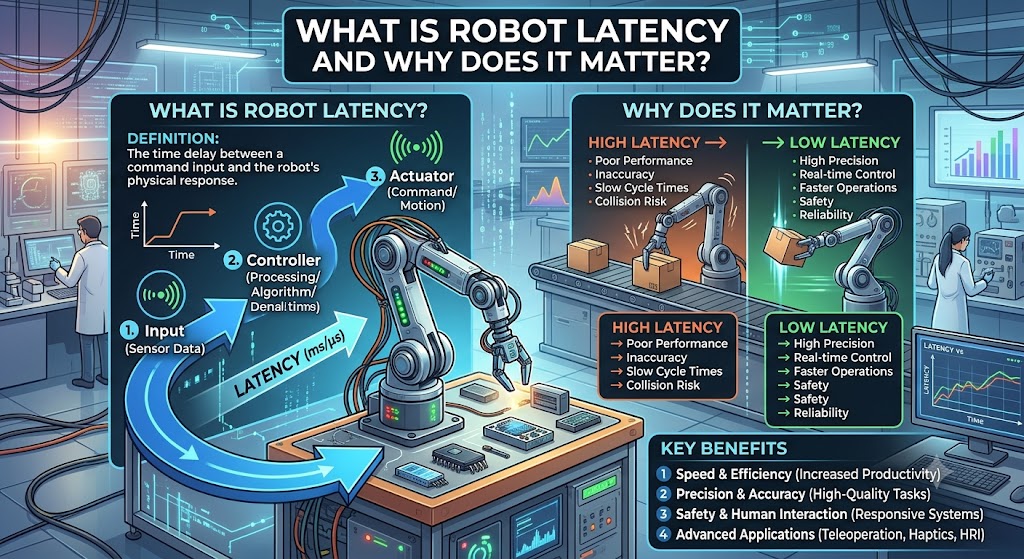
Robot latency is the delay between something happening in the physical world and the robot responding to it.
The concept is easier to understand as a chain:
Event → sensing → processing → decision → command → movement
Every stage takes time.
Suppose a camera detects an obstacle.
The image has to be captured.
The relevant information needs to be processed.
The system has to identify the obstacle.
The control software needs to decide how the robot should react.
A movement command then needs to reach the appropriate motors.
The physical body finally responds.
If the system adds a network trip between sensing and decision-making, more delay is introduced.
The actual acceptable latency depends on the task. A robot generating a daily performance report can tolerate substantial delay. A robot correcting its balance while walking cannot.
This creates different classes of robotic workloads.
Tasks That Can Tolerate More Delay
These can often rely more heavily on cloud systems:
- Long-term analytics
- Fleet reporting
- Historical data processing
- Model training
- Software distribution
- Non-urgent scheduling
Tasks That Usually Need Fast Local Response
These are more suitable for edge processing:
- Obstacle detection
- Balance correction
- Collision avoidance
- Joint control
- Immediate sensor processing
- Safety responses
The distinction is not always absolute, but it provides a useful architecture principle.
Why Real-Time AI Is Different From Ordinary AI
AI is often discussed as though all inference works in the same way.
It does not.
A chatbot can take a little time to generate a response without creating a physical safety problem. A humanoid robot cannot always afford that flexibility.
Real-time AI is concerned with producing a useful response within a time constraint that matters to the physical system.
For a robot, the question is not simply:
“Did the AI make the correct prediction?”
It is also:
“Did it make the prediction quickly enough to act on it?”
Suppose a robot correctly identifies an object after two seconds, but the object had already fallen during those two seconds. The model may have been accurate, but the system still failed.
Real-time AI therefore requires a combination of:
- Fast inference
- Predictable response times
- Efficient data processing
- Reliable sensor pipelines
- Fast communication between software components
- Appropriate hardware acceleration
This is where the hardware and software architecture become inseparable.
How Edge AI Fits Into a Humanoid Robot
Edge AI refers to running AI inference near the point where data is generated rather than relying entirely on a remote cloud service.
In a humanoid robot, that can mean processing information directly on onboard computers.
A camera captures a frame.
An onboard model analyses it.
The system detects an obstacle.
The control software changes the robot’s movement.
The entire loop can happen locally.
This does not require the robot to operate without cloud connectivity. It simply means the most time-sensitive decisions do not need to wait for the cloud.
Modern robotics platforms can use combinations of:
- CPUs for general-purpose computation
- GPUs for parallel workloads
- NPUs or other AI accelerators for inference
- Dedicated microcontrollers for low-level control
The exact combination depends on the robot’s design and computational needs.
The Hidden Problem: Sensor Data Is Massive
A humanoid robot can have several cameras and numerous other sensors operating simultaneously.
A single camera can produce a continuous stream of high-resolution frames. Multiply that by several cameras and add depth sensors, inertial data, force measurements and other telemetry, and the amount of raw information becomes enormous.
Sending everything to a remote cloud environment is not always practical.
It can consume network bandwidth, increase costs and introduce additional latency.
Edge processing allows the robot to reduce that data before transmission.
Instead of sending every raw frame to the cloud, the robot might locally identify useful events and transmit only the information required for broader analysis.
For example:
Raw camera feed → local object detection → relevant event → cloud
The cloud does not necessarily need every pixel from every camera at every moment.
This is an important part of efficient robotics infrastructure.
Edge Computing Is Not Just About Speed
Latency receives most of the attention, but edge computing provides several other advantages.
Lower Network Dependence
A robot can continue performing certain tasks when connectivity is poor or temporarily unavailable.
This becomes particularly important in warehouses, construction sites, underground environments and industrial facilities where wireless connectivity may not always be perfect.
Lower Bandwidth Requirements
Local processing can reduce the amount of raw data that needs to be transmitted.
Potential Cost Savings
Sending enormous sensor streams continuously to cloud infrastructure can be expensive at large scale. Processing more information locally can reduce data-transfer requirements.
Improved Privacy
Some sensor data, particularly camera and audio information, may be sensitive. Processing information locally can reduce how much raw data leaves the device, although privacy depends on the complete system architecture.
More Predictable Performance
Local processing can help reduce dependence on variable network conditions.
That predictability is particularly valuable when timing matters.
What Should Stay on the Robot?
The exact boundary between local and cloud computing depends on the robot, but a useful rule is to keep immediate physical control close to the machine.
Functions that can reasonably be handled locally include:
- Balance control
- Motor commands
- Collision detection
- Immediate obstacle avoidance
- Basic computer vision
- Sensor fusion
- Emergency safety responses
The robot may also keep a local copy of models and essential software so it can continue operating if the network goes offline.
This is similar to designing other resilient systems: critical functionality should not depend on an external service that can fail.
What Should Move to the Cloud?
Cloud systems become useful when the task involves large-scale computation, storage or coordination.
A robotics company could use the cloud for:
- Training AI models
- Aggregating telemetry
- Comparing performance across fleets
- Managing robot configurations
- Storing long-term data
- Running digital twins
- Monitoring maintenance requirements
- Distributing software updates
- Coordinating enterprise integrations
Imagine a company operating 10,000 humanoid robots across warehouses.
A single robot can decide locally whether an obstacle is blocking its path.
The cloud can analyse data from all 10,000 machines and discover that robots in one facility are experiencing unusually high wheel or joint temperatures.
The two layers therefore solve different problems.
Edge computing handles the immediate environment.
Cloud computing handles the bigger picture.
The Robot Needs a Real-Time Data Pipeline
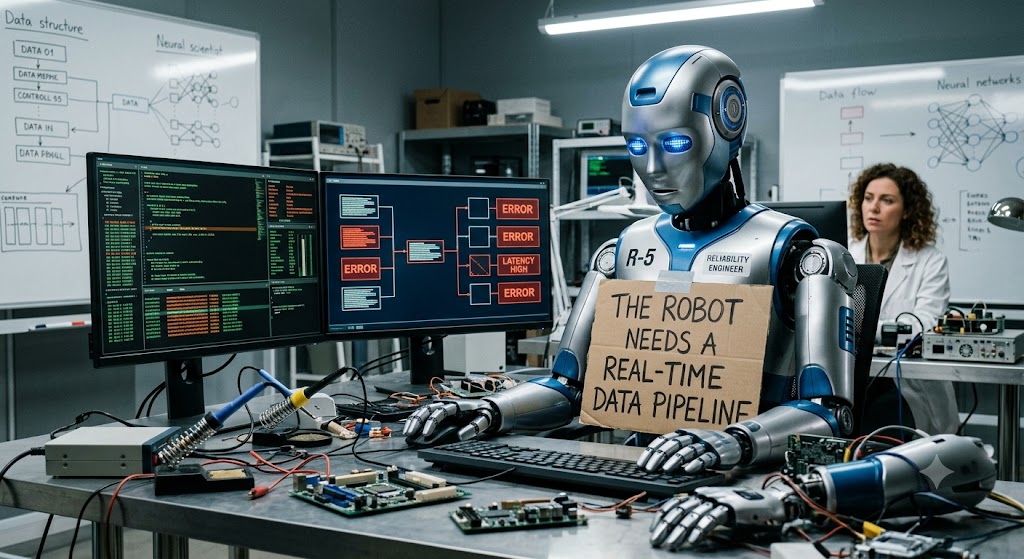
The computing hardware alone does not create a responsive robot.
Data has to travel efficiently through the software stack.
A simplified pipeline might look like:
Sensor → Driver → Data processing → Perception model → State estimation → Planner → Controller → Actuator
Each stage adds processing time.
This is why software architecture matters as much as processor specifications.
A powerful GPU can still be wasted if data spends too long waiting in software queues. A sophisticated AI model may perform poorly if the sensor pipeline introduces unnecessary overhead.
Robotics engineers therefore have to think about:
- Data movement
- Memory access
- Scheduling
- Model size
- Inference speed
- Process priorities
- Communication overhead
- Failure handling
The objective is not maximum computing power.
It is useful computing within a predictable time budget.
Why a Smaller AI Model Can Sometimes Be Better
More parameters do not automatically make an AI model more useful for robotics.
A very large model may provide impressive general-purpose reasoning but require substantial computational resources.
A smaller model that produces sufficiently accurate results at much lower latency may be more valuable for a physical robot.
This creates a familiar engineering trade-off:
Accuracy vs speed vs compute cost vs energy consumption
For cloud software, spending additional computing resources may be acceptable if the result justifies the expense.
For a battery-powered robot carrying its own processors, every additional watt has consequences.
Higher computational loads can increase energy consumption and potentially reduce operating time.
This is why optimisation is not an optional engineering exercise in robotics. It can directly affect whether the robot can complete a shift.
Battery Life Makes Robotics Computing Harder
A desktop computer can be connected to a wall socket.
A humanoid robot has to carry its power source around.
That changes how engineers think about computing.
More powerful processors can improve AI inference and perception, but they also consume energy. Cameras, sensors, wireless communication and motors all compete for the same battery capacity.
This creates a three-way relationship:
Computing power ↔ AI capability ↔ battery life
A system that performs extremely sophisticated local inference but drains its battery rapidly may be less useful than a slightly less capable system that can remain operational for several more hours.
This makes hardware efficiency a major part of robotics computing.
Specialised accelerators can be valuable because they are designed to execute particular types of workloads more efficiently than a general-purpose processor.
What Happens When the Internet Goes Down?
This is one of the most important tests for a connected robot.
A well-designed system should not suddenly lose fundamental safety capabilities because a cloud server becomes unreachable.
Imagine a humanoid robot working in a warehouse when its wireless connection drops.
It may no longer be able to:
- access a new task list,
- upload telemetry,
- contact a remote management service,
- retrieve certain cloud data.
But basic functions should ideally remain available, such as maintaining balance, stopping safely and avoiding immediate collisions.
This is another reason local AI and edge computing matter.
Connectivity should improve the robot’s capabilities rather than determine whether the machine can safely exist in its environment.
5G Helps, But 5G Is Not a Substitute for Edge Computing
5G networks can provide high bandwidth, broad coverage and low latency compared with older wireless technologies. That makes them useful for connected robotics.
However, even a fast network introduces some delay.
And network quality depends on the environment.
A robot operating inside a facility with strong 5G coverage is in a different situation from one working underground, inside dense industrial structures or in an area with network congestion.
For this reason, the better architecture is usually not:
“Use 5G so everything can run in the cloud.”
It is:
“Use 5G to connect the robot to systems that do not need to run locally.”
Critical physical control can remain local.
Higher-level coordination can use the network.
This separation makes the entire system more resilient.
Edge AI and Computer Vision Work Closely Together
Computer vision is one of the obvious candidates for edge processing because visual information is highly time-sensitive.
A robot can potentially process camera frames locally to detect:
- People
- Obstacles
- Objects
- Doors
- Floor boundaries
- Moving machinery
The local system can then pass higher-level information to other components rather than transmitting all raw visual data.
For example:
Camera → Edge vision model → “Person detected at 3 metres” → Navigation system
That is considerably more efficient than sending every camera frame to a remote server and waiting for a response.
The robot still needs a robust model and good sensors, but edge inference removes unnecessary network dependency from the immediate perception loop.
Why Latency Is Different From Bandwidth
These concepts are often mixed together.
Bandwidth refers broadly to how much data a connection can carry.
Latency refers to how long it takes information to travel and a response to return.
A network can have high bandwidth and still have latency that is too high for a particular robotic application.
Imagine downloading a huge dataset. High bandwidth is extremely valuable.
Now imagine trying to stop a robot from hitting an obstacle. The size of the dataset is less important than how quickly the critical information can be processed and acted upon.
This distinction is central to designing robotic networks.
A high-bandwidth connection does not automatically solve every real-time control problem.
The Future May Use Three Layers of Intelligence
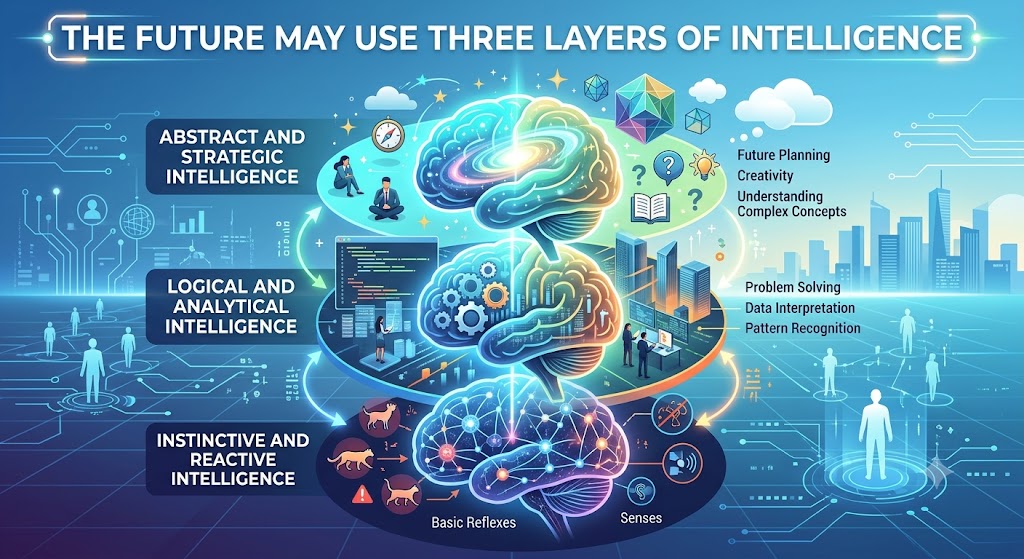
As humanoid robots become more sophisticated, a three-layer architecture is likely to become increasingly common.
Layer 1: Local Control
The robot handles immediate physical responses.
This includes:
- Joint control
- Balance
- Collision avoidance
- Emergency responses
Layer 2: Edge Intelligence
Nearby or onboard computing handles more complex but still time-sensitive perception and AI.
This can include:
- Object recognition
- Scene understanding
- Local planning
- Sensor fusion
Layer 3: Cloud Intelligence
Remote infrastructure handles large-scale computation and coordination.
This can include:
- AI training
- Fleet learning
- Analytics
- Digital twins
- Long-term planning
- Software management
The boundaries will vary by application, but the principle is powerful.
Not every decision belongs in the same place.
The physical world demands immediate responses. Large-scale intelligence benefits from enormous remote computing resources.
What Does This Mean for Robotics Developers?
The shift toward edge computing changes the role of software engineers working in robotics.
A developer cannot optimise only for model accuracy.
The complete system needs to be evaluated.
A useful checklist includes:
| Question | Why It Matters |
| How quickly does the model infer? | Determines response time |
| How much memory does it require? | Affects hardware choice |
| How much power does it consume? | Affects battery life |
| What happens if the network disappears? | Determines resilience |
| How is sensor data processed? | Affects latency and bandwidth |
| How are models updated? | Affects security and reliability |
| What happens when inference fails? | Determines safety |
| Can the software recover? | Determines operational reliability |
This is a major difference between testing a normal web application and testing an autonomous physical system.
A slow webpage is frustrating.
A delayed safety response can be dangerous.
What Does Edge Computing Mean for Robot Cybersecurity?
Moving computation to the edge improves responsiveness, but it also creates another security consideration: more intelligence is now physically present on the device.
An edge computer may contain:
- AI models
- sensor data
- credentials
- configuration files
- control software
- communication keys
Protecting that hardware becomes important.
A security architecture may therefore need secure boot, encrypted storage, authenticated software, protected credentials and strict access control.
The robot should also be able to distinguish legitimate software updates from unauthorised ones.
This becomes particularly important when large robot fleets are involved. The compromise of one device is serious; the compromise of a system responsible for distributing trusted software to thousands of devices is potentially much more significant.
Edge computing therefore reduces one class of dependency while creating new hardware-security requirements.
How Edge Computing Could Change Humanoid Robots
The importance of edge computing will grow as robots become more autonomous.
Early connected robots can rely heavily on external systems because humans may supervise them and their tasks may be tightly controlled.
A general-purpose humanoid operating independently has different requirements.
It needs to make decisions continuously.
It needs to operate around people.
It needs to cope with unreliable connectivity.
It needs to respond quickly.
And it needs to keep working even when cloud services are unavailable.
That makes local computation increasingly valuable.
The most capable robots may therefore look less like thin clients connected to the cloud and more like mobile edge-computing platforms with cloud support.
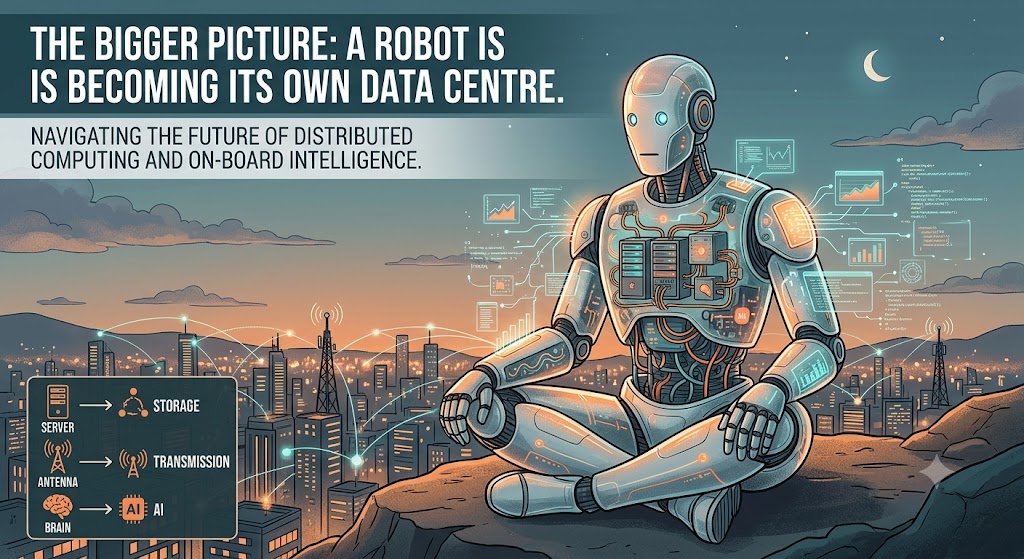
The Bigger Picture: A Robot Is Becoming Its Own Data Centre
This is perhaps the most interesting way to understand the shift.
A modern humanoid robot can contain:
- Multiple processors
- AI accelerators
- Storage
- Cameras
- Networking hardware
- Sensors
- Local AI models
- Security systems
- Real-time software
In a sense, the robot is carrying a miniature computing environment around with it.
The cloud remains enormously important, but the robot increasingly needs enough intelligence at the edge to function independently.
That changes the relationship between the physical machine and the network.
The robot does not simply consume cloud services.
It becomes a computing node within a much larger distributed system.
Frequently Asked Questions
What is edge computing in robotics?
Edge computing in robotics means processing data close to where it is generated, usually on the robot itself or on nearby computing infrastructure. This can reduce latency and network dependence for time-sensitive tasks.
Why do humanoid robots need edge computing?
Humanoid robots need fast responses to changes in their physical environment. Local processing can allow perception, control and safety-related decisions to happen without waiting for a remote cloud server.
What is edge AI?
Edge AI is artificial intelligence that performs inference near the source of the data rather than sending all information to a distant cloud service.
What is robot latency?
Robot latency is the delay between a physical event being detected and the robot responding to it. Low latency is particularly important for balance, navigation, obstacle avoidance and other real-time tasks.
What is real-time AI in robotics?
Real-time AI is AI designed to provide useful results within a time constraint that matters to the physical system. Accuracy alone is insufficient if the decision arrives too late to be useful.
Do humanoid robots need cloud computing?
Cloud computing can provide valuable services such as AI model training, analytics, fleet management, storage and software distribution. However, critical real-time functions can often be handled locally.
Can a humanoid robot work without the internet?
A well-designed robot can retain essential local capabilities even without network connectivity. Cloud-dependent functions may stop working, but basic movement and safety systems should not necessarily depend on continuous internet access.
Is 5G enough for robotics?
5G can provide useful high-speed and low-latency connectivity, but it does not eliminate the need for local processing. Network conditions can vary, and some robotic decisions need to happen immediately.
Why is edge computing better than cloud computing for robots?
It is not universally better. Edge computing is particularly useful for latency-sensitive and safety-related functions, while cloud computing is better suited to large-scale storage, training, analysis and coordination.
Does edge AI save battery?
It can reduce certain network and data-transfer requirements, but local AI processing also consumes energy. The overall impact depends on the hardware, workload and system architecture.
Why can’t every robot decision run in the cloud?
Network delay, connectivity failures, bandwidth limitations and reliability concerns make remote-only control unsuitable for many real-time robotic tasks.
What is robotics computing?
Robotics computing covers the hardware and software used to process sensor data, run AI models, plan movement, control actuators and coordinate the robot’s digital systems.
The Fastest Robot Still Needs the Right Computing Architecture
The humanoid robot running 100 metres in record time is the part everyone can see. The less visible achievement is the computing system required to make a machine perceive, decide and move quickly enough for that performance to be possible.
As robots leave controlled demonstrations and enter warehouses, factories, hospitals and other unpredictable environments, latency becomes more than a technical specification. It becomes part of the robot’s ability to function safely.
That is why the future of robotics is unlikely to belong entirely to the cloud or entirely to the edge. The strongest systems will divide the workload intelligently: local processors handle the decisions that cannot wait, edge systems provide nearby intelligence and the cloud takes care of large-scale computation and coordination.
The result is not simply a smarter robot. It is a distributed computing system with legs, sensors and the ability to act in the physical world.