
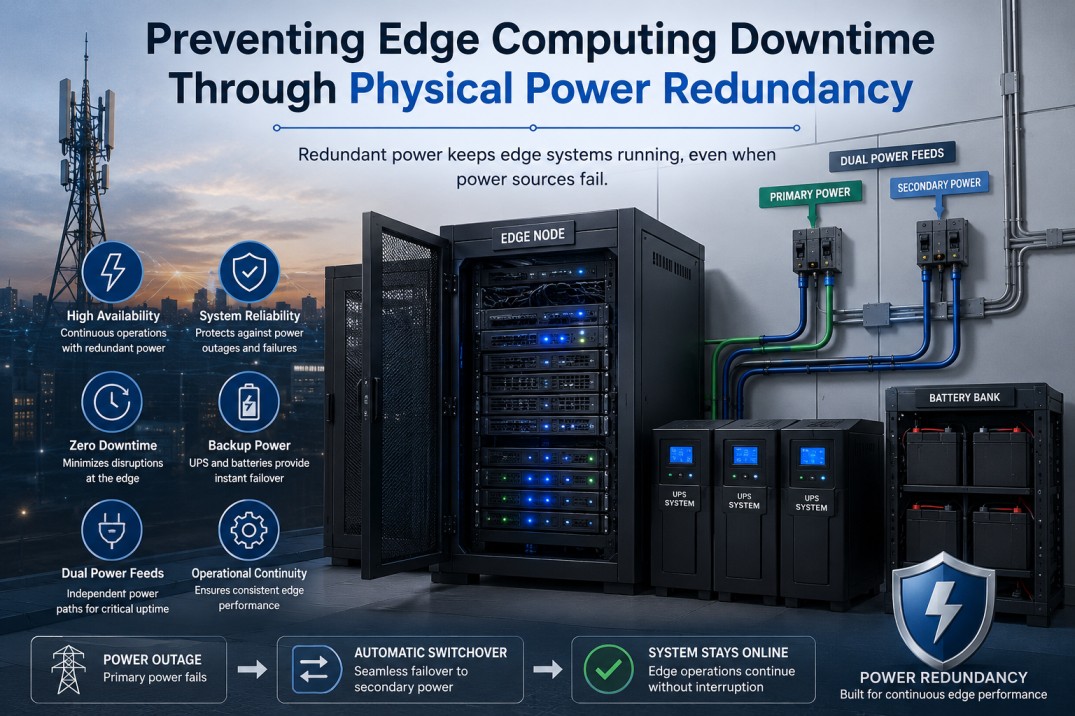
The rapid expansion of digital infrastructure has fundamentally changed where data is processed. As businesses move away from relying entirely on centralised data centres, localised edge nodes are becoming the backbone of modern operations. By bringing processing power closer to the end user, companies can drastically reduce latency and handle real-time data more effectively. However, moving critical infrastructure out of purpose-built data facilities introduces a new set of physical vulnerabilities.
Understanding the Vulnerabilities of Edge Nodes
As organisations increasingly navigate the architectural differences of edge computing vs cloud computing, deploying localised nodes offers immense speed benefits but simultaneously strips away the built-in redundancies of large-scale server farms. Traditional data centres are engineered with massive backup generators, complex environmental controls, and multiple independent power feeds. In contrast, an edge computing node might sit in a retail backroom or a manufacturing warehouse, fully exposed to local grid fluctuations and temperature changes.
Because these remote setups lack facility-wide safeguards, site managers must secure their own physical power redundancy to prevent data corruption during sudden outages. An uninterrupted power supply is the critical first line of defence. However, the internal chemical components of these fallback systems degrade over time. Sourcing fresh UPS replacement batteries before the existing units fail ensures that localised servers maintain the necessary runtime required to safely shut down or transition to backup generators during a grid blackout.
The Rising Cost of Infrastructure Downtime
When a remote node goes dark, the financial consequences accumulate rapidly across the entire network. According to recent industry evaluations detailed in the Uptime Institute’s Annual outage analysis 2026, power issues remain the dominant cause of impactful downtime, with over half of all major outages costing organisations more than $100,000. In sectors like general manufacturing, unplanned IT downtime can now reach upwards of $260,000 per hour.
These figures only account for immediately visible revenue loss. In high-volume retail environments, power failures that disrupt localised point-of-sale systems or inventory databases can cost businesses upwards of $1.1 million per hour in operational delays. The indirect costs of an outage, such as regulatory compliance fines and damaged brand reputation, are typically three to five times larger. For Australian businesses, these risks are compounded by ongoing grid reliability concerns. The Australian Energy Market Operator projects that total electricity consumption will increase by over 40 percent in the coming decade, creating severe supply constraints that make local energy redundancy essential.
Strategies for Maintaining Hardware Resilience
Protecting edge infrastructure requires more than just installing backup hardware and walking away. Because these systems often operate in suboptimal environments, a proactive approach to maintenance is essential for long-term stability. IT managers must establish strict protocols for monitoring both the power equipment and the physical spaces housing them.
- Monitor ambient temperatures: Operating environments critically dictate hardware resilience. For every 10 degrees Celsius increase above the optimal 20 to 25 degrees, a backup battery’s expected lifespan is effectively halved. Unventilated edge closets are particularly prone to overheating.
- Track capacity degradation: Industry safety standards dictate that once a unit’s performance degrades below 80 percent of its original rated capacity, it can no longer guarantee safe operational runtime and requires immediate replacement.
- Evaluate battery chemistry: Standard Valve Regulated Lead-Acid fallback units typically last between three to five years. Upgrading to lithium-ion alternatives can provide up to 12 years of service and handle significantly more charge cycles before degrading.
- Audit physical security: Ensure that edge locations are properly ventilated, free from dust accumulation, and secure from accidental human interference.
Securing the Future of Localised Networks
By the end of 2027, over half of all enterprise-managed data will be processed outside traditional cloud environments. As this massive shift towards decentralised architecture continues, the reliability of local hardware will become a primary competitive advantage. Organisations that treat their remote processing nodes with the same level of care and physical redundancy as primary data centres will be best positioned to avoid catastrophic failures. Investing in robust physical power safeguards today is the most effective way to ensure continuous, uninterrupted digital operations tomorrow. By prioritising proactive hardware maintenance and power continuity, IT leaders can protect their bottom line and keep their critical edge networks online, regardless of external grid conditions.