
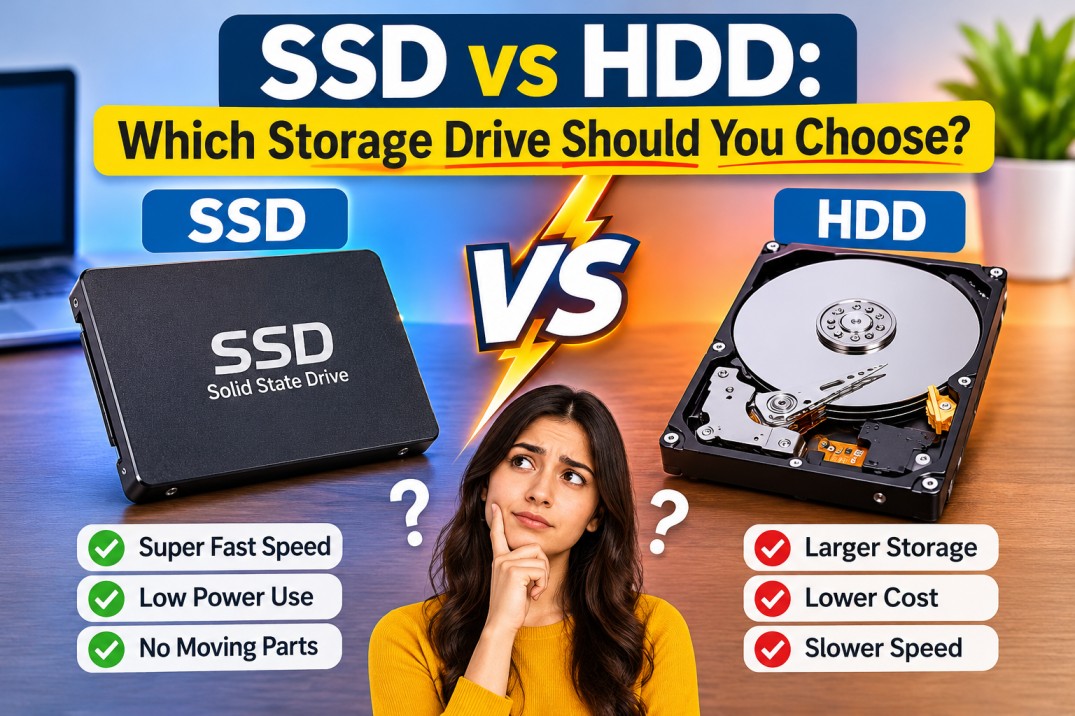
Choosing between an SSD and an HDD can affect how quickly your computer starts, how smoothly applications run, and how much storage you get for your money. Although both drives store operating systems, documents, photos, videos, and games, they use different technologies. Understanding the differences between SSDs and HDDs helps you choose the right storage solution for your budget, performance expectations, and everyday needs.
Whether you are buying a new laptop, upgrading an older computer, building a gaming PC, or looking for affordable backup storage, the right choice depends on how you use your device. This guide compares SSD vs HDD storage across speed, capacity, reliability, price, gaming performance, and upgrade options so you can make an informed decision.
What Is an SSD?
A solid-state drive, commonly called an SSD, is a storage device that uses flash memory to store digital information. Unlike traditional hard disk drives, SSDs do not rely on rotating platters or mechanical read/write heads. This design allows them to access data quickly, operate silently, and handle everyday physical movement more effectively.
SSDs are widely used in modern laptops, desktops, gaming computers, and portable storage devices. They can store operating systems, applications, documents, photographs, videos, and other digital files. Installing Windows on an SSD can make a computer feel considerably more responsive, particularly when upgrading from an older HDD.
How Solid-State Drives Store Data
SSDs store information in NAND flash memory cells. These cells retain data without requiring a continuous power supply, allowing files and applications to remain available after the computer shuts down. A controller manages how information is stored, retrieved, and distributed across the memory cells.
Because SSDs have no moving mechanical components, they can access scattered pieces of information without waiting for a disk to rotate into position. This makes them particularly effective at handling operating system tasks, application launches, and workloads involving numerous small files.
For example, opening a browser, switching between applications, or searching through folders may feel faster on an SSD. However, the improvement depends on the computer’s other components, the drive’s performance, and the type of workload being performed.
SATA SSDs Versus NVMe SSDs
Not all SSDs deliver the same performance. SATA SSDs use the SATA interface, which was originally developed for storage devices such as traditional hard drives. They commonly offer sequential read speeds around 500 to 550 MB/s, although actual performance varies by model and workload.
NVMe SSDs use the Non-Volatile Memory Express protocol over PCIe connections. Depending on the drive and PCIe generation, they can deliver substantially higher sequential transfer speeds than SATA SSDs. This makes them useful for demanding applications, large file transfers, and certain professional workloads.
However, the fastest drive is not always necessary. A SATA SSD can provide a substantial improvement over an HDD for everyday computing, while an NVMe SSD may be more appropriate for users who need higher performance. Always check your computer’s specifications before purchasing either type.
What Is an HDD?
A hard disk drive, or HDD, is a traditional storage device that records information magnetically on rotating disks called platters. A mechanical read/write head accesses the information while the platters spin. HDDs have been used in computers for decades because they provide relatively affordable storage in large capacities.
Although SSDs have become increasingly common, HDDs remain useful for storing large collections of documents, photographs, videos, games, and archived projects. They are particularly attractive when storage capacity matters more than rapid access to files.
How Hard Disk Drives Work
When a computer saves information to an HDD, the drive records the data magnetically on its platters. To retrieve a file, the drive positions its read/write head over the appropriate location while the platters rotate.
This mechanical process introduces delays that do not occur in the same way with SSDs. The drive may need to wait for the correct section of a platter to reach the read head, making random access slower. As a result, computers using HDDs can take longer to start applications or load operating system files.
Nevertheless, HDDs can deliver useful sequential transfer speeds when copying large files. Their performance varies with platter speed, recording technology, cache, drive condition, and interface.
Internal and External HDDs
Internal HDDs are installed inside compatible desktop computers and some laptops. They are commonly used as secondary storage for large media collections, archived work, and files that do not need to be accessed frequently.
External HDDs connect through USB or another supported interface and are convenient for transferring files between devices. They are also popular for creating local backups because users can disconnect them after copying important data.
External HDDs are available in portable and desktop formats. Portable models usually draw power through their USB connection, while some larger desktop models require a separate power adapter. Before purchasing one, check its capacity, connection type, physical size, and compatibility with your computer.
SSD vs HDD: Key Differences
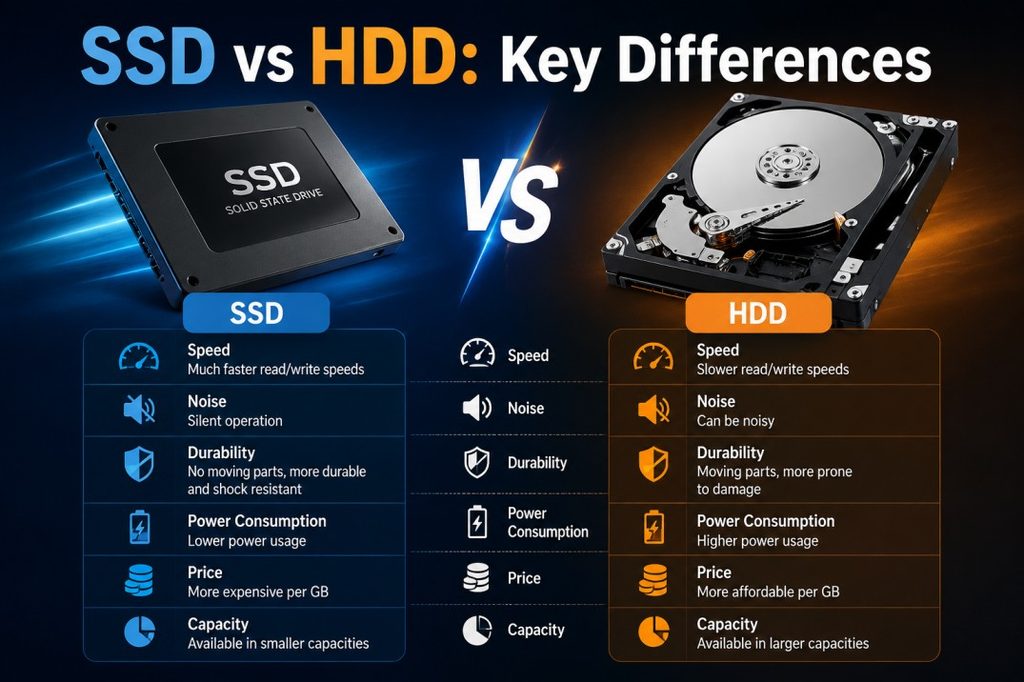
The main difference between an SSD and an HDD is how each technology stores and retrieves information. SSDs use electronic flash memory, while HDDs rely on mechanical components and magnetic platters. This distinction influences their speed, physical durability, noise, power requirements, and price.
Speed and Responsiveness
Speed is one of the biggest advantages of an SSD. It can access data much faster than a conventional HDD, particularly when performing tasks that involve many small files. This matters because operating systems and applications regularly read and write numerous files during normal operation.
An SSD can reduce startup times, make applications open more quickly, and improve the responsiveness of an older computer. It can also help reduce delays when switching between applications or searching through large collections of files.
HDDs are generally slower at these tasks because their mechanical read/write heads must move to the required locations. However, the difference depends on the specific hardware and workload. Sequential file transfers, for example, do not always show the same performance gap as random-access operations.
Storage Capacity and Cost
HDDs often provide more storage per rupee than SSDs, making them attractive for people who need several terabytes of space. A large HDD can store extensive video collections, photographs, downloaded files, and completed projects without requiring the higher expenditure that may accompany an SSD of comparable capacity.
SSDs are available in capacities ranging from smaller drives intended for basic computing to multi-terabyte models for gaming and professional work. Their prices vary depending on capacity, interface, performance, brand, and market conditions.
When comparing costs, consider both the price and the purpose of the drive. Paying more for an SSD may be worthwhile if faster access improves your daily workflow. If you mainly need inexpensive space for files that are rarely opened, an HDD may offer better value.
Noise, Power Use and Physical Design
SSDs operate silently because they have no spinning platters or moving read/write heads. HDDs may produce audible spinning sounds or clicking associated with normal mechanical operation. Unusual, repeated clicking can indicate a problem and should not be ignored.
SSDs also tend to be more resistant to physical shock because they contain no moving mechanical parts. This can be particularly useful in laptops and portable storage devices that are frequently carried around. However, SSDs can still be damaged by impact, electrical faults, excessive heat, or other failures.
Power consumption varies by model and workload. SSDs often use less power during many everyday operations, although high-performance NVMe drives can consume considerable power under heavy workloads. Physical dimensions also differ: SSDs are available in compact M.2 formats and 2.5-inch enclosures, while HDDs commonly use 2.5-inch or 3.5-inch designs.
Durability and Data Reliability
Neither storage technology is immune to failure. HDDs contain moving parts that can wear out or become damaged by physical shocks. SSDs avoid mechanical wear but depend on electronic components, controllers, firmware, and flash memory that has finite write endurance.
An SSD’s rated endurance can help indicate how much data can be written over its expected service life, but it does not guarantee when the drive will fail. Likewise, an HDD may continue working for years or develop a fault unexpectedly.
The safest approach is to maintain regular backups regardless of the drive you use. Keep additional copies of important files on separate storage devices or another suitable backup destination. For particularly valuable data, avoid relying on a single drive as the only copy.
Which Is Better for Gaming?
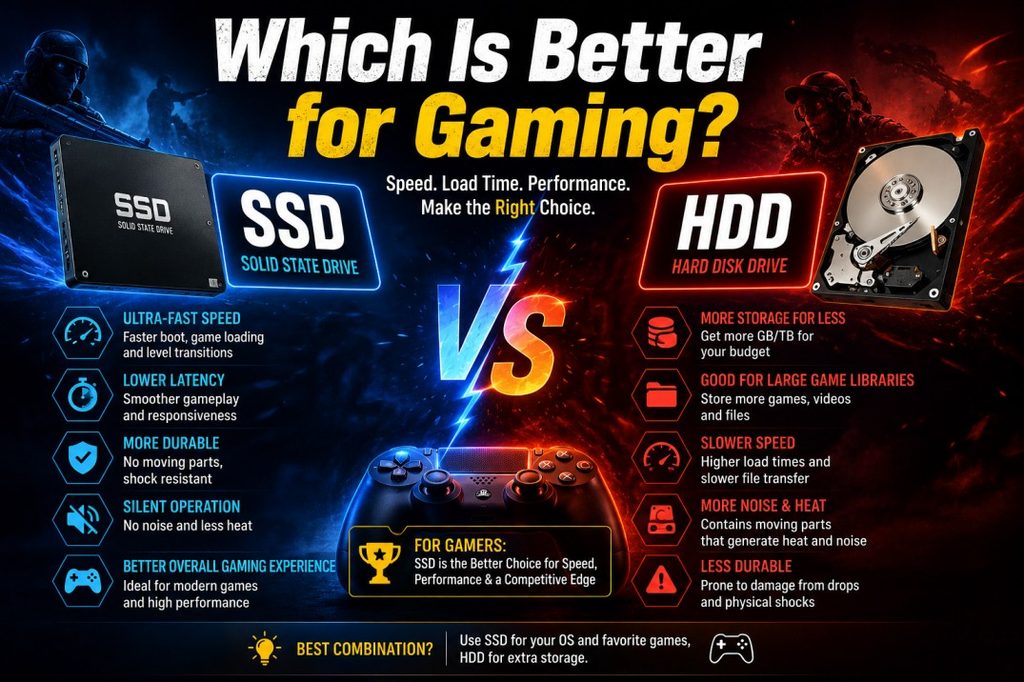
For most modern gaming computers, an SSD is the preferred choice for installing the operating system and frequently played games. Games often load numerous assets, configuration files, textures, and other data during startup and gameplay. Faster storage can reduce waiting times and improve the overall experience.
However, gaming performance depends on several components. An SSD cannot compensate for an underpowered graphics card or processor, and it does not automatically increase frame rates in every game.
Game Loading Times
Installing a game on an SSD can reduce the time required to launch it, load levels, and move between certain game environments. Games designed around fast storage may also benefit from quicker asset streaming, helping them retrieve resources as needed.
The improvement depends on the game, storage device, and system configuration. Moving from an HDD to an SSD can make a noticeable difference, while upgrading from a good SATA SSD to a high-end NVMe SSD may produce a smaller improvement in some games.
For gamers, this means an SSD is often a more useful upgrade than choosing a faster storage interface solely for gaming. If your existing computer still uses an HDD, replacing it with an SSD may be a practical first step.
Storage Requirements for Modern Games
Modern games can occupy substantial storage space, with some installations exceeding 100GB. Installing several large games, downloadable content, updates, and recording software can quickly consume the available space on a smaller drive.
A 256GB SSD may be sufficient for a basic computer with one or two smaller games, but it can become restrictive for a dedicated gaming setup. A 512GB drive provides more room, while a 1TB SSD is a practical option for many gamers who want to keep several titles installed simultaneously.
Players with extensive game libraries may prefer a 2TB SSD or a combination of SSD and HDD storage. Before choosing a capacity, check the storage requirements of the games you play and allow extra room for updates and future installations.
Combining SSD and HDD Storage
You do not necessarily have to choose between an SSD and an HDD. Many desktop computers support a combination of both, allowing you to balance speed with affordable capacity.
For example, you can install Windows, essential applications, and frequently played games on a 1TB SSD. A 2TB HDD can then store older games, gameplay recordings, movies, photographs, and other large files.
This arrangement keeps frequently accessed content on faster storage while reducing the cost of maintaining a large collection of files. However, not every laptop has room for two drives, so check the manufacturer’s specifications and available connections before planning a dual-drive setup.
Which Drive Is Better for Work and Everyday Use?
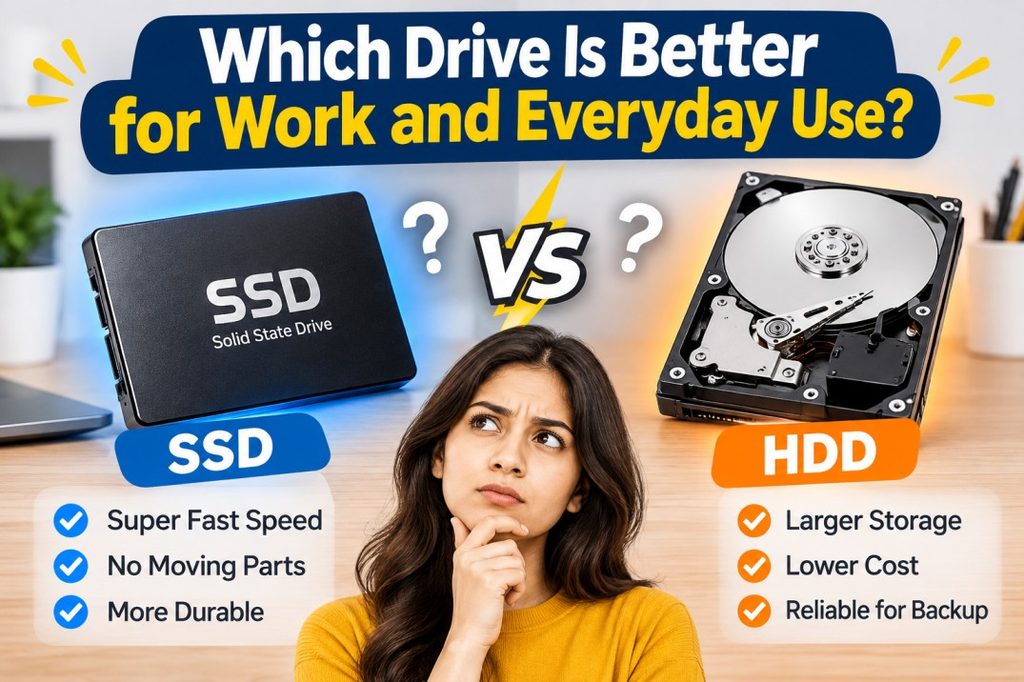
The best drive for work depends on your applications, storage requirements, and budget. For most people who use a computer for browsing, studying, office work, and general productivity, an SSD provides the most noticeable improvement in everyday responsiveness.
Students and Office Users
Students and office professionals often work with documents, web browsers, spreadsheets, presentations, email, and video conferencing applications. An SSD can help these programs launch more quickly and make the computer feel more responsive during routine tasks.
If an older laptop has become slow despite having sufficient memory and a reasonably capable processor, replacing its HDD with an SSD may improve its usability. However, a storage upgrade will not solve every performance problem. Insufficient RAM, overheating, outdated software, or an aging processor may also contribute to slow performance.
For a new laptop, an SSD is generally the better starting point. A capacity of 512GB is suitable for many everyday users, while 1TB provides more flexibility for larger files and additional applications.
Video Editors and Creators
Video editors, photographers, designers, and other creative professionals often work with large files that need to be accessed frequently. An SSD can help applications load quickly, improve project responsiveness, and accelerate certain file-transfer operations.
NVMe SSDs may be especially useful when working with high-resolution footage, large project files, or demanding workflows that benefit from high storage throughput. However, the actual improvement depends on the software, file format, processor, memory, and graphics hardware.
HDDs remain useful for storing completed projects, raw footage that is not currently being edited, and long-term media collections. A practical setup is to use an SSD for active projects and applications while keeping a larger HDD for archived work.
Backup and Archival Storage
HDDs can be an economical choice for maintaining backups of photographs, documents, videos, and other large collections of data. Their relatively low cost per unit of capacity makes them suitable for users who need several terabytes without paying for an equally large SSD.
An external HDD can also be disconnected after a backup is completed, reducing its exposure to some forms of malware and accidental deletion while disconnected. However, it can still be damaged, lost, or stolen.
For important files, follow a backup strategy that maintains multiple copies on separate devices or locations. Periodically verify that the files can be opened and restored. Neither an HDD nor an SSD should be treated as a guaranteed permanent archive.
How Much SSD Storage Do You Need?
Choosing the right SSD capacity involves balancing current storage usage with future requirements. A drive that is too small can fill up quickly, while a larger drive may cost more than necessary. Consider your operating system, applications, games, media files, and expected growth before deciding.
256GB vs 512GB
A 256GB SSD can suit users who mainly browse the internet, work with documents, attend online meetings, and use a limited number of applications. It can also be appropriate for a secondary computer that stores most large files elsewhere.
However, the usable capacity will be lower than the advertised figure, and Windows, installed applications, updates, temporary files, and personal data all occupy space. Users who install several games or store large photographs and videos may find 256GB restrictive.
A 512GB SSD offers more flexibility for everyday computing. It provides additional room for applications, documents, and a modest game library without requiring users to manage storage as frequently. For many students and office users, it represents a reasonable balance between cost and capacity.
1TB and Larger Capacities
A 1TB SSD is a practical choice for users who want room for multiple applications, games, photographs, and other personal files. It can also suit people who prefer to keep their primary files on the computer rather than relying heavily on external storage.
A 2TB SSD may be worthwhile for gamers with large libraries, video editors working with extensive media files, and professionals handling substantial projects. Higher capacities can also reduce the need to uninstall applications or move files between drives.
Before buying a large SSD, consider whether all your data needs fast access. If much of your storage will contain old videos, archived documents, or rarely accessed files, combining a smaller SSD with a larger HDD may be more economical.
Calculate Your Storage Requirements
You can estimate how much storage you need by adding the space used by your operating system, applications, games, personal files, and expected future growth. It is also important to leave sufficient free space for updates, temporary files, and routine operations.
Consider this example:
- Applications: 100GB
- Games: 150GB
- Personal files: 100GB
- Expected future growth: 150GB
- Total estimated requirement: 500GB
In this example, a 512GB SSD would leave little room for additional growth and other system files not included in the estimate. A 1TB SSD would offer considerably more flexibility.
Review your current storage usage before purchasing a drive. On Windows, open Settings, select System, and choose Storage to see how space is being used. This information can help you select a capacity based on actual requirements rather than guesswork.
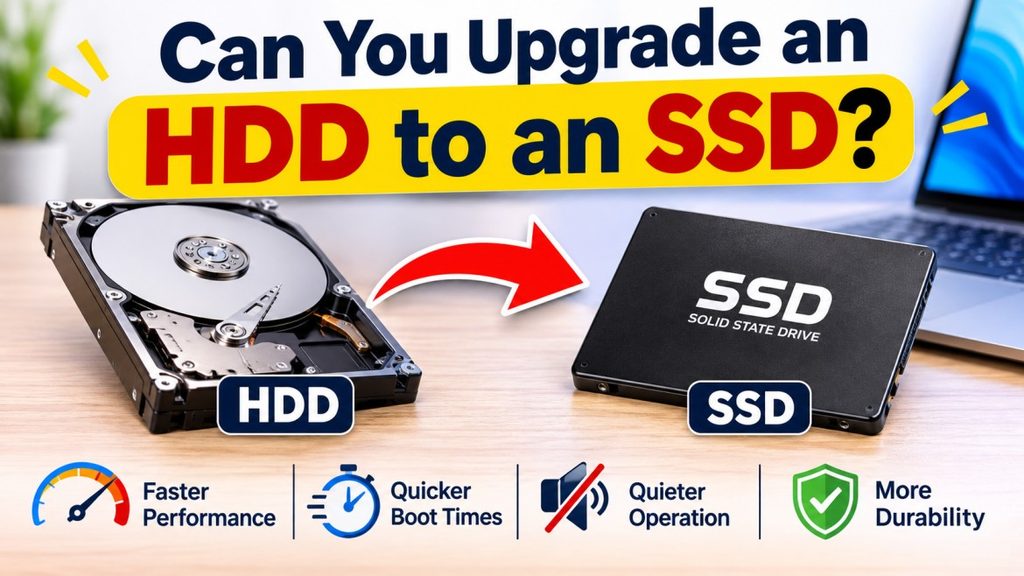
Can You Upgrade an HDD to an SSD?
In many computers, upgrading from an HDD to an SSD is a practical way to improve performance. However, the process depends on the device’s supported storage interfaces, available space, operating system, and installation requirements.
Before purchasing a drive, confirm that the new SSD is compatible with your computer and that you have a reliable backup of your important files.
Check Laptop and Desktop Compatibility
Start by identifying the type of storage currently installed in your computer. Consult the manufacturer’s specifications, maintenance manual, or system documentation to determine which replacement options are supported.
Some computers support 2.5-inch SATA SSDs, while others use M.2 drives. An M.2 drive may support SATA or NVMe, depending on the hardware. The M.2 form factor alone does not guarantee NVMe compatibility, so check the exact specifications.
Desktop computers may offer additional drive bays and motherboard connections, making it easier to retain an existing HDD alongside a new SSD. Laptops can have more limited space, and some models use soldered storage that cannot be replaced. Confirm these details before ordering components.
Clone a Drive or Reinstall Windows
There are two common ways to transfer your system to an SSD: cloning the existing drive or performing a clean installation of Windows.
Drive cloning copies the existing operating system, applications, settings, and files to the new SSD. This can save time, but the destination drive must have sufficient capacity for the data being transferred, and the cloning software must support the drives involved.
A clean Windows installation starts with a fresh operating system setup. It can help eliminate unwanted applications and configuration problems, but you may need to reinstall programs, restore personal files, and adjust settings.
Choose the method that best suits your situation. If you prefer to keep your existing setup, cloning may be convenient. If your current installation has persistent software problems, a clean installation may be worth considering.
Back Up Data Before Upgrading
Always create a backup before replacing or modifying a storage drive. Copy important documents, photographs, videos, and other files to a separate storage device or another reliable backup destination. Verify that the backup contains the files you need and that they can be accessed.
If you plan to clone the drive, follow the software manufacturer’s instructions and confirm that the cloning process has completed successfully. After installation, check that Windows starts correctly and that your important files and applications are available.
Keep the original drive untouched until you have tested the new SSD and confirmed that the system works as expected. Disconnect power before installing internal hardware, follow the device manufacturer’s safety instructions, and seek professional assistance if you are unsure how to open the computer.
Frequently Asked Questions
Is an SSD Always Faster Than an HDD?
SSDs generally provide faster data access and better everyday responsiveness than conventional HDDs. This is particularly noticeable during computer startup, application launches, and tasks involving many small files. However, performance varies by model, interface, workload, and system configuration. Some budget SSDs may also experience limited sustained write performance under particular conditions.
Can an SSD Fail?
Yes, SSDs can fail because of electronic faults, controller problems, firmware issues, flash-memory wear, or other defects. Although SSDs have no moving parts, that does not make them immune to damage or data loss. Check drive health when appropriate and maintain regular backups rather than relying entirely on the drive’s expected lifespan.
Is an HDD Better for Backups?
An HDD is often a cost-effective option for storing large backups because it provides substantial capacity at a relatively low price. However, an HDD is not automatically safer than an SSD, and either type can fail. Maintain multiple copies of important files, keep at least one backup separate from your main computer, and periodically test whether the data can be restored.
Can I Use an SSD and HDD Together?
Yes, many desktop computers and some laptops support both an SSD and an HDD. You can use the SSD for Windows, applications, and frequently accessed files while reserving the HDD for large media collections, older games, and archives. Before purchasing additional storage, verify that your computer has the necessary drive bays, connections, and compatibility.
Conclusion
When comparing SSD vs HDD storage, an SSD is generally the better choice for speed, responsiveness, silent operation, and everyday computing. An HDD remains valuable when you need affordable storage for large collections of files, backups, and archived projects.
For most new computers, an SSD should be the primary drive. If you need more capacity without significantly increasing your budget, combining an SSD with an HDD can provide a practical balance between performance and storage space. Ultimately, choose the drive that matches your workload, device compatibility, budget, and future storage requirements.