
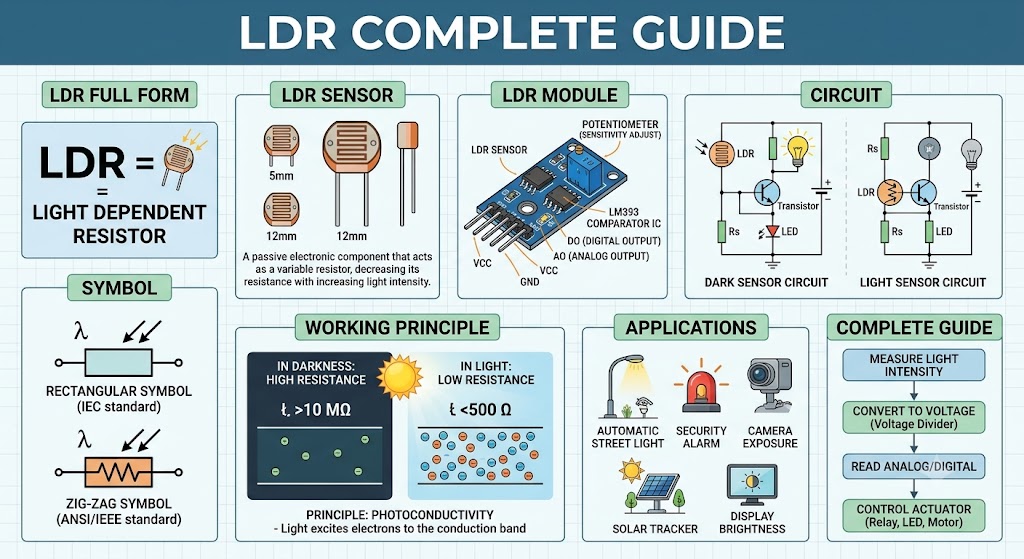
Electronics has transformed the way we interact with technology, and one of the simplest yet most useful components is the LDR, also known as the LDR sensor. Whether you are a student, electronics hobbyist, engineer, or someone exploring automation projects, understanding the LDR full form, LDR sensor full form, LDR module, LDR circuit, LDR symbol, LDR meaning, and LDR full form in chat can help you better understand how light-controlled electronic systems work. People also search for terms like doxy 1 ldr, but it is important to note that this refers to a medicine and is unrelated to the electronic Light Dependent Resistor discussed in this article.
From automatic street lights to smartphone brightness adjustment and smart home systems, LDRs have become an essential part of modern electronic circuits. They are inexpensive, reliable, easy to use, and suitable for beginners learning electronics as well as professionals designing advanced automation systems.
The popularity of LDRs comes from their ability to detect changes in light intensity without requiring complicated circuitry. Their simple operating principle makes them ideal for educational projects, industrial automation, security systems, agricultural equipment, and energy-saving devices.
In this comprehensive guide, you will learn everything about LDRs, including their working principle, construction, circuit diagrams, advantages, disadvantages, applications, and frequently asked questions.
What Is an LDR?
The LDR is an electronic component whose electrical resistance changes according to the amount of light falling on its surface. As the light intensity increases, the resistance decreases. When the surrounding area becomes darker, the resistance increases significantly.
The term LDR stands for Light Dependent Resistor. It is also commonly known as a photoresistor because its resistance depends entirely on the amount of incident light rather than manual adjustment or electrical control.
An LDR is manufactured using semiconductor materials that become more conductive when exposed to light. This phenomenon allows electronic circuits to automatically detect day and night conditions without human intervention.
Unlike ordinary resistors that maintain nearly constant resistance, an LDR continuously changes its resistance based on environmental lighting conditions.
This unique characteristic makes it one of the most widely used light sensors in electronics and automation projects.
Today, LDRs are found in everything from garden lighting and camera systems to industrial monitoring equipment and energy-efficient buildings.
LDR Full Form and LDR Meaning
The LDR full form is Light Dependent Resistor. The name itself clearly explains how this component functions. Its resistance depends directly on the amount of light reaching its surface.
The LDR full form is used in schools, engineering colleges, competitive examinations, electronics interviews, and technical documentation because it represents one of the most fundamental electronic sensing devices.
The LDR meaning becomes easier to understand when broken into three simple words.
“Light” refers to visible or nearby light energy.
“Dependent” means the resistance changes according before the amount of light received.
“Resistor” means it opposes electric current, although the amount of resistance varies continuously.
The LDR meaning is therefore a resistor whose electrical resistance changes according to the surrounding light intensity.
During daylight, resistance becomes low, allowing more current to pass through the circuit.
At night or in darkness, resistance increases dramatically, reducing current flow.
This automatic behavior makes LDRs ideal for circuits that must respond to environmental lighting conditions.
LDR Sensor Full Form and Working Principle
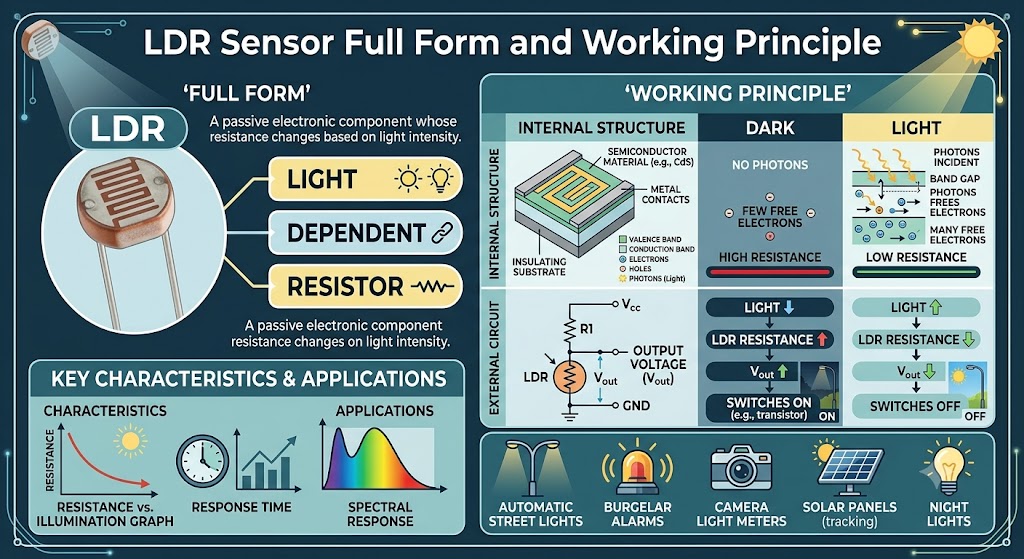
The LDR sensor full form is Light Dependent Resistor Sensor. Although people often use both terms interchangeably, the sensor generally refers to the complete sensing arrangement where the LDR is integrated into a practical electronic circuit.
The LDR sensor full form is widely used in educational projects because it represents one of the easiest sensors for beginners to understand and implement.
The working principle is based on photoconductivity.
Photoconductivity is a property of semiconductor materials where electrical conductivity increases when exposed to light.
When photons strike the semiconductor surface inside the LDR, they excite electrons and create additional charge carriers.
As the number of charge carriers increases, electrical resistance decreases.
When the surrounding light reduces, fewer electrons are available for conduction.
As a result, resistance rises again.
This continuous variation allows electronic circuits to detect changing lighting conditions accurately.
The response happens automatically without requiring mechanical movement or external control.
Because of its simplicity, the sensor remains highly reliable even after years of operation.
Construction of an LDR Sensor
An LDR sensor consists of a photosensitive semiconductor material deposited in a zigzag or serpentine pattern over an insulating base.
The LDR sensor is enclosed inside a transparent protective casing that allows light to reach the sensitive surface while protecting it from dust, moisture, and physical damage.
Cadmium Sulfide, commonly called CdS, has traditionally been one of the most widely used materials for manufacturing LDRs because of its excellent sensitivity to visible light.
The zigzag conductive path increases the effective resistance while maximizing the area exposed to incoming light.
Two metallic terminals connect the sensing material to the external electronic circuit.
The transparent cover ensures that light reaches the sensing surface efficiently without significantly reducing sensitivity.
Modern manufacturing techniques have improved durability, consistency, and response speed, making today’s LDRs suitable for both educational experiments and commercial electronic products.
Despite their simple appearance, these components are carefully engineered to provide stable performance across a wide range of lighting conditions.
Characteristics of an LDR
Every electronic component has unique electrical characteristics, and the LDR is no exception.
Its resistance may vary from a few hundred ohms under bright illumination to several megaohms in complete darkness.
This wide operating range allows designers to build circuits capable of detecting even relatively small changes in ambient light.
The response time of an LDR is generally slower than some modern optical sensors, but it remains perfectly suitable for applications such as automatic lighting, brightness control, and environmental monitoring.
LDRs consume extremely little power, making them ideal for battery-operated devices and energy-efficient electronic systems.
Their compact size allows easy integration into printed circuit boards without occupying much space.
The combination of low cost, simplicity, and dependable operation continues to make the LDR one of the most popular light-sensing components in electronics.
LDR Module and Its Components
An LDR module is a ready-to-use electronic board that combines an LDR with additional components such as a comparator, variable resistor, indicator LEDs, and output pins. Instead of building a complete sensing circuit from scratch, users can connect the module directly to a microcontroller or development board.
The biggest advantage of an LDR module is its simplicity. Beginners can easily connect it to platforms like Arduino, ESP8266, ESP32, Raspberry Pi, or other development boards without requiring advanced electronics knowledge.
Most modules include a potentiometer that allows users to adjust the light sensitivity. This means you can decide at what light level the module should trigger an output, making it useful for different environments and applications.
An onboard LED indicator usually shows whether the sensor has detected light above or below the selected threshold. This makes testing and troubleshooting much easier during project development.
Most LDR modules provide both digital and analog outputs. The analog output continuously changes according to light intensity, while the digital output switches between HIGH and LOW when the preset light level is crossed.
Because of their affordability and ease of use, LDR modules are widely used in educational laboratories, robotics competitions, automation systems, and DIY electronics projects.
LDR Symbol in Circuit Diagrams
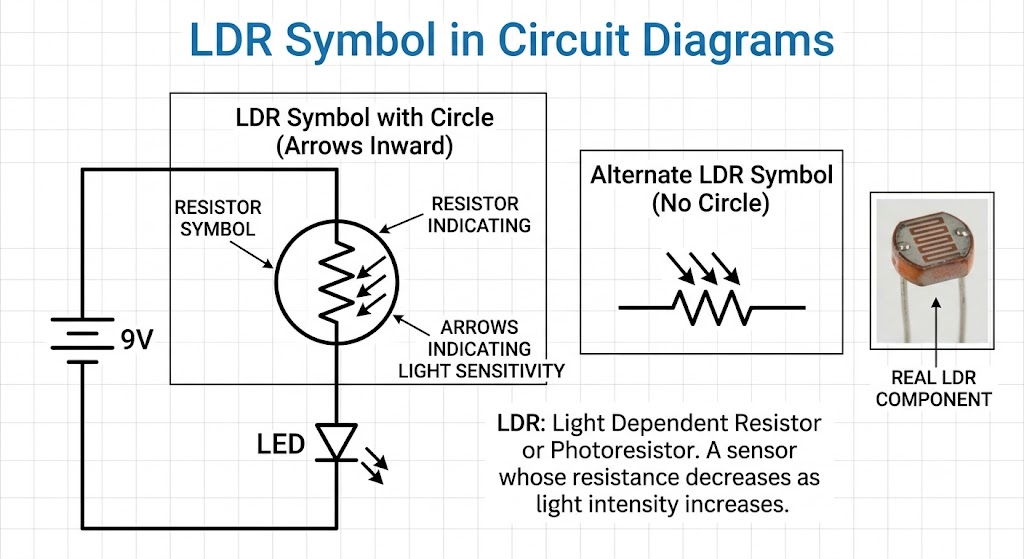
Understanding the LDR symbol is essential for reading circuit diagrams correctly. Electronic schematics use standardized symbols so engineers across the world can easily understand circuit designs regardless of language.
The standard LDR symbol resembles a resistor with two arrows pointing toward it. The resistor represents the sensing element, while the arrows indicate incoming light falling on the surface of the photoresistor.
Some circuit diagrams use a zigzag resistor symbol, while others use a rectangular resistor depending on the drafting standard being followed. Regardless of the drawing style, the incoming arrows remain the identifying feature.
Learning electronic symbols is an important skill because almost every project, textbook, and circuit manual uses schematic diagrams instead of photographs.
Students preparing for engineering entrance examinations or electronics practicals frequently encounter LDR symbols in questions involving automatic lighting systems and sensor circuits.
Once you recognize the symbol, understanding larger automation circuits becomes much easier.
LDR Circuit and How It Works
An LDR circuit is one of the simplest electronic circuits that beginners can build. It generally consists of an LDR, a fixed resistor, a power supply, and an output device such as an LED, transistor, relay, or microcontroller input.
The working principle of an LDR circuit is based on voltage division. As the resistance of the LDR changes with light intensity, the output voltage also changes, allowing other components to detect whether the environment is bright or dark.
For example, in an automatic street light circuit, the LDR senses sunlight during the day. Since the resistance becomes low, the control circuit keeps the street lights switched off.
When darkness arrives, the resistance increases significantly. This changes the voltage supplied to the transistor or relay, automatically turning the street lights on without requiring human intervention.
The same concept is used in automatic garden lights, emergency lighting systems, and smart home automation.
Because the circuit contains only a few inexpensive components, it is commonly used as one of the first practical experiments in electronics laboratories.
Types of LDR Sensors
Although all LDRs operate using the same basic principle, different materials are used depending on the required sensitivity and application.
Intrinsic photoresistors are manufactured using pure semiconductor materials. Their conductivity changes naturally when exposed to light, making them suitable for certain specialized electronic applications.
Extrinsic photoresistors contain carefully added impurities that improve sensitivity to particular wavelengths of light. These devices are more common in practical electronics because they provide better performance across different lighting conditions.
Some LDRs are designed specifically for visible light, while others can respond to infrared or ultraviolet wavelengths depending on the semiconductor material used.
Manufacturers also produce LDRs in different sizes and resistance ranges to suit various applications, from simple educational projects to industrial automation equipment.
Selecting the correct LDR depends on operating voltage, expected light intensity, response speed, environmental conditions, and overall circuit requirements.
Applications of LDR Sensors
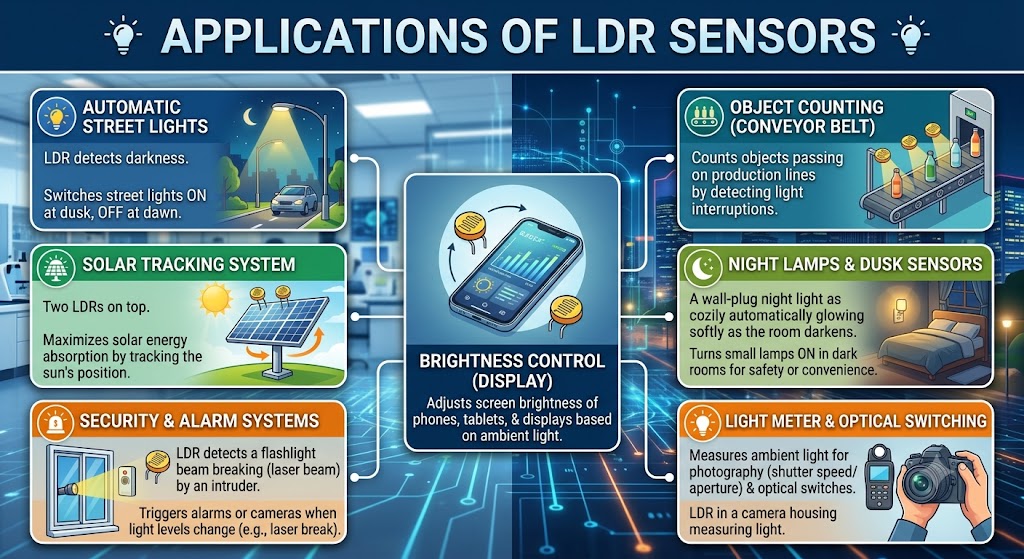
The LDR sensor has become an important component in countless electronic devices because of its ability to automatically detect changes in surrounding light. From homes to factories, these sensors improve convenience, efficiency, and energy savings.
One of the most common applications of the LDR sensor is automatic street lighting. The lights switch on after sunset and turn off automatically during daylight, reducing electricity consumption without manual operation.
Modern smartphones use LDR-based or similar light sensors to adjust display brightness according to surrounding lighting conditions. This improves readability while conserving battery life.
Digital cameras also benefit from light sensing technology. Exposure settings can automatically adjust depending on ambient lighting, helping users capture better photographs.
Security systems frequently use LDRs to detect unexpected changes in light levels, triggering alarms or surveillance equipment when necessary.
Smart homes integrate LDR sensors with intelligent controllers to automate curtains, lighting systems, and energy management solutions based on natural daylight.
Agricultural applications include greenhouse monitoring, plant growth studies, and automated lighting control for indoor farming systems.
Educational laboratories continue using LDRs because they provide students with a simple introduction to sensor technology and electronic automation.
Industrial automation systems use LDRs for object detection, machine monitoring, and production line control where changes in light indicate different operating conditions.
Their versatility, low cost, and reliability explain why LDR sensors remain popular despite the availability of more advanced optical sensing technologies.
Advantages of LDR Sensors
The popularity of the LDR sensor continues to grow because it offers several practical advantages for students, hobbyists, and professional engineers. Its simple design and dependable operation make it suitable for a wide variety of electronic projects.
One major benefit of the LDR sensor is its low cost. Compared to many advanced optical sensors, an LDR is inexpensive and easily available, making it ideal for educational institutions and budget-friendly projects.
Another advantage is the simple interface. Most LDR circuits require only a few external components, allowing beginners to build working projects without extensive electronics knowledge.
LDRs consume very little electrical power, making them suitable for battery-powered devices and energy-efficient automation systems.
Their compact size allows easy installation inside small electronic products without increasing the overall dimensions of the device.
These sensors are highly reliable when operated within their specified conditions and can continue functioning for many years with minimal maintenance.
LDRs also provide smooth resistance variation according to light intensity, making them useful for applications requiring gradual brightness detection instead of simple ON and OFF operation.
Disadvantages of LDR Sensors
Like every electronic component, LDRs also have certain limitations that designers should consider before selecting them for a project.
The most noticeable limitation is relatively slow response speed. LDRs require a short amount of time to adjust when light conditions change rapidly, making them less suitable for extremely high-speed optical applications.
Temperature variations can slightly affect resistance values, influencing measurement accuracy under certain environmental conditions.
Some traditional LDR materials also contain cadmium compounds, leading to environmental concerns in certain regions where electronic waste regulations are strict.
LDRs cannot measure light intensity as precisely as specialized digital optical sensors designed for scientific or industrial measurements.
Their performance may gradually change after prolonged exposure to harsh environmental conditions such as excessive humidity, dust, or continuous direct sunlight.
Despite these limitations, LDRs remain an excellent choice for most educational, domestic, and general automation applications.
LDR vs Photodiode vs Phototransistor
Many beginners wonder whether an LDR is better than a photodiode or a phototransistor. The answer depends entirely on the application.
An LDR is designed primarily for detecting gradual changes in ambient light. It is inexpensive, easy to use, and requires very little circuit complexity.
Photodiodes operate much faster than LDRs. They are commonly used in communication systems, barcode scanners, optical receivers, and high-speed sensing applications where rapid response is essential.
Phototransistors provide higher sensitivity than photodiodes because they amplify the incoming light signal internally. They are often used in object detection systems, industrial automation, and optical switching circuits.
If your project involves automatic lighting, smart homes, garden lights, or educational experiments, an LDR is usually the most practical choice.
If high-speed detection or precise optical measurement is required, photodiodes or phototransistors generally offer better performance.
Selecting the correct sensor depends on cost, response time, sensitivity, circuit complexity, and intended application.
LDR with Arduino Projects
Arduino has made electronics learning much easier, and LDRs are among the first sensors most beginners connect to a microcontroller.
A basic Arduino project connects the LDR in a voltage divider configuration with one analog input pin. As light intensity changes, the analog value received by the Arduino also changes continuously.
Students often create automatic night lamps where an LED turns on after sunset and switches off during daylight.
Another popular project involves automatic garden lighting that conserves electricity by operating only when natural light becomes insufficient.
Smart classroom demonstrations use LDRs to explain analog sensing, voltage division, and conditional programming concepts.
Home automation enthusiasts frequently integrate LDR modules with relays to control household lighting automatically according to outdoor brightness.
Advanced users combine LDR sensors with Wi-Fi-enabled controllers to monitor environmental lighting remotely using smartphones or cloud platforms.
These practical projects help beginners understand both electronics and programming while developing problem-solving skills.
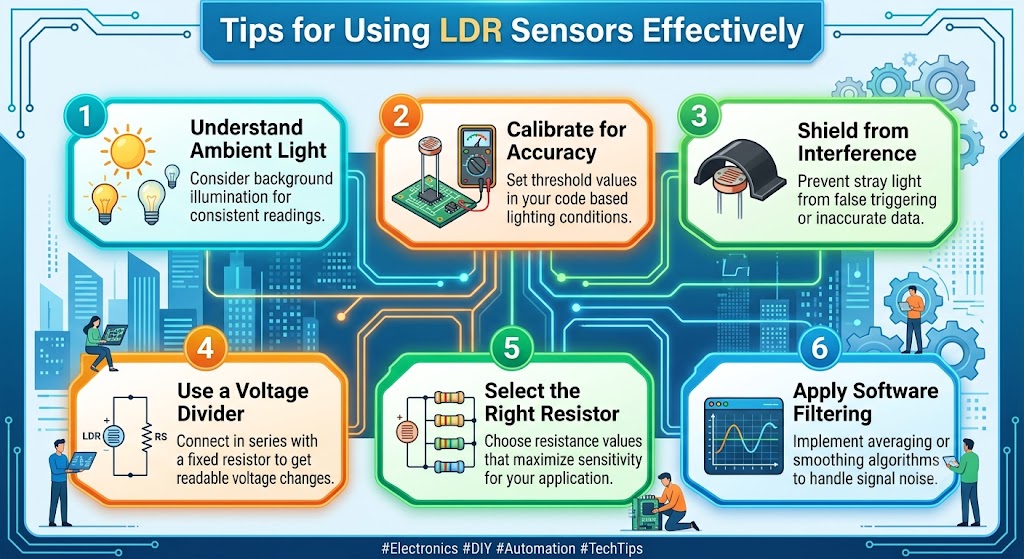
Tips for Using LDR Sensors Effectively
Proper installation significantly improves the performance of an LDR-based project.
Avoid placing the sensor where unwanted artificial light may interfere with measurements.
Keep the sensing surface clean because accumulated dust can reduce sensitivity over time.
If outdoor installation is required, use a transparent waterproof enclosure that protects the sensor while allowing sufficient light transmission.
Always select resistor values suitable for your operating voltage and desired sensitivity.
Test the circuit under different lighting conditions before final installation to ensure reliable operation throughout the day.
Regular maintenance helps maintain consistent performance, especially in dusty or humid environments.
Frequently Asked Questions
1. What is the LDR full form?
The full form of LDR is Light Dependent Resistor. It is an electronic component whose resistance changes according to the amount of light falling on its surface.
2. What is an LDR sensor used for?
An LDR sensor detects light intensity and is commonly used in automatic street lights, garden lighting, smart homes, security systems, cameras, and educational electronics projects.
3. What is the difference between an LDR and a normal resistor?
A normal resistor has a fixed resistance value, whereas an LDR continuously changes its resistance depending on surrounding light conditions.
4. What is an LDR module?
An LDR module is a ready-made sensor board that includes an LDR along with supporting electronic components, making it easier to connect with Arduino and other microcontrollers.
5. Why does LDR resistance decrease in light?
Light energy releases additional charge carriers inside the semiconductor material, increasing conductivity and reducing electrical resistance.
6. Can an LDR work at night?
Yes. In darkness the resistance becomes very high, allowing circuits to detect nighttime conditions and activate devices such as automatic lights.
7. What are the main applications of LDRs?
Common applications include automatic lighting, brightness control, smart agriculture, industrial automation, security systems, and educational electronics.
8. Is an LDR an analog sensor?
Yes. An LDR naturally produces continuously varying resistance according to changing light intensity, making it an analog sensing device.
9. Can beginners use an LDR for projects?
Absolutely. LDRs are inexpensive, simple to connect, and widely recommended for students learning electronics and microcontroller programming.
10. Is doxy 1 LDR related to an LDR sensor?
No. Doxy 1 LDR is a medicine, while an LDR in electronics refers to a Light Dependent Resistor. They are completely unrelated terms.
Conclusion
The LDR remains one of the simplest and most practical light-sensing components used in modern electronics. Its ability to change resistance according to light intensity makes it suitable for countless applications ranging from automatic street lights and smart homes to industrial automation and educational experiments.
Whether you are learning the LDR full form, understanding the LDR meaning, building an LDR circuit, studying the LDR symbol, experimenting with an LDR module, or exploring the LDR sensor full form, mastering this versatile component provides an excellent foundation in electronics and automation. With proper circuit design and installation, LDRs continue to deliver reliable, energy-efficient, and cost-effective solutions for a wide range of real-world applications.