
How a small Tamil movie leak site became a billion-dollar industry’s worst nightmare — and what it tells us about the global war on digital piracy
TamilRockers piracy website, online movie piracy India, Tamil film industry piracy problem, illegal movie download sites, movie piracy impact on Bollywood and Kollywood — these are topics that have dominated headlines, courtrooms, and industry boardrooms for over a decade. TamilRockers is not just a website. It is a phenomenon — a case study in how digital piracy evolves, adapts, and survives despite the best efforts of law enforcement, governments, and billion-dollar film industries. Whether you’re a film enthusiast, a cybersecurity student, a policy researcher, or simply someone who has heard the name and wondered what the fuss is all about, this is the complete, honest, educational story of TamilRockers — what it is, where it came from, how it operates, who uses it, and what damage it has left in its wake.
1. What Exactly Is TamilRockers? The Origin Story
To understand TamilRockers, you have to go back to where it started — not with servers and code, but with a community of people who were passionate about Tamil cinema and frustrated by access.
TamilRockers as a piracy platform was founded sometime around 2011, initially as a torrent website focused primarily on Tamil-language films — the output of Kollywood, the Tamil film industry based in Chennai, India. In its earliest form, it was one of dozens of regional-language torrent sites catering to Tamil-speaking audiences globally, many of whom lived outside India and had limited legitimate access to new Tamil releases.
What separated TamilRockers from its contemporaries was speed and scope. Movie piracy websites in India had existed for years, but most operated with a lag — uploading films days or weeks after theatrical release. TamilRockers began developing a reputation for uploading films on the same day as their cinema release, sometimes within hours. This “day-zero leak” capability made it extraordinarily popular and extraordinarily dangerous to the film industry simultaneously.
Over time, the platform expanded well beyond Tamil films. TamilRockers content library grew to include Telugu, Malayalam, Kannada, Hindi (Bollywood), and even Hollywood films dubbed in Indian languages. The name remained Tamil-rooted, but the operation had become a full-spectrum South Asian and global piracy portal.
2. How Piracy Websites Like TamilRockers Actually Work
Understanding the technical structure of how movie piracy sites operate helps explain why they’ve been so difficult to shut down permanently — and why the game of whack-a-mole between authorities and piracy sites has gone on for so long.
At the most fundamental level, torrent-based piracy websites work as indexes. They don’t necessarily host the actual movie files on a single server that can be seized and destroyed. Instead, they host torrent files or magnet links — small pieces of data that connect users to each other in a peer-to-peer (P2P) network where the actual film files are distributed across thousands of individual computers simultaneously.
When a user downloads a movie through a torrent system, they’re not pulling data from one central server. They’re pulling tiny pieces of the file from dozens or hundreds of other users who already have it, simultaneously. This distributed architecture makes torrent piracy websites inherently resilient — there is no single point of failure to shut down.
Domain hopping is another core survival mechanism. When authorities in India, the UK, or other jurisdictions issue court orders blocking a specific domain (like tamilrockers.com), the operators simply register a new domain (tamilrockers.nl, tamilrockers.ws, tamilrockers.vc) and redirect their user base there. This has happened dozens of times with TamilRockers specifically — each court-ordered block spawning a new domain within days.
Mirror sites and proxy sites emerged as another layer of resilience. Third parties — not even the original operators — create copies of the site’s interface on new domains, keeping the content accessible even when the primary domain is blocked. This is why TamilRockers mirror sites proliferate rapidly after each legal action.
The sites generate revenue primarily through advertising — often displaying ads for gambling, adult content, or dubious software — meaning the operators profit financially from every visitor, regardless of whether they complete a download.
3. The Scale of the Problem — Just How Big Is Movie Piracy in India?
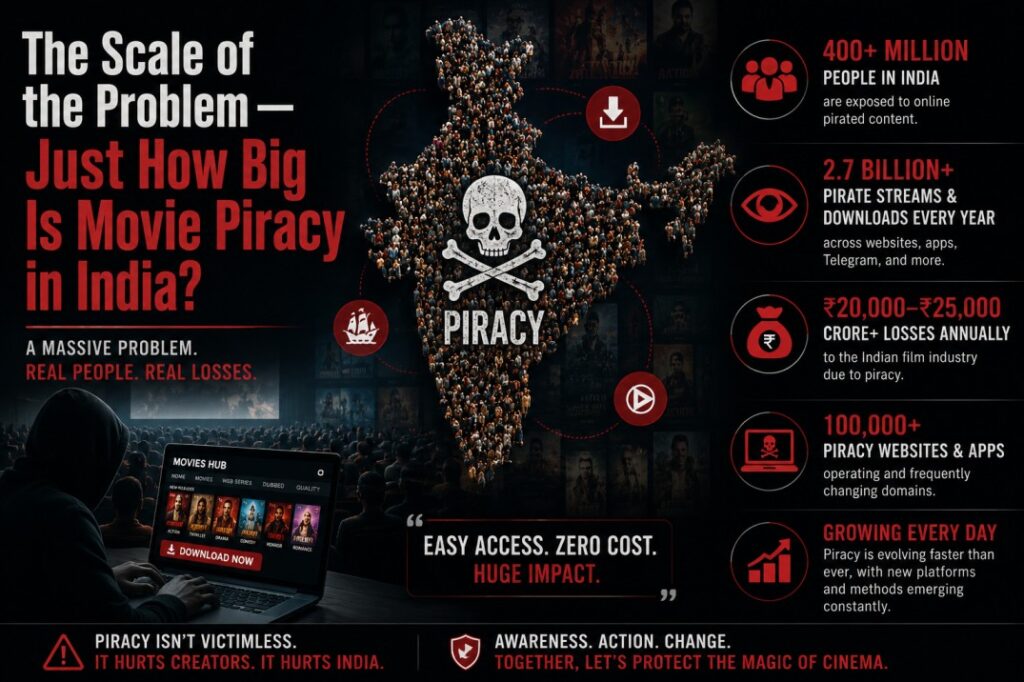
The numbers around online movie piracy in India are staggering, and they provide essential context for understanding why TamilRockers has attracted such intense legal, governmental, and industry attention.
India is one of the world’s largest film markets, producing more films annually than any other country. The Indian film industry — spanning Bollywood, Kollywood, Tollywood, Mollywood, and other regional industries — generates billions of dollars in revenue and employs millions of people directly and indirectly. It is also, by most estimates, one of the most piracy-affected film industries on earth.
Film piracy losses in India are estimated by industry bodies to run into thousands of crores of rupees annually. The Producers Guild of India and various industry associations have repeatedly cited figures suggesting that a single major film can lose 20–40% of its potential box office revenue to piracy, with some blockbusters suffering even higher losses when major leaks occur on opening weekend.
Day-one movie leaks impact has been demonstrated concretely in box office data. Films that appear on piracy sites within the first 24 hours of release show measurable drops in second-day and second-weekend ticket sales — particularly in smaller cities and towns where cinema access is limited and economic barriers to ticket purchases are higher.
For Tamil cinema specifically, the damage has been particularly acute. Several major productions have publicly attributed disappointing box office performances to TamilRockers leaks, creating an atmosphere of dread among producers during release weekends — with teams actually monitoring piracy sites in real time to track whether their film has appeared.
4. Who Uses Piracy Sites — The Complicated Human Reality
The conversation about who uses movie piracy websites is more nuanced than the film industry’s preferred narrative of “thieves stealing from creators,” and understanding it honestly is important for anyone trying to think clearly about the issue.
Why people use piracy sites breaks down into several distinct motivations, and understanding them is key to understanding why legal action alone has never been sufficient to solve the problem.
Geographic access barriers have historically been the most sympathetic driver. Tamil-speaking diaspora communities in Malaysia, Singapore, Sri Lanka, the UK, Canada, and elsewhere often had no legitimate way to watch new Tamil releases on or near their release date. Cinema releases outside India were limited; streaming rights were fragmented and inconsistently available. Piracy filled a genuine access gap that the industry itself had failed to address.
Economic barriers are the second major driver, particularly within India. For a family in a rural area where the nearest multiplex is two hours away and tickets cost more than a day’s wage, the calculation around piracy is complicated by real economic hardship. This doesn’t make piracy legal or harmless — but it contextualizes the demand.
Habit and convenience are the third driver, and arguably the most frustrating for the industry because they’re the hardest to address with moral arguments. For a segment of users, piracy is simply the path of least resistance — faster, cheaper, and more convenient than any legitimate alternative, regardless of whether those alternatives exist. Convenience-driven piracy is most common among younger, tech-savvy users who have grown up expecting instant, free access to digital content.
Researchers, journalists, and analysts represent a small but real category of users who access piracy sites for study purposes — examining site structures, cataloging content, tracking upload patterns, or documenting the piracy ecosystem. This is the most clearly “informational” category of engagement.
5. The Legal War Against TamilRockers — A Timeline of Action
The legal history of anti-piracy action against TamilRockers reads like a long, exhausting chase — authorities gaining ground, then losing it; courts issuing orders that are technically complied with and practically irrelevant.
Indian copyright law and piracy falls primarily under the Copyright Act of 1957 and its subsequent amendments, as well as the Information Technology Act of 2000. Uploading, distributing, or facilitating access to copyrighted content without authorization is clearly illegal under Indian law, with penalties including imprisonment and significant fines.
The Madras High Court has been particularly active in issuing website blocking orders against piracy sites, instructing Indian Internet Service Providers (ISPs) to block access to TamilRockers domains. These orders have been issued repeatedly — sometimes blocking dozens of domains in a single ruling. Telecom operators including Airtel, Jio, BSNL, and Vodafone Idea have all been directed to implement these blocks at various points.
The most significant law enforcement action came in April 2018, when a team of Tamil Nadu police and cybercrime officials arrested several individuals believed to be associated with TamilRockers operations. The arrests were widely reported as a major blow to the site. Within weeks, however, the site was operational again on new domains — demonstrating the fundamental resilience challenge that makes taking down piracy websites permanently so difficult.
Anti-Piracy Cell operations in India have expanded significantly over the past decade. The Motion Picture Association (MPA), which represents major Hollywood studios globally, has worked with Indian authorities and industry bodies on coordinated anti-piracy campaigns. The Film Federation of India and individual production houses have also funded dedicated anti-piracy teams that monitor leak sites in real time.
Despite all of this — the court orders, the ISP blocks, the arrests, the international cooperation — TamilRockers has continued to operate in some form, demonstrating the extraordinary persistence of well-organized piracy networks and the structural limitations of jurisdiction-specific legal action against globally distributed digital operations.
6. The Human Cost — How Piracy Affects Real People in the Film Industry
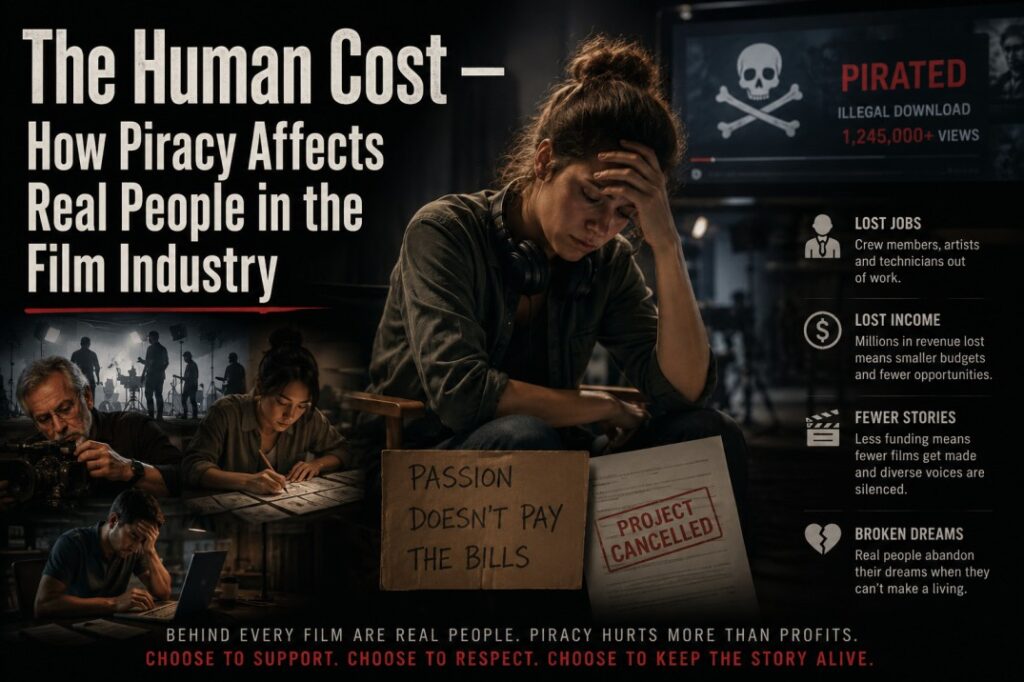
Discussions of piracy often get abstract quickly — focusing on corporate revenue figures and industry statistics. The human impact of movie piracy on individuals working in the film industry is a more grounded and often more compelling part of the story.
The film industry is not just stars and studios. A single major Tamil or Hindi production employs hundreds of people below the line — junior artists, technicians, set designers, costume departments, caterers, drivers, spot boys — many of whom are daily wage workers for whom a film’s commercial success directly determines whether they get rehired for the next project.
When a film underperforms at the box office due to a piracy leak, the ripple effects travel far beyond the producer’s P&L statement. Independent filmmakers — those making smaller, non-franchise films without the cushion of a major studio’s resources — are often the hardest hit. For them, a single week of strong box office performance can mean the difference between recouping investment and financial ruin.
Several Tamil directors and producers have spoken publicly and emotionally about specific films where they believe TamilRockers leaks materially affected their films’ commercial performance. Pa. Ranjith, Vetrimaaran, and others making films with social messages and smaller budgets have expressed particular anguish — these are films that depend on word-of-mouth box office momentum, which piracy leaks short-circuit before it can build.
The psychological impact on filmmakers who have spent years on a project — only to watch it appear on a piracy site hours after its theatrical premiere — is rarely discussed but genuinely significant. Several have spoken about the dread and helplessness of release weekends, constantly refreshing piracy monitoring alerts while simultaneously hoping their film connects with audiences.
7. The Industry’s Response — What Film Industries Have Done to Fight Back
The film industry’s response to combating movie piracy in India has evolved significantly over the years, moving from primarily reactive (suing after leaks) to increasingly proactive (trying to prevent them).
Watermarking technology has become standard practice for major releases. Digital prints distributed to cinemas now carry unique, invisible identifiers — imperceptible to viewers but detectable in pirated copies — that allow studios to trace exactly which cinema, on which date, a specific pirated recording originated. This has enabled targeted legal action against specific theaters and individuals.
Anti-camcording measures have been strengthened. Camera detection systems, night-vision monitoring of theater audiences, and strict protocols around film print distribution have all been deployed. Several cinema chains have implemented comprehensive bag checks and phone restrictions for major release weekends.
Streaming strategy has arguably been the most effective long-term response. The rapid growth of legitimate streaming platforms — Amazon Prime Video, Netflix, Disney+ Hotstar, Sun NXT, Aha, ZEE5 — and the shortened theatrical-to-streaming windows for Indian content have dramatically improved legitimate access. When a film is available on a major streaming platform within 4–6 weeks of theatrical release (as many now are), the incentive to seek out pirated versions weakens considerably.
Day-and-date digital releases — releasing a film simultaneously in theaters and on streaming platforms — have been tested by several productions, particularly post-pandemic. The results have been mixed commercially but demonstrate the industry’s willingness to experiment with distribution models that compete with piracy on convenience.
Cyber cell collaborations between production houses and state police departments have become more structured and better funded. Dedicated anti-piracy cells now operate around major release weekends, monitoring known piracy sites and coordinating rapid response when leaks are detected.
8. The Global Context — India’s Piracy Problem in International Perspective
Movie piracy is a global problem, and TamilRockers sits within a much larger international ecosystem of piracy networks. Understanding this context helps explain both the persistence of the problem and the shape of potential solutions.
The most visited piracy sites globally — The Pirate Bay, YTS, RARBG (now defunct), 1337x — operate on the same structural principles as TamilRockers, with the same jurisdictional evasion strategies and the same resilience in the face of legal action. Global movie piracy statistics consistently show that despite decades of legal action, piracy traffic has remained remarkably stable — and in some markets, grown — because the underlying demand drivers (access, cost, convenience) have never been fully addressed by legitimate alternatives.
The shutdown of Megaupload in 2012 — at the time the largest piracy operation ever shut down by law enforcement — provides a cautionary case study. Despite the arrest of its operators, a comprehensive international law enforcement operation, and asset seizures worth hundreds of millions of dollars, overall global piracy traffic was unaffected within months. Demand migrated to alternative platforms immediately.
This pattern — piracy hydra effect — where cutting off one head produces several new ones — has been consistent across every major anti-piracy enforcement action. It suggests that enforcement alone, without addressing demand-side factors, is structurally incapable of solving the problem.
Countries where legal streaming availability is comprehensive, affordable, and well-marketed consistently show lower piracy rates. This correlation has driven the industry’s accelerating investment in streaming infrastructure globally — recognizing that the most effective anti-piracy tool is a better legitimate product.
9. What Has Changed — The Evolving Landscape of Tamil Cinema and Streaming
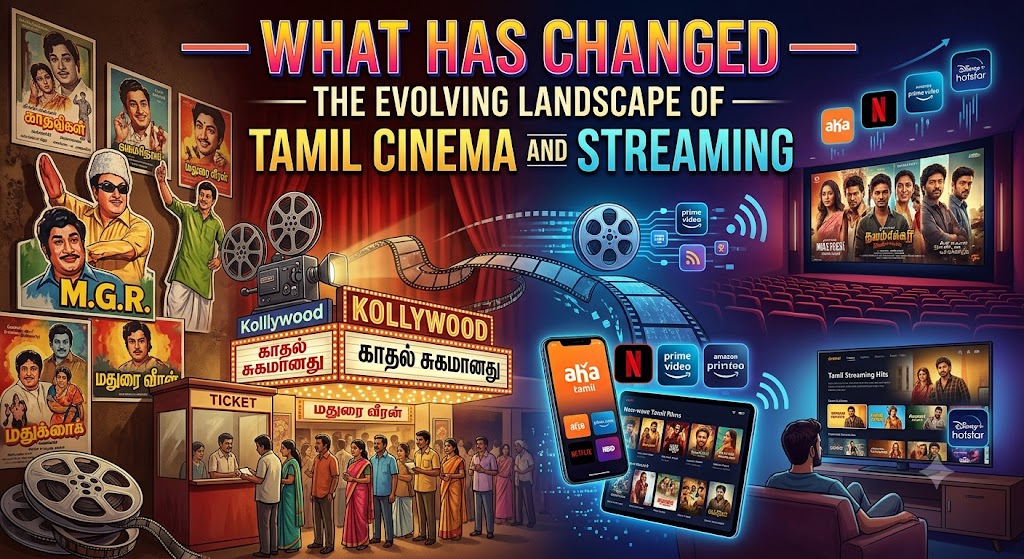
Something genuinely significant has shifted in the Tamil film ecosystem over the past five years, and TamilRockers’ impact on Tamil cinema must be understood in that evolving context.
The growth of OTT platforms in Tamil Nadu has been explosive. Sun NXT, the streaming arm of Sun TV Network, has deep roots and an enormous Tamil content library. Amazon Prime Video has made significant investments in original Tamil content, signing major stars and directors. Netflix has expanded its Tamil-language offerings substantially. Disney+ Hotstar combines Star’s existing Tamil content library with new originals.
For Tamil-speaking audiences globally — historically a primary TamilRockers demographic — legitimate Tamil movie streaming access is now genuinely comprehensive in a way it wasn’t in 2011 when TamilRockers first emerged. The access gap that partly drove early piracy demand has narrowed substantially.
Subscription prices for Indian streaming platforms remain relatively affordable by global standards — another deliberate strategy to compete with the zero-cost proposition of piracy. OTT vs piracy pricing has become a genuine competitive dynamic, with platforms occasionally offering theatrical-adjacent releases for premium one-time fees that still undercut the total cost of a cinema outing.
The Tamil film industry’s resilience in this environment has been remarkable. Despite years of piracy pressure, Tamil cinema has continued to produce major commercial and critical successes, expand internationally, and develop global fan bases — particularly for superstar-driven productions whose theatrical experience is considered irreplaceable by dedicated fans.
10. Lessons Learned — What TamilRockers Teaches Us About Digital Piracy
After more than a decade, lessons from TamilRockers for the film industry and policymakers are clearer than they’ve ever been — and they extend well beyond Tamil cinema to the global challenge of managing creative content in the digital age.
Enforcement without access creates demand. Every jurisdiction that has blocked TamilRockers without simultaneously improving legitimate Tamil content access has seen users simply route around the block. The lesson is structural: piracy is a service problem as much as a legal problem.
Speed matters more than price. Research consistently shows that piracy demand spikes in the hours after a theatrical release and before a streaming release. The theatrical-to-digital window — the gap between cinema release and legitimate digital availability — is the single most potent driver of piracy behavior for new releases. Shortening this window consistently reduces piracy, regardless of price.
Community matters. TamilRockers built loyal communities around shared cultural identity and passion for Tamil cinema. The most effective counter-strategies have similarly built community — fan clubs, streaming platform communities, social media engagement around legitimate releases — creating positive social reinforcement around legal viewing.
Technology will keep evolving. Every anti-piracy technology generates a counter-technology. Watermarks generate watermark-stripping tools. Blocks generate proxies. This arms race has no permanent winner on either side — which is why the most durable solutions are economic and social rather than purely technical.
The creators’ stories matter. The most effective anti-piracy campaigns have been those that humanize the impact — showing not corporate revenue graphs but the faces of the daily wage workers whose livelihoods depend on a film’s success. Anti-piracy awareness in India has been most persuasive when it connects piracy behavior to tangible human consequences.
Conclusion: A Mirror Held Up to the Digital Age
TamilRockers is, ultimately, a mirror. It reflects the gaps in legitimate content distribution, the economics of entertainment access, the limits of jurisdiction-specific law in a borderless internet, and the extraordinary demand for Tamil cinema globally. It reflects the ingenuity of those who built it, the frustration of the industry it targeted, and the complex motivations of the millions who used it.
The future of piracy and cinema will be written not just in courtrooms and cybercrime cells, but in streaming platform boardrooms, government policy offices, and the homes of film fans deciding whether to subscribe or search. The most effective answer to TamilRockers was always — and remains — making the legitimate alternative better, faster, cheaper, and more accessible than the illegal one.
That story is still being written. And for Tamil cinema — vibrant, global, and stubbornly resilient — it’s one worth following closely.