
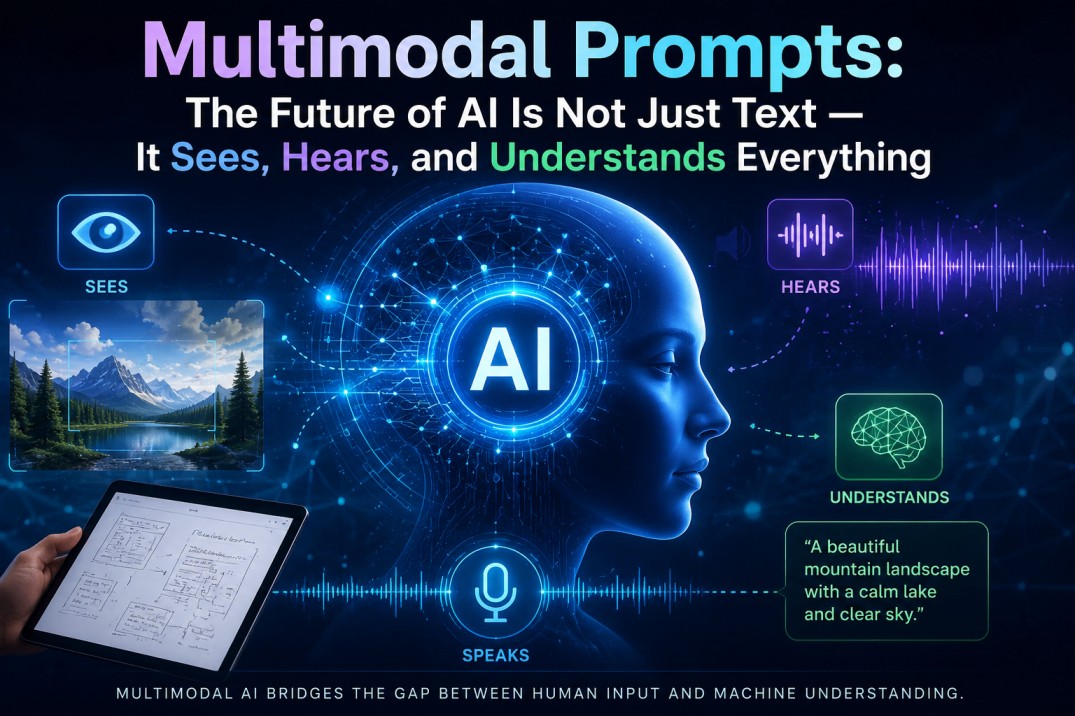
Why typing words into a chatbox is just the beginning — and how multimodal AI prompting is rewriting the rules of human-machine interaction
Multimodal prompts, multimodal AI, image and text AI prompting, multimodal large language models, AI that understands images and text — these are no longer buzzwords reserved for research papers and Silicon Valley keynotes. They are the beating heart of the next wave of artificial intelligence, and they are already changing how millions of people work, create, and communicate. If you’ve ever uploaded a photo to an AI tool and asked it a question, congratulations — you’ve already used a multimodal prompt. But what you’ve experienced so far is just the surface. The depth of what multimodal AI can do, how to prompt it effectively, and why it matters enormously for the future is a story worth telling in full.
1. What Are Multimodal Prompts? The Concept Explained Simply
Let’s start at the beginning, because multimodal prompting is one of those terms that sounds more complicated than it actually is.
A “prompt” in AI is simply the input you give a model — the instruction, question, or content you feed it to get a response. Traditionally, that input was text. You typed words; the AI responded with words. Simple, linear, one-dimensional.
Multimodal prompts break that single dimension wide open. The word “multimodal” comes from “multiple modes” — meaning multiple types of input. A multimodal prompt can combine text with images, audio, video, documents, code, structured data, or any combination of the above. You’re not just telling the AI what you need — you’re showing it, playing it, feeding it the full context of your world.
Think about how humans communicate. We don’t just use words. We point at things. We draw diagrams. We show photos. We play sounds. We gesture. Multimodal AI interaction mirrors this richness — it allows you to communicate with AI the way you naturally communicate with other humans.
The technical backbone of this is multimodal large language models (MLLMs) — AI systems trained not just on text, but on images, audio, and other data types simultaneously, learning the relationships between them. When you show such a model a photo of a broken pipe and ask “what’s wrong here?”, it draws on both its visual understanding and its knowledge of plumbing. That cross-modal reasoning is the magic.
2. The Different Modes: What Can You Feed a Multimodal AI?
Understanding types of multimodal AI input is the foundation of prompting effectively. Different models support different combinations, but here’s the full landscape of what’s possible today and what’s emerging tomorrow.
Text + Image is the most common and widely available combination. You provide an image (a photo, screenshot, diagram, chart, painting, document scan — anything visual) alongside a text instruction. This is the image-text AI prompt that most people have encountered. “Describe this image,” “what’s wrong in this photo,” “translate the text in this picture,” “analyze this chart” — all classic examples.
Text + Audio is a rapidly growing mode. You provide a voice recording, a music clip, a podcast excerpt, or ambient sound, and ask the AI to transcribe it, identify it, analyze its emotional tone, or summarize its content. Audio AI prompting is transforming accessibility tools, podcast workflows, and customer service automation.
Text + Video is the frontier that’s generating the most excitement. Feeding a video clip to an AI and asking it to summarize events, identify objects, track motion, or describe what’s happening frame by frame opens up possibilities in surveillance, education, sports analysis, and film production that simply didn’t exist before. Video understanding AI is still maturing but evolving at a breathtaking pace.
Text + Documents allows you to feed PDFs, spreadsheets, presentations, or scanned files to an AI and interact with them conversationally. Ask questions about a 200-page contract. Cross-reference data across multiple reports. Summarize a research paper. This is document intelligence AI and it’s already saving professionals thousands of hours.
Text + Structured Data means feeding tables, JSON files, databases, or code files alongside natural language instructions — asking the AI to analyze, clean, visualize, or reason over the data while you describe the goal in plain English.
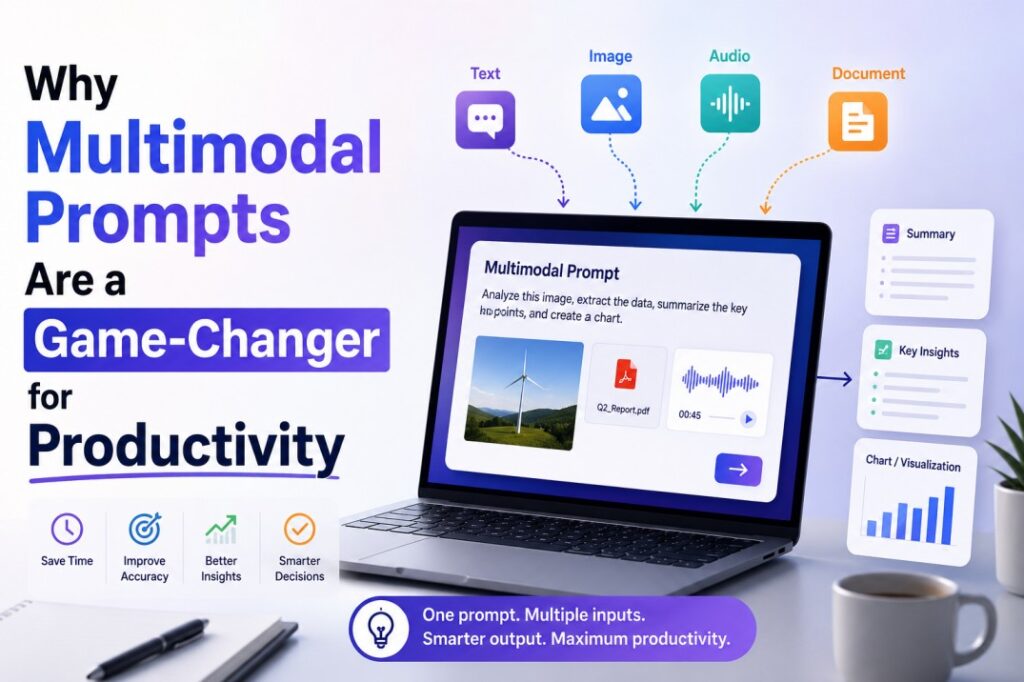
3. Why Multimodal Prompts Are a Game-Changer for Productivity
If text-only AI felt like having a brilliant colleague who worked blindfolded, multimodal AI for productivity is like giving that colleague their full senses back.
The productivity gains are concrete and measurable. A graphic designer can take a screenshot of a client’s existing brand materials, paste it into a multimodal AI, and say “create a new color palette that’s consistent with this aesthetic.” No need to describe the colors in words. No ambiguity. The AI sees what you see.
Multimodal prompting for business has transformed workflows across industries. A lawyer photographs a handwritten contract clause and asks the AI to type it up and flag any concerning language. A medical professional uploads an X-ray and asks for a differential diagnosis to review with their clinical judgment. An architect photographs a site and asks the AI to suggest preliminary design constraints based on visible structural and environmental factors.
The key insight is that visual context in AI prompts eliminates one of the most frustrating bottlenecks in human-AI collaboration: the translation problem. When you have to describe an image in words to give an AI context, you inevitably lose information. Nuance disappears. Details get omitted. But when you simply show the image, the full fidelity of the information transfers instantly.
For content creators, the gains are similarly dramatic. Upload a mood board and ask for a blog post that captures that aesthetic. Show a product photo and ask for five different caption styles. Feed a screenshot of a competitor’s landing page and ask for an analysis of their messaging strategy. AI content creation with images has become standard practice among top digital marketers.
4. How to Write Effective Multimodal Prompts — The Craft Behind the Ask
Knowing that you can use images and audio with AI is step one. Knowing how to prompt effectively across modalities is where most people get stuck — and where the real gains live. Effective multimodal prompting techniques are still being developed by the community in real time, but several best practices have emerged clearly.
Be specific about what you want the AI to focus on. When you upload an image, the AI sees everything — which means it needs guidance about where to direct its attention. “Describe this image” is weak. “Identify the three main objects in the foreground and describe their spatial relationship to each other” is strong. Precise visual AI prompts consistently outperform vague ones.
Combine modes deliberately, not casually. Don’t upload an image just because you can. Ask yourself: does this visual input add something my text alone can’t convey? If yes, include it. If you’re asking a general question that doesn’t depend on the specific image, text alone is faster and equally effective.
Set the context before the question. Tell the AI what kind of expert it should behave as before asking your visual question. “You are an experienced structural engineer. I’m going to show you a photo of a wall crack. Assess its severity and likely cause.” This role-based multimodal prompting consistently produces more authoritative and useful outputs.
Ask follow-up questions across modalities. One of the most underused techniques is iterative multimodal prompting — having a back-and-forth conversation about a single image or document. Upload a chart once, then ask five different questions about it across multiple turns. Ask it to reinterpret the same image from a different angle. Push the conversation deeper.
Use reference images for creative direction. Instead of describing a visual style in words (frustrating and imprecise), show an example of it. “Write a product description in this tone” paired with a screenshot of your favorite brand’s copy is far more effective than a paragraph trying to describe that tone abstractly.
5. Multimodal Prompts in Education — Learning That Actually Makes Sense
Education is perhaps the sector where multimodal AI in education is having its most profound early impact, and the reasons are intuitive: learning has always been multimodal.
Students have always learned better from diagrams alongside text, from demonstrations alongside explanations, from images alongside words. Yet traditional AI tutoring tools were entirely text-based, forcing a fundamentally visual, physical, and auditory learning experience into a narrow channel. Multimodal AI tutoring tears down that constraint.
A student can photograph a geometry problem from their textbook and ask for a step-by-step solution that references the specific diagram in the photo. A biology student can upload a cell diagram and ask “identify each labeled part and explain its function.” A history student can show an AI a photograph from the 1930s and ask it to place the image in historical context, describe what’s visible, and explain its significance.
Visual learning with AI prompts is particularly transformative for subjects that live in images — anatomy, astronomy, art history, geography, architecture, chemistry (molecular structures), and physics (force diagrams). These subjects have always been underserved by text-only tools. Multimodal AI finally gives them their native environment.
For language learners, multimodal prompts open remarkable new pathways. A learner can photograph a street sign, a menu, a billboard, or a handwritten note in a foreign language and ask for translation, pronunciation guidance, and cultural context simultaneously. Language learning with image AI makes the real world your textbook.

6. Multimodal AI in Healthcare — Seeing What Matters Most
Few applications of multimodal AI in healthcare carry more weight — or more responsibility — than medical imaging and clinical support. This is a domain where the stakes are literally life and death, and where visual information is irreplaceable.
Radiologists, dermatologists, pathologists, and other visual-specialist physicians have long relied on pattern recognition across enormous volumes of images. AI trained on millions of medical images — X-rays, MRIs, CT scans, dermoscopy images, histology slides — can now assist in identifying anomalies, flagging areas of concern, and providing probabilistic assessments for clinicians to evaluate.
Medical image AI analysis is not about replacing doctors. It’s about giving them a second pair of eyes that never gets tired, never misses a detail due to cognitive fatigue, and can cross-reference millions of prior cases in milliseconds. When a radiologist reviews an AI-flagged chest X-ray, they review the AI’s output as one input among many — but that input can catch things that might otherwise slip through.
Multimodal health AI prompts from patients themselves are also emerging. Someone photographs a skin condition and asks an AI for a preliminary assessment before deciding whether to book a doctor’s appointment. A caregiver photographs a medication label to confirm dosage instructions. A patient uploads a blood test result and asks for a plain-English explanation of each value.
The ethical guardrails are important — these tools should inform, not replace clinical judgment — but the access they provide to people without ready healthcare access is genuinely significant.
7. Creative Industries and Multimodal Prompting — Where Art Meets Algorithm
For designers, photographers, filmmakers, and artists, multimodal AI for creative work has opened a dimension that text-only AI simply couldn’t reach.
The most basic creative multimodal use is image analysis for design feedback. Upload your design, your logo, your layout, or your illustration, and ask for specific feedback: “Is the visual hierarchy effective?”, “Does the color contrast meet accessibility standards?”, “Does this composition feel balanced?” Getting instant, articulate feedback on visual work — without needing a human reviewer — is a significant creative accelerant.
Style transfer prompting takes this further. Show the AI an example of a visual style — a particular illustrator’s work, a specific photography aesthetic, a graphic design era — and ask it to describe the defining characteristics. Use that description to guide image generation tools. This bridges the gap between inspiration and execution.
Photographers use multimodal prompts to ask for editing suggestions based on uploaded photos. “What adjustments would improve this portrait?” yields specific guidance about lighting, color grading, cropping, and retouching. Photo editing guidance through AI is faster and more accessible than searching tutorials for every specific challenge.
Filmmakers and video editors have begun using video multimodal AI prompts to analyze footage — identifying pacing issues, suggesting cut points, analyzing color grading consistency across scenes, or flagging continuity errors. The workflow implications for post-production are enormous.
8. Multimodal Prompts for Business and Enterprise
The enterprise world has quietly become one of the biggest adopters of multimodal AI for business, for reasons that are deeply practical: businesses generate enormous volumes of non-text information, and most of it has been essentially invisible to AI until now.
Consider the volume of charts, graphs, infographics, presentations, scanned invoices, product photos, facility blueprints, equipment manuals, handwritten notes, and visual reports that flow through any mid-to-large organization. Text-only AI could analyze the descriptions of these materials. Enterprise multimodal AI can analyze the materials themselves.
Document processing with multimodal AI has transformed back-office operations. Scanned invoices can be read, validated, and processed without human data entry. Handwritten forms can be digitized and filed automatically. Blueprints and technical diagrams can be queried conversationally.
Retail businesses use product image AI analysis to manage inventory, check planogram compliance (whether products are placed correctly on shelves), analyze competitor product displays, and generate marketing copy from product photos automatically.
In manufacturing, multimodal AI is used for visual quality control — identifying defects, misalignments, or irregularities in products on production lines with a speed and consistency no human inspector can match.
Customer service is being transformed too. When customers submit support tickets with screenshots of errors or photos of damaged products, multimodal AI customer support systems can analyze the visual content, understand the problem, and generate appropriate responses or escalation decisions without human review of every case.
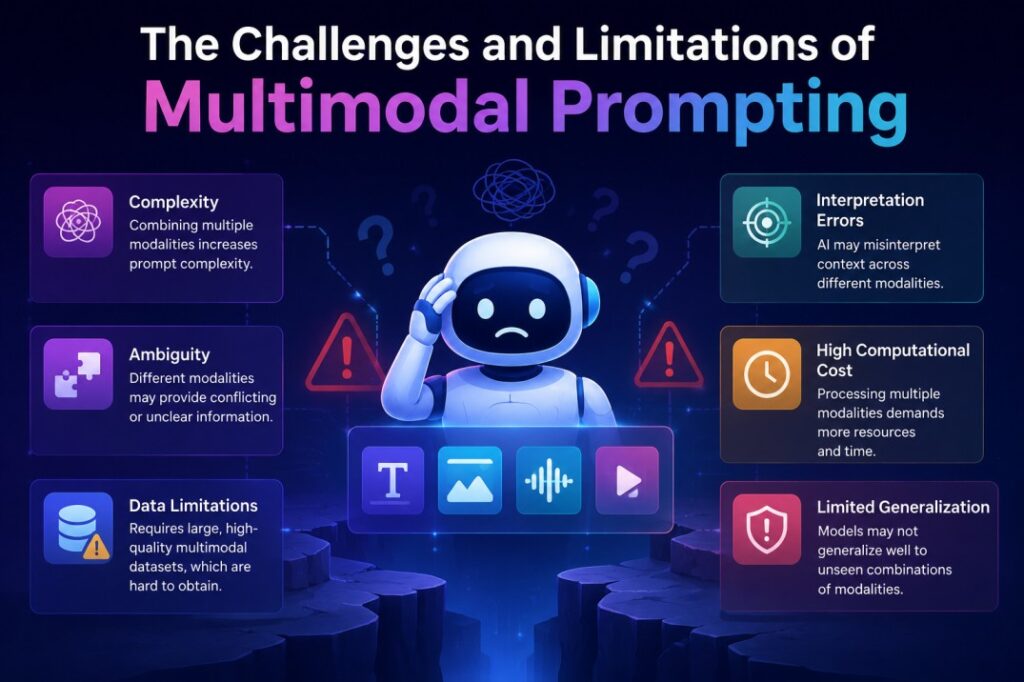
9. The Challenges and Limitations of Multimodal Prompting
No technology worth discussing is without its complications, and multimodal AI limitations are real and worth understanding clearly.
Hallucination extends to visual modalities. Just as text AI can confidently state incorrect facts, multimodal AI can misidentify objects, misread text in images, or make confident but wrong inferences from visual data. Multimodal AI accuracy varies significantly across tasks and models, and visual outputs always warrant verification for high-stakes applications.
Privacy concerns with image-based AI are significant. Uploading photos to AI systems means sharing visual data with those systems — raising questions about storage, usage, and potential for exposure. Sensitive images (medical scans, confidential documents, identifiable faces) require careful handling and an understanding of each platform’s data policies.
Bias in multimodal models is another serious concern. AI systems trained on visual data inherit the biases present in their training sets — underrepresentation of certain demographics, cultural artifacts in how objects and scenes are categorized, and performance disparities across different populations. Ethical multimodal AI use requires awareness of these limitations.
Cost and accessibility remain real barriers. Processing images and audio requires significantly more computational resources than text alone, which is reflected in pricing models. As the technology matures and costs decrease, this barrier will lower — but it remains a factor today.
10. The Future of Multimodal Prompting — What’s Coming Next
If what exists today feels impressive, the trajectory of future multimodal AI is almost difficult to comprehend from our current vantage point.
Real-time multimodal interaction is the near-term frontier. Rather than uploading static images or audio files, future systems will process live video feeds, real-time audio, and continuous sensor data — creating AI that can see and hear the world as it happens and respond instantly. Imagine an AI that watches your cooking via webcam and gives you real-time guidance. Or one that listens to a meeting and surfaces relevant information as topics arise.
Embodied multimodal AI — AI integrated into robots and physical systems — will take multimodal prompting out of screens entirely. The robot that sees an object, understands its function, and responds to natural language instructions about what to do with it is no longer science fiction.
Cross-modal generation is expanding rapidly. Today’s AI can receive multiple modes as input. Tomorrow’s will generate across multiple modes simultaneously — producing a report that automatically includes relevant charts, a presentation that matches spoken narration to generated visuals, or an educational module that produces text, images, and audio in a single, coherent package.
The multimodal AI future is one where the interface between human intention and machine execution becomes as rich, natural, and frictionless as human-to-human communication. We’re not there yet. But we are closer than most people realize.
Conclusion: Prompting in Full Color
Text-only AI was always a grayscale version of what’s possible. Multimodal AI prompting is the full-color edition — richer, faster, more intuitive, and dramatically more powerful. Whether you’re a student photographing a math problem, a doctor reviewing a scan, a designer seeking feedback on a layout, or a business analyst trying to make sense of a wall of charts, multimodal prompts give you a tool that finally meets you where your work actually lives.
The key is learning to think in modes. Ask yourself not just what you want to communicate to the AI, but how — which combination of text, image, audio, or document best captures the full context of your question. The richer your input, the richer your output.
The era of advanced multimodal prompting is here. The only question is how creatively you’ll use it.