
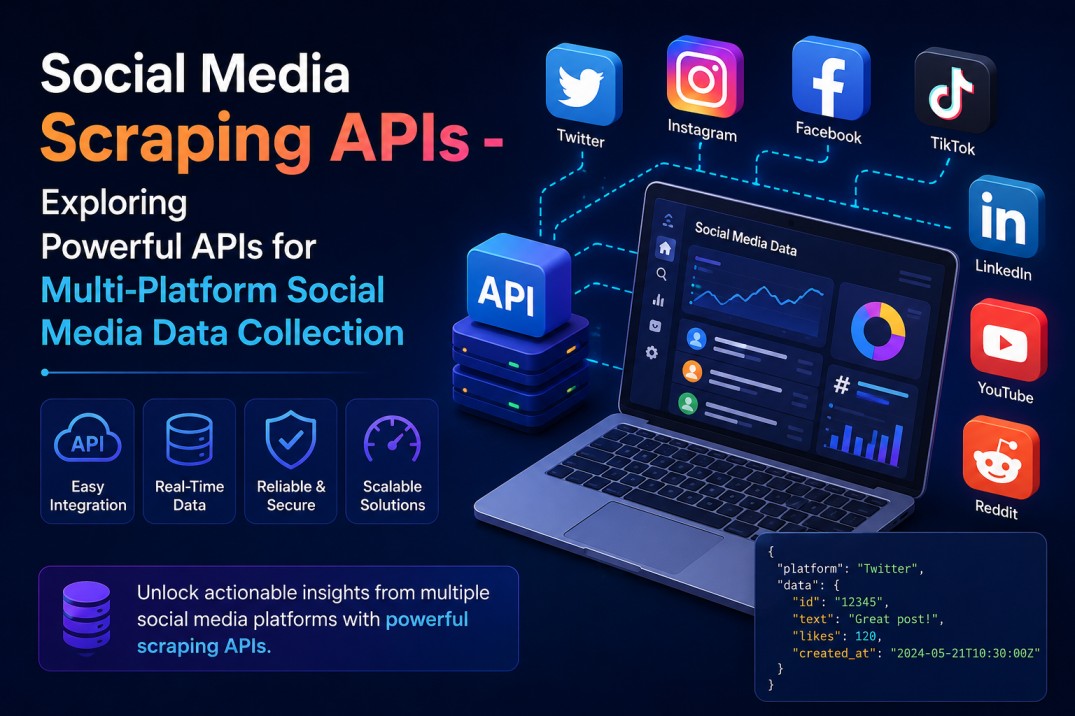
Social media platforms generate vast amounts of information through public posts, videos, captions, hashtags, comments, and engagement activity. For businesses, researchers, and marketing professionals, collecting this information across multiple platforms can provide a broader understanding of audience interests and online discussions. Social Media Scraping APIs offer a structured way to retrieve supported public data, helping organizations automate collection tasks, organize information, and prepare it for analysis. By bringing data from different social environments into a consistent workflow, these APIs can make research more manageable and improve the efficiency of social media analysis.
As organizations expand their digital activities, their research requirements often become more complex. They may need to examine different content formats, monitor several topics, or compare public discussions across multiple platforms. A well-planned API-based approach can support these activities while reducing repetitive manual work.
Understanding Multi-Platform Social Media Data Collection
Multi-platform data collection involves gathering selected information from more than one social media environment. Each platform has its own content formats, access conditions, technical structure, and available data fields.
For example, one platform may focus primarily on short-form videos, while another may feature image-based posts, longer discussions, or professional updates. These differences influence how information is collected and analyzed.
Scraping APIs provide interfaces that allow applications to request supported information from accessible sources. Depending on the platform and available permissions, collected fields may include public captions, post dates, hashtags, content links, profile details, and visible engagement figures.
The retrieved information can then be organized in a central data environment. This makes it easier to examine different content sources without managing every collection process separately.
Reducing Manual Collection Across Platforms
Collecting information manually from several social media platforms can require considerable time. Researchers may need to open individual posts, record captions, note publication dates, and organize engagement information in separate documents.
The workload increases when research needs to be repeated regularly or expanded to cover additional subjects. Manual processes can also introduce inconsistent formatting, duplicate entries, and missing details.
An API-based workflow can automate supported retrieval activities through predefined requests. Users can specify relevant keywords, hashtags, public profiles, or content categories, depending on the capabilities of each source.
Automation helps reduce repetitive work and gives teams more time to evaluate the collected information. It also makes recurring research easier because established collection configurations can be reused where appropriate.
Combining Data from Different Social Platforms
One of the main advantages of a multi-platform approach is the ability to examine related conversations across different online environments.
For example, a business researching a product category may find public discussions through video content, image-based posts, and text-focused conversations. Each format may reveal a different aspect of audience interest.
A central collection system can store available information from supported sources using a common internal structure. Fields such as publication date, content category, source platform, public URL, and available engagement figures can help standardize records.
However, standardization should not remove important differences between platforms. Engagement metrics may be calculated or displayed differently, and content formats may not be directly comparable. Preserving source information helps analysts interpret each dataset accurately.
Supporting Audience and Market Research
Social media conversations can provide useful indications of audience interests, frequently discussed subjects, and common questions. Collecting public information across several platforms can give researchers a wider view of these discussions.
For example, a business studying consumer technology may examine public posts about product features, demonstrations, and everyday experiences. Comparing different content environments may reveal which subjects appear consistently and where particular discussions are more prominent.
Market research can also help identify information gaps. If audiences repeatedly ask similar questions, businesses may consider providing clearer explanations or educational content.
These findings should be treated as research indicators rather than definitive evidence of customer preferences. Social media users do not necessarily represent an entire market, so conclusions should be considered alongside other relevant information.
Identifying Trends Across Multiple Platforms
Trends may appear differently depending on the social media environment. A subject might become popular through short-form videos before generating broader discussions elsewhere. Monitoring selected public information across platforms can help researchers observe these developments.
APIs that support recurring collection can help gather information at consistent intervals. Researchers can compare keywords, hashtags, content categories, and publication patterns over time.
For instance, a business in the travel industry may monitor public discussions about destinations, travel activities, and seasonal experiences. Reviewing information from different platforms can help identify recurring interests and changes in the topics being discussed.
Trend analysis requires suitable timeframes and careful interpretation. A temporary increase in posts may reflect a short-lived event rather than a lasting change in audience interest.
Organizing Large Volumes of Social Media Data
Collecting information from multiple sources can create large datasets. Without a consistent organization method, records may become difficult to locate, compare, and maintain.
A structured database can help manage information by using fields such as source platform, content type, publication date, topic, and public content link. This allows analysts to filter records and retrieve relevant information more efficiently.
Data cleaning is also essential. Collection processes may produce duplicate posts, missing fields, inconsistent timestamps, or irrelevant results. Reviewing these issues improves the reliability of the dataset.
Organizations should also consider how long information needs to be stored and which records remain useful for the research purpose. Clear retention procedures can prevent unnecessary data accumulation and make storage management easier.
Integrating APIs with Analytical Tools
Multi-platform data collection becomes more useful when the resulting information connects with existing analytical systems.
Depending on technical capabilities, API responses can be transferred to spreadsheets, databases, reporting dashboards, or internal applications. This creates a more organized flow between collection and analysis.
For example, a marketing team may store public content from several platforms in a central database. Analytical tools can then help compare recurring topics, content formats, and available engagement indicators.
Automated reporting can also support recurring research. Teams may generate periodic summaries and examine how public discussions change over time.
A reliable integration process should include response validation, error handling, and appropriate access controls. These measures help maintain data consistency and prevent incomplete information from being treated as a complete result.
Choosing Suitable Social Media Scraping APIs
Selecting suitable APIs requires an understanding of the project’s objectives and technical requirements. Not every API supports the same platforms, fields, or collection methods.
Organizations should review supported sources, available information, response formats, request limits, authentication requirements, and documentation. They should also consider whether the API can support the expected collection volume.
Consistent response structures can simplify integration, but differences between platforms may require separate processing rules. Testing a small collection before expanding the workflow can help identify technical limitations and improve configuration.
Reliability also involves monitoring failed requests, handling unavailable records, and maintaining clear collection logs. These practices help teams understand the quality and completeness of their datasets.
Maintaining Responsible Data Collection Practices
Multi-platform collection requires careful attention to privacy, platform policies, and applicable legal requirements. Public visibility does not automatically permit unrestricted data collection, storage, or reuse.
Organizations should review the terms and access conditions of each platform before beginning a project. They should collect only information they are permitted to access and that is necessary for a defined purpose.
Private profiles, restricted content, and information requiring unauthorized access should not be targeted. Stored records should also be protected through appropriate security measures, access controls, and retention policies.
Where possible, aggregated or anonymized findings can reduce unnecessary exposure of individual users. Respecting platform limits and privacy requirements supports responsible and sustainable research.
Conclusion
Social media scraping APIs provide a structured approach to collecting supported public information across multiple platforms. They can reduce manual work, organize different content formats, and connect collected records with analytical systems.
Their effectiveness depends on choosing suitable sources, maintaining consistent data structures, validating results, and interpreting platform differences carefully. When combined with clear research objectives and responsible collection practices, multi-platform data extraction can help businesses and researchers understand online discussions, identify emerging topics, and make more informed decisions.