
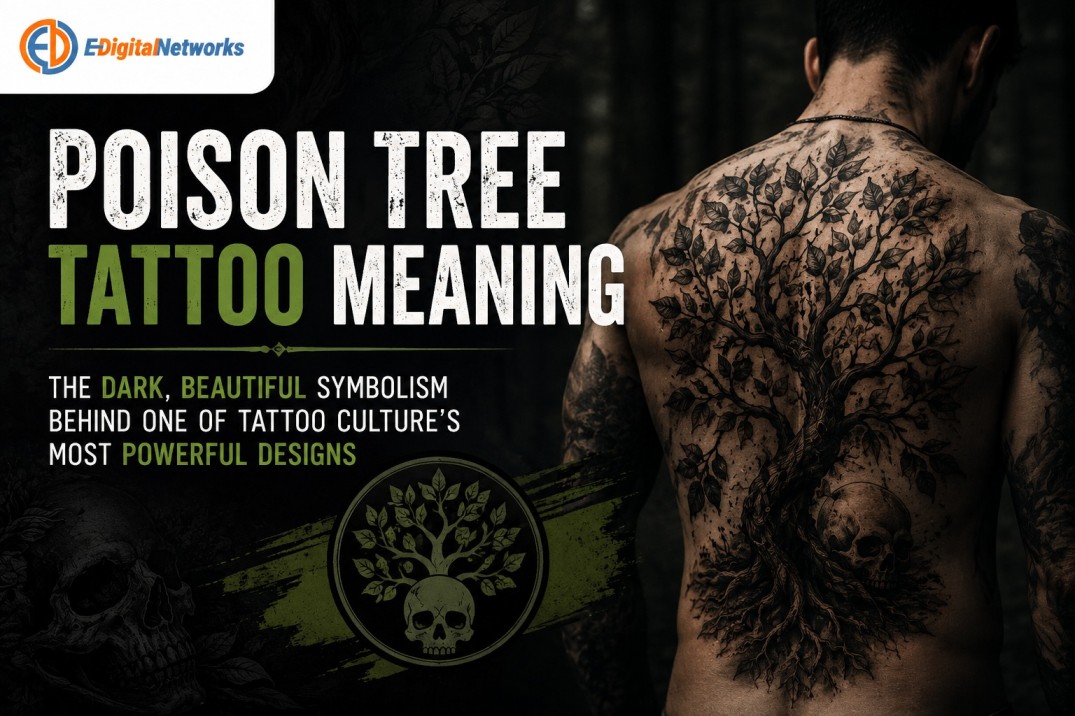
There is something undeniably magnetic about a tattoo that makes people stop and ask questions. The poison tree tattoo, poison tree tattoo meaning, what does a poison tree tattoo mean, dark tree tattoo symbolism, William Blake tattoo designs, and tree of anger tattoo are searches that have been climbing steadily, and for good reason. This is not just a tattoo trend. It is a deeply layered piece of wearable art rooted in one of the most emotionally resonant poems in the English language. Whether you are considering getting one yourself, trying to decode what someone else’s ink means, or simply drawn to the fascinating intersection of literature and body art, this complete guide unpacks every layer of meaning, history, design variation, and symbolic weight behind the poison tree tattoo.
1. The Origin Story: William Blake’s “A Poison Tree” and Why It Became a Tattoo Icon
To truly understand the poison tree tattoo, you have to start where the symbol was born: on the page, not the skin.
“A Poison Tree” is a short but devastating poem written by William Blake, published in 1794 as part of his collection “Songs of Experience.” Blake was one of the most visionary and unconventional poets and artists of his era, a man who wrote with equal intensity about innocence, corruption, spiritual freedom, and human darkness. “A Poison Tree” is four stanzas long and tells a deceptively simple story. The speaker is angry at a friend, tells the friend about it, and the anger dissolves. But the speaker is also angry at a foe, conceals that anger, nurses it privately with fears and tears, and the anger grows into something poisonous. Eventually the anger produces a bright, shining apple. The foe steals the apple, eats it, and is found dead beneath the tree at dawn.
The poem is a clinical, almost cold-blooded study of what happens when anger is suppressed rather than confronted. It does not celebrate vengeance. It does not apologize for it either. It simply observes, with devastating clarity, the natural growth of hidden resentment into something lethal.
This is the symbolic core that poison tree tattoos draw from. The tattoo is not just a pretty dark tree design. It carries within it an entire philosophy about emotion, honesty, suppression, and consequence. That intellectual and emotional weight is exactly why it resonates so deeply with people who choose to wear it permanently on their skin.
2. What Does a Poison Tree Tattoo Mean? The Core Symbolism Explained
The poison tree tattoo meaning is not singular. Like all truly powerful symbols, it holds multiple layers of interpretation, and different people connect with different aspects of what it represents.
At its most fundamental level, the poison tree tattoo is a symbol of suppressed anger and the consequences of emotional concealment. The tree in Blake’s poem grows from unexpressed wrath. Every time the speaker hides their fury, waters it with tears, and tends it with fears and deceit, the tree grows taller and more toxic. For many people who wear this tattoo, it is an acknowledgment of their own capacity to harbour darkness when they feel unable or unwilling to speak their truth.
It is also widely interpreted as a symbol of betrayal. The apple that grows from the poison tree is deceptively beautiful. It is bright, appealing, and ultimately deadly. People who have been betrayed, or who have themselves been the source of betrayal in complex interpersonal dynamics, sometimes choose this tattoo as a way of marking that experience permanently. It captures the seductive danger of something that appears good on the surface but carries poison within.
Transformation and consequence is another core layer of meaning. The tree does not begin poisonous. It becomes poisonous through a specific process of emotional neglect and concealment. This transformation narrative resonates with people who have been through experiences that changed them, perhaps from open and trusting to guarded and defensive, or from innocent to aware of human complexity in harder ways.
Some wearers interpret the poison tree tattoo meaning through the lens of personal power. There is a quiet, unsettling power in Blake’s speaker. They tend their anger deliberately, patiently, and with dark purpose. For people who have felt powerless in situations of conflict or abuse, this symbol of quietly growing inner strength, however dark its nature, carries a kind of defiant energy.
Duality and contradiction are also central themes. The tree is beautiful and deadly. The apple is bright and poisonous. The growth process mirrors acts of care: watering, sunlight, tending. Poison tree tattoos speak to the human capacity to hold contradictions within ourselves, to be loving and capable of harm, to be wounded and dangerous simultaneously.
3. Design Elements: What a Poison Tree Tattoo Actually Looks Like
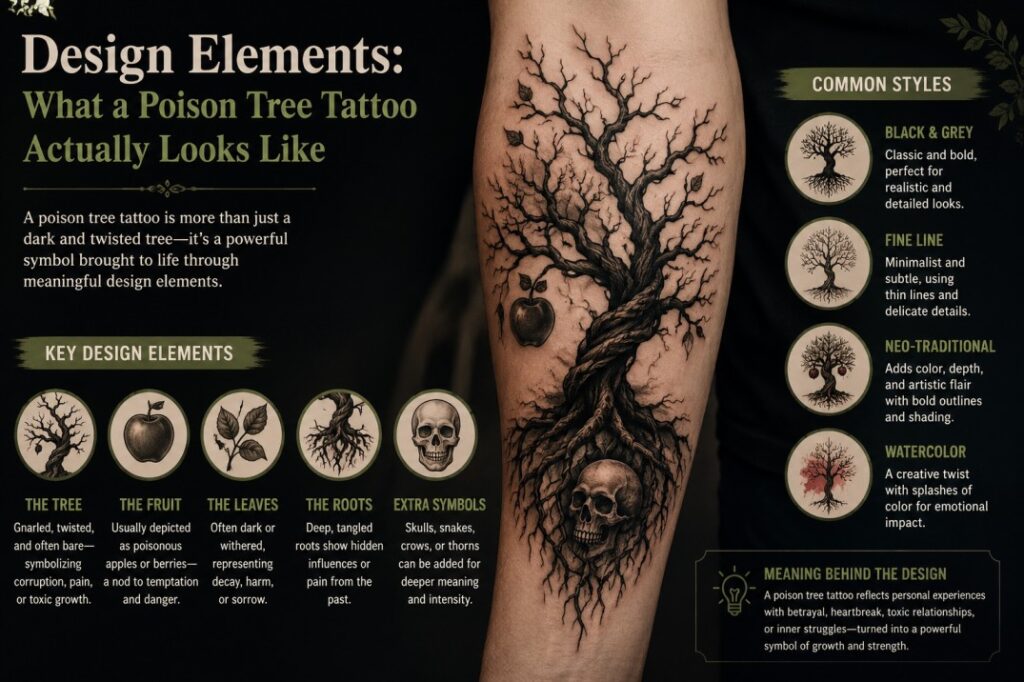
Understanding the symbolism is one dimension. Understanding the visual language of poison tree tattoo designs is another, because the way this tattoo looks varies enormously depending on the artist and the wearer’s intentions.
The tree itself is the centrepiece and comes in many forms. Some designs feature a dramatically bare, twisted tree with gnarled branches reaching upward like dark fingers against a pale background. This version emphasizes desolation, raw emotional exposure, and the skeletal quality of something stripped of life’s comforting disguises. Dark tree tattoo designs of this style often sit beautifully in black and grey ink with strong contrast and fine line detail.
Other designs show the tree in full, lush growth with dark foliage, capturing the idea that the poison tree is not obviously malevolent in appearance. It looks like any other tree. It is only the fruit it bears that reveals its nature. This version carries the symbolism of concealed danger more directly.
The apple is a design element that many choose to include, and its treatment is often the most symbolically loaded decision in the composition. A bright red apple glowing among dark branches creates a jarring, beautiful contrast that perfectly captures the poem’s central image. Some artists render the apple as partially bitten, or as decaying despite its outward brightness. Others show it fallen to the ground beside an implied figure.
Roots are another powerful design element. Deeply rendered root systems spreading beneath the tree add a layer of meaning around what lies beneath the surface, the hidden emotional material that feeds the tree’s dark growth. Root-heavy compositions often appeal to people whose connection to the tattoo is about acknowledging what they carry beneath their composed exterior.
Poison tree tattoo placement also shapes the design significantly. Full back pieces allow for sprawling compositions where the tree spans the entire canvas, roots at the lower back and branches reaching toward the shoulders. Sleeve designs wrap the tree around the arm, which can make the branches appear to encircle the wearer. Forearm and shin placements work well for more contained compositions with strong vertical orientation. Rib and chest placements are chosen by people who want the tattoo close to the heart or hidden under clothing, which itself adds a layer of thematic resonance given the poem’s theme of concealment.
4. Color vs. Black and Grey: Which Style Suits a Poison Tree Tattoo Best
Poison tree tattoo styles break broadly into two camps when it comes to color approach, and each creates a distinctly different emotional effect.
Black and grey poison tree tattoos dominate the genre, and for good reason. The poem’s emotional register is dark, complex, and largely devoid of warmth. Black and grey ink renders the tree with a stark, timeless quality that suits the subject matter perfectly. Fine line black and grey work can capture the intricate detail of bark texture, the delicate spread of bare branches, and the deep shadows of dense foliage with a realism that feels almost haunting in the best possible sense.
Neo-traditional and illustrative styles bring a slightly more stylized quality that can add an artistic, almost storybook dimension to the design. This suits wearers who want to reference the poem’s origins as a piece of literary art rather than purely personal emotional symbolism.
Colour poison tree tattoos make a powerful statement when the apple is rendered in vivid red against otherwise dark or monochromatic ink. This technique creates a visual focal point that is impossible to ignore, drawing the eye directly to the poisoned fruit and making the contrast between beauty and danger undeniable. Some artists go further, adding subtle purples and dark greens to the foliage to suggest something lush but slightly unnatural.
Blackwork and dark illustration styles push the design into more graphic, high-contrast territory that emphasizes the tattoo’s connection to darkness, occult aesthetics, and Gothic art traditions. These designs tend to feel bold and declarative, worn by people who want their tattoo to command attention immediately.
5. Poison Tree Tattoos and Their Connection to Gothic and Dark Art Traditions
The poison tree tattoo does not exist in a vacuum. It sits at the intersection of several rich aesthetic and cultural traditions that collectively explain its powerful draw for a particular type of tattoo enthusiast.
Gothic tattoo symbolism has always been interested in the dark and the beautiful, the decaying and the sublime. Dead trees, dark forests, ravens, skulls, and imagery of natural things rendered sinister have been Gothic tattoo staples for decades. The poison tree fits seamlessly into this tradition while elevating it with genuine literary provenance.
William Blake himself was deeply engaged with visionary, mystical, and dark artistic territory. His illuminated manuscripts combined text and image in ways that were radical for his time, and the visual tradition he established has influenced generations of artists working in dark and fantastical modes. Tattoo artists who work in illustrative and neo-traditional styles frequently cite Blake as an influence, making William Blake tattoo designs a natural and growing subcategory of literary tattooing.
Dark romanticism as an artistic movement is another relevant context. Dark romanticism explored the psychological, the irrational, and the morally ambiguous in ways that mainstream romanticism shied away from. Edgar Allan Poe, Nathaniel Hawthorne, and Herman Melville in literature, and a parallel tradition in visual art, all explored how darkness and beauty coexist in human experience. Poison tree tattoos belong in this lineage.
The forbidden knowledge symbol is a related tradition worth noting. The apple in Blake’s poem echoes the apple of Eden, the fruit of forbidden knowledge that carries both enlightenment and consequence. This biblical resonance gives the poison tree tattoo an additional symbolic layer for people drawn to themes of knowledge, temptation, and the price of awareness.
6. Who Gets a Poison Tree Tattoo? The People Behind the Ink
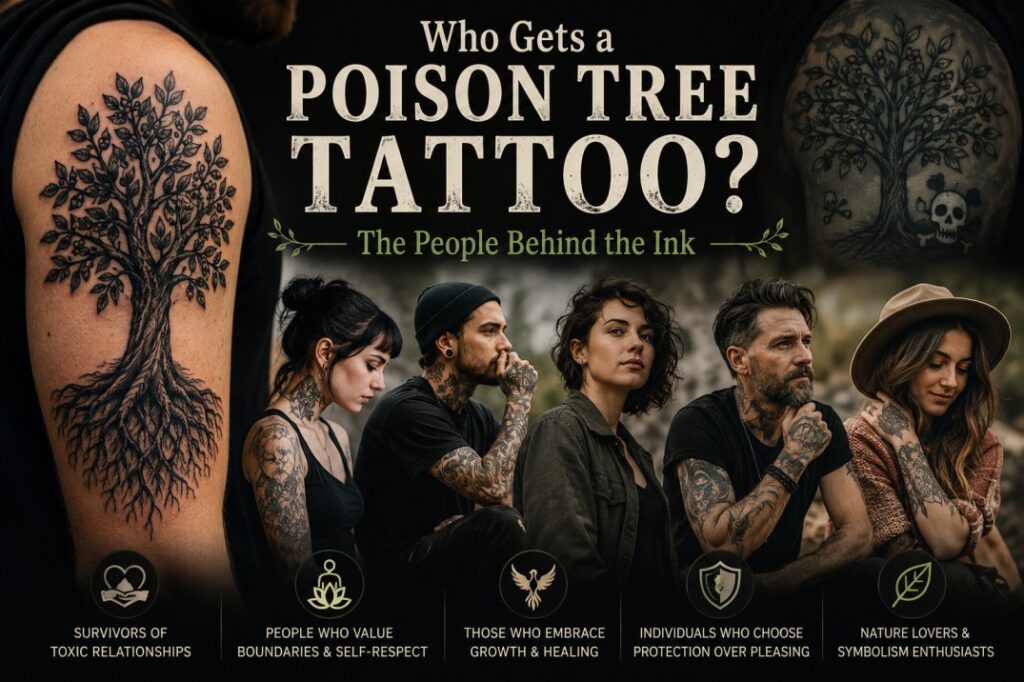
Understanding who gets poison tree tattoos reveals a great deal about the depth of meaning people attach to this design and the diverse range of personal experiences it encapsulates.
Survivors of toxic relationships are among the most common groups drawn to this tattoo. The imagery of something beautiful and nurturing revealed as poisonous speaks directly to the experience of loving or trusting someone who ultimately caused harm. The tattoo becomes a marker of that experience, a reminder to recognize the signs of concealed poison in future, and often a symbol of having survived.
People who struggle with anger management or suppressed emotions find in the poison tree a mirror for their internal experience. Rather than glorifying that anger, the tattoo often functions as a honest reckoning, an acknowledgment of what lives inside them and a commitment to understanding it rather than continuing to hide it. In this reading, the tattoo is actually an act of emotional honesty.
Literary tattoo enthusiasts choose it for its connection to Blake’s poetry and the broader tradition of wearing literature on the body. For readers and writers, a poison tree tattoo is an immediate signal to other literature lovers, a line of communication written in ink that says something specific about the books and ideas that have shaped you.
Artists, musicians, and creative people drawn to dark themes find the aesthetic perfectly aligned with their artistic sensibilities. The tree’s visual drama, its layered symbolism, and its connection to one of art history’s great visionaries make it a particularly resonant choice for creatively inclined individuals.
People marking periods of personal transformation choose it to commemorate a before-and-after point in their lives. The transformation in Blake’s poem, from expressed anger to concealed poison to ultimate consequence, maps onto many kinds of personal journeys through grief, loss, and change.
7. Placement Guide: Where to Put a Poison Tree Tattoo on Your Body
Poison tree tattoo placement is a decision that interacts meaningfully with the tattoo’s symbolism, and giving it genuine thought produces more satisfying results than simply asking for the design wherever there is space.
The back is the most expansive and dramatic option. A full back poison tree can incorporate everything: deep roots, a towering trunk, spreading branches, and the apple rendered in exquisite detail somewhere in the composition. The back is also a private placement, hidden under clothing, which aligns with the poem’s theme of concealment. You carry the tree with you invisibly until you choose to reveal it.
Forearm placements make the tattoo more visible and therefore more of a public statement. People who choose forearm placements for their poison tree tattoo are generally comfortable discussing its meaning and want the tattoo to be part of their visible identity rather than a private symbol.
The chest placement, particularly over or near the heart, carries obvious emotional resonance for a tattoo about anger, betrayal, and hidden emotional growth. Many wearers who choose chest placements describe wanting the tree to be literally close to the seat of feeling.
Rib placements are painful but private, chosen by people who want an intimate relationship with their tattoo that is not on public display. The rib cage’s natural curvature can actually enhance a vertical tree design beautifully.
Leg placements, including shin and thigh, work well for medium to large compositions and offer a canvas that allows for root systems to be fully rendered at the lower end of the design. The thigh in particular offers generous space for detailed compositions.
Smaller, more minimal poison tree tattoo designs work on wrists, ankles, and behind the ear for people who want the symbol without the scale.
8. Pairing Symbols: What Works Well with a Poison Tree Tattoo
Most tattoos do not exist in isolation. For people building larger compositions or sleeve designs, understanding what pairs well with a poison tree tattoo is essential for creating a visually and symbolically coherent piece.
The apple is the most natural companion, either incorporated into the tree design itself or as a separate element. A fallen apple, a bitten apple, or an apple with a worm or serpent emerging from it all extend the symbolism in meaningful directions.
The raven or crow pairs beautifully with a dark tree design and carries its own rich symbolism around wisdom, death, and the liminal space between worlds. A raven perched in the branches of a poison tree creates a composition that feels literary, dark, and visually striking.
Hourglass imagery combined with a poison tree speaks to the patience required to nurture hidden anger to its full toxic potential, the passage of time as a slow poison in itself.
Blake’s own artwork and text elements offer direct literary pairing. Excerpts from “A Poison Tree” itself rendered in calligraphic script alongside the tree design is a choice that combines the visual and the verbal in the tradition of Blake’s own illuminated manuscripts.
Skull and botanical combinations situate the poison tree within a broader memento mori tradition, reminding the wearer and viewer that beauty and death are perpetual companions.
Thorns integrated into the tree’s bark or branches extend the symbolism naturally, because thorns appear beautiful on a rose but exist to wound. The contradiction of beauty and pain that thorns embody maps perfectly onto the poison tree’s central themes.
Moon phases combined with a dark tree create a nocturnal, mystical atmosphere that emphasizes the hidden, night-blooming quality of the poem’s imagery.
9. Talking to Your Tattoo Artist: How to Brief a Poison Tree Design
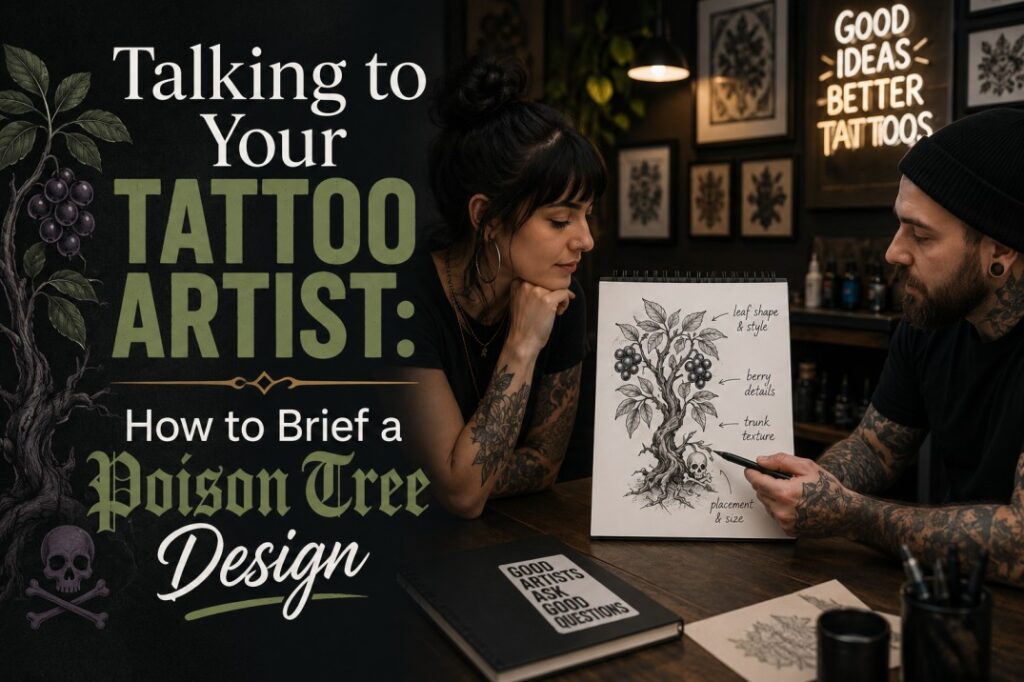
Getting a poison tree tattoo that truly satisfies requires a thoughtful briefing conversation with your chosen artist. The design’s complexity and symbolic depth reward a detailed discussion rather than a brief reference image and a vague direction.
Start with the emotional meaning you want the tattoo to carry for you personally. The clearer you are about which aspect of the poison tree symbolism resonates most, whether it is suppressed anger, betrayal, personal transformation, or literary connection, the better your artist can make visual decisions that serve that intention.
Reference images matter, but use them as directional rather than prescriptive. Show your artist examples of dark tree designs you admire, but be explicit that you want their interpretation rather than an exact copy of someone else’s work. The best poison tree tattoo artists will bring their own creative lens to the reference material.
Discuss whether you want the apple included and if so, how you want it treated. This is often the decision that most significantly shapes the overall tone of the piece.
Have an honest conversation about scale and placement before finalizing the design. Tattoo sizing for tree designs matters because the fine detail work that makes a poison tree compelling can get lost if the tattoo is too small for the level of detail you want. A skilled artist will advise you honestly about minimum size requirements for specific elements.
Ask to see a sketch or digital mockup before committing to the needle. Reputable artists who take pride in custom work will offer this as standard practice. Never sit for a tattoo of this complexity without seeing an approximation of the final design first.
10. Aftercare and Long-Term Care for a Poison Tree Tattoo
Investing in a meaningful, complex piece of ink requires equal investment in proper tattoo aftercare to ensure the design remains crisp, vibrant, and exactly as intended for years to come.
In the first week, your tattoo is essentially an open wound and should be treated with appropriate care. Keep it clean with gentle, fragrance-free soap and warm water. Apply a thin layer of recommended aftercare ointment or lotion to keep the skin moisturised and support healing. Avoid submerging in pools, hot tubs, or open water during this period.
Tattoo healing for dark ink designs typically takes two to four weeks for the surface skin to heal fully, though deeper skin layers continue healing for up to three months. During this period, peeling and light scabbing are normal. Do not pick or scratch at peeling skin, as doing so can pull ink out of the design and create patchy areas that require touch-up work.
Sun protection is critical for long-term tattoo preservation. UV exposure is the primary cause of tattoo fading and distortion over time. Apply high SPF sunscreen to your healed poison tree tattoo whenever it is exposed to sun, and consider UV-protective clothing for extended outdoor exposure.
Moisturising regularly with a fragrance-free lotion keeps the skin supple and helps maintain the clarity of fine line detail work. Well-moisturised skin holds tattoo ink significantly better than dry, stressed skin.
Touch-up sessions should be expected for detailed pieces. Even with perfect aftercare, some areas of a complex composition may need a touch-up visit after six to twelve months. This is normal and not a reflection of poor initial work. Building a relationship with your artist that includes touch-up sessions as part of the process sets realistic expectations.
Frequently Asked Questions About Poison Tree Tattoos
What is the main meaning of a poison tree tattoo?
The core meaning centres on suppressed anger, emotional concealment, betrayal, and the dark consequences that grow from unaddressed negative emotions, drawn from William Blake’s 1794 poem of the same name.
Is a poison tree tattoo a negative symbol?
Not necessarily. While it draws from dark themes, many wearers interpret it as a symbol of self-awareness, personal transformation, survival, and the honest acknowledgment of human emotional complexity rather than a purely negative statement.
Does a poison tree tattoo always reference Blake’s poem?
Not always. Some wearers are drawn purely to the visual aesthetic of dark tree imagery without specific literary intent. However, the symbolic depth of the design is significantly enriched by the poem’s context.
How long does a poison tree tattoo take to complete?
Depending on size and complexity, a detailed poison tree tattoo can take anywhere from two hours for a smaller, simpler design to multiple sessions of four to six hours each for a large back or sleeve piece.
Where is the best placement for a poison tree tattoo?
The back offers the most space for elaborate compositions. The forearm is ideal for people who want the tattoo visible. Chest and rib placements suit those who want a more intimate, private relationship with the design.
Can a poison tree tattoo be combined with other literary tattoos?
Absolutely. Blake’s broader body of work offers rich companion imagery, and other dark literary sources including Poe, Shakespeare, and Byron pair naturally with the poison tree’s aesthetic and thematic territory.