
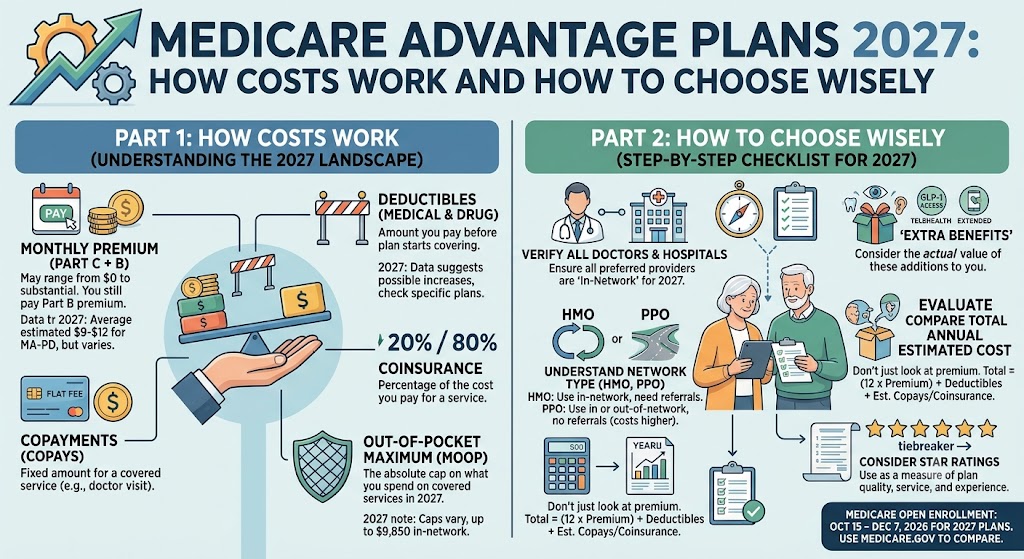
Understanding how your healthcare dollars are spent can feel more complicated than it should be, especially when comparing options during open enrollment. For those evaluating Medicare Advantage Plans 2027, knowing how the different cost components interact is just as important as comparing covered services. This guide breaks down the core cost structure in plain language and walks through a practical approach to selecting a plan that fits your health needs and budget priorities.
Rather than listing dollar figures that change year to year and vary by plan and region, this article focuses on the underlying concepts so you can confidently evaluate any plan brochure or summary of benefits you receive. Once you understand what each cost term actually means and how the pieces fit together, comparing plans becomes far less intimidating.
What Is a Premium and Why Does It Matter?
A premium is the recurring payment you make to keep your Medicare Advantage plan active, typically billed on a monthly basis. Think of it as the price of admission to the plan’s network and benefit structure. Some Medicare Advantage plans are structured with very low or no separate premium beyond what you already pay for Medicare Part B, while others charge an additional amount in exchange for broader coverage or extra benefits.
It’s tempting to assume that the plan with the lowest premium is automatically the best deal, but that’s not always true. A lower premium might come with higher costs elsewhere, such as larger copayments for specialist visits or a higher out-of-pocket limit. The premium is just one piece of the puzzle, and it should always be weighed against the full picture of what you’ll pay when you actually use care.
How Does a Deductible Work in a Medicare Advantage Plan?
A deductible is the amount you’re responsible for paying out of your own pocket before your plan begins sharing costs for certain services. Not every Medicare Advantage plan includes a deductible, and some apply deductibles only to specific categories of care, such as prescription drugs, rather than to all medical services.
Once you’ve met your deductible for the year, your plan typically starts covering a larger portion of your costs for covered services. This is why understanding whether a plan has a deductible, and what it applies to, is an essential step before enrolling. A plan without a deductible might seem more attractive on the surface, but it’s worth checking how that structure affects other costs like copayments and coinsurance.
What’s the Difference Between a Copayment and Coinsurance?
These two terms are often confused, but they work differently. A copayment is a fixed cost you pay for a specific service, such as a visit to a primary care doctor or a trip to urgent care. Because it’s a flat amount, a copayment is predictable and makes it easier to budget for routine care.
Coinsurance, on the other hand, is a percentage-based share of the cost for a service, which means what you owe can vary depending on the total cost of the care received. Coinsurance often applies to higher-cost services, such as hospital stays or certain outpatient procedures. Because it’s not a fixed cost, coinsurance can be harder to predict, especially for more complex or ongoing treatments.
When reviewing a Medicare Advantage plan, pay close attention to which services are subject to copayments versus coinsurance. A plan that relies heavily on coinsurance for services you expect to use frequently may end up being costlier than one with predictable copayments, even if the stated costs look similar on paper.
What Is an Out-of-Pocket Maximum and Why Is It Important?
Every Medicare Advantage plan includes an annual out-of-pocket maximum, which is the most you’ll have to pay for covered in-network services within a plan year. Once you reach this limit, your plan covers one hundred percent of costs for covered services for the remainder of the year. This is one of the most important protections built into Medicare Advantage plans, and it’s a feature that Original Medicare alone does not include.
The out-of-pocket maximum acts as a safety net against catastrophic healthcare expenses. If you experience a serious illness, injury, or need extensive treatment in a given year, this limit ensures your costs won’t continue climbing indefinitely. When comparing plans, it’s worth noting that some plans offer a lower out-of-pocket maximum for in-network care but a separate, often higher, limit that includes out-of-network services combined.
How Do These Cost Components Work Together?
It helps to think of these cost elements as layers. First, you pay your premium to stay enrolled. Then, depending on the plan, you may need to meet a deductible before certain benefits kick in. After that, you’ll typically pay copayments for routine services and coinsurance for larger or specialized services. Throughout the year, these payments count toward your out-of-pocket maximum, and once you hit that ceiling, the plan takes over the remaining costs for covered care.
Two plans with the same premium might have very different cost structures underneath. One plan might emphasize low copayments for frequent visits, while another might have a higher deductible but lower coinsurance for major procedures. The right structure for you depends heavily on how often you expect to need care and what type of care you anticipate using.
How Should You Choose a Medicare Advantage Plan Based on Cost Structure?
Selecting a plan isn’t just about finding the lowest premium. Here’s a step-by-step approach to making a more informed decision.
Start by reviewing your healthcare usage patterns. If you visit doctors frequently or manage a chronic condition, a plan with low copayments for routine visits may save you more over the course of the year than one with a rock-bottom premium.
Examine the deductible structure closely. Determine whether the plan applies a deductible to all services or only to specific categories like prescription drugs. This affects how quickly you start receiving full plan benefits.
Compare how copayments and coinsurance are applied across different service types. Look specifically at the categories you’re most likely to use, such as specialist visits, diagnostic testing, or hospital care, and consider how predictable those costs will be.
Check the out-of-pocket maximum carefully, including whether it applies only to in-network care or combines in-network and out-of-network costs. This number represents your worst-case financial exposure for the year, so it shouldn’t be overlooked.
Factor in any additional benefits the plan offers, since many Medicare Advantage plans include extras beyond what Original Medicare covers. While these shouldn’t be the sole reason for choosing a plan, they can add meaningful value when combined with a cost structure that fits your needs.
Think about network access and flexibility. A plan with attractive cost-sharing terms may not be useful if your preferred doctors or specialists aren’t included in the network, so cross-reference your provider preferences against each plan’s network before making a final decision.
Frequently Asked Questions
Does every Medicare Advantage plan include a deductible?
No. Some plans include a deductible for all services, some apply it only to certain categories like prescription drugs, and others have no deductible at all. Always check the plan’s specific terms.
Is coinsurance always more expensive than a copayment?
Not necessarily. Coinsurance is based on a percentage of the service cost, so it can be lower or higher than a flat copayment depending on the total cost of the care received.
What happens after I reach my out-of-pocket maximum?
Once you reach the out-of-pocket maximum for the year, your Medicare Advantage plan covers the full cost of covered, in-network services for the remainder of that plan year.
Can I switch plans if the cost structure doesn’t work for me?
Yes. Medicare Advantage plans can typically be changed during designated enrollment periods, giving you the opportunity to reassess your choice based on how your healthcare needs evolve.
Should I choose a plan based on premium alone?
It’s best to avoid making a decision based on premium alone. Reviewing the full cost structure, including deductibles, copayments, coinsurance, and the out-of-pocket maximum, gives a more accurate picture of what you’ll actually pay throughout the year.
Final Thoughts
Choosing a Medicare Advantage plan involves more than comparing headline numbers. By understanding how premiums, deductibles, copayments, coinsurance, and out-of-pocket maximums work together, you can make a more confident, informed decision that aligns with both your healthcare needs and your financial comfort. Taking the time to map out your expected usage against each plan’s cost structure is one of the most valuable steps you can take before enrollment season closes.