
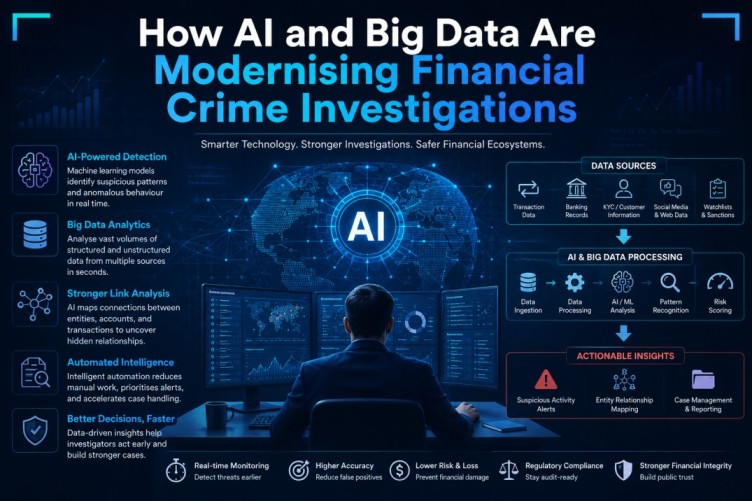
Financial crime operates on an unimaginably massive scale. An estimated $3 trillion in illicit funds successfully flows through the international financial system every year. To combat this, financial institutions are pouring vast resources into regulatory technology, with North American compliance markets alone exceeding $10.7 billion in 2026. The financial commitment is substantial, as institutions typically allocate between 2.9 percent and 8.7 percent of their total non-interest expenses strictly toward maintaining regulatory frameworks. Recent industry surveys reveal that over half of these organisations spend more than $10 million annually solely on money laundering management. However, simply throwing money at the problem is no longer working. Legacy systems are buckling under the sheer volume of digital transactions, forcing a much-needed technological shift toward intelligent automation and big data analytics.
Uncovering Complex Threats Through Data Integration
Sophisticated financial criminals rarely operate in a straight line. They use tactics like structuring deposits just below reporting thresholds, commonly known as smurfing, and layer funds through circular transfers to obscure their origins. Catching these complex manoeuvres requires breaking down isolated data silos. Legacy compliance architectures frequently rely on fragmented relational databases, which prevent security teams from collaboratively identifying cross-channel threats.
Modern financial compliance relies heavily on graph database technology and advanced big data analytics. By treating data connections as primary analytical targets, investigators can map hidden relationships such as shared IP addresses, connected mobile devices, or overlapping corporate co-ownerships that traditional databases routinely miss. Implementing dedicated Anti-Money Laundering Software provides the technological solution needed to unify fragmented records into a single intelligence layer. This approach ensures that investigative teams can identify complex networks and close cases significantly faster.
The Growing Burden of False Positives
For decades, banks and regulatory bodies relied on rigid, rules-based transaction monitoring. While these systems were adequate for simpler times, they now generate a staggering volume of inaccurate alerts. Benchmark reports from 2026 indicate that false positive rates in compliance screening still hover between 85 and 95 percent across the global industry.
Each of these alerts costs institutions an average of $25 to $50 to process manually. More importantly, they drain human resources, as compliance teams often spend up to 90 percent of their investigative time reviewing warnings that pose no actual risk. Industry experts note that traditional frameworks leave institutions caught in an endless loop of rigid processes and alerts that make no real difference. This operational failure makes AI adoption absolutely essential for operationalising compliance and cutting false positives in everyday banking operations. Shifting from reactive rules to behavioural pattern recognition is now a necessity rather than a luxury.
Scaling Compliance with Intelligent Automation
As transaction volumes explode, expanding human headcount to manually review data is both economically and practically impossible. Instead, forward-thinking organisations are turning to artificial intelligence as a force multiplier. This evolution moves beyond simple automated checks and embraces more sophisticated, autonomous models.
For example, understanding what is agentic AI is crucial for modern enterprise security. These autonomous systems can proactively plan tasks, evaluate data in real time, and support human workers by automating complex decisions. Rather than waiting for a human investigator to connect the dots, these intelligent agents can independently cross-reference databases, filter out irrelevant noise, and present a concise summary of genuine threats. This allows small compliance teams to manage exponentially larger workloads without sacrificing accuracy or expanding their manual workforce.
Adapting to Evolving Australian Regulations
The push toward advanced technology is not just driven by efficiency. It is also mandated by increasingly strict regulatory standards. In Australia, the recent Tranche 2 reforms that came into effect in July 2026 have expanded regulatory obligations to over 100,000 new entities, including lawyers, accountants, and real estate professionals.
AUSTRAC has explicitly highlighted how generative artificial intelligence and digital channels are accelerating the speed of financial crime. In response, regulators expect reporting entities to deploy highly adaptive frameworks. Key capabilities that modern businesses must adopt include:
- Integrating machine learning models that evolve alongside new financial threats.
- Replacing fragmented relational databases with unified, graph-powered intelligence layers.
- Transitioning from manual alert management to proactive behavioural risk scoring.
- Ensuring cross-departmental visibility to track sophisticated, multi-layered transactions.
As digital threats grow more complex, the tools used to detect them must evolve at an equal pace. By leveraging big data analytics and autonomous AI, financial institutions can finally overcome the massive data challenges of modern compliance. This technological transformation protects the integrity of the global financial system while ensuring businesses can scale their security operations effectively and sustainably.