
Entering 2026, Thailand’s digital landscape is more connected and competitive than ever before. With internet penetration reaching nearly 95 per cent and 67.8 million users relying heavily on their mobile devices for local discovery, simply having a basic website is no longer enough to capture regional market share. Thailand’s digital economy has seen immense growth recently, underscoring the massive financial stakes of maintaining a highly reliable commercial website. Thai internet users spend an average of 21 hours online each week, and they have been conditioned by ubiquitous 4G and 5G networks to expect a seamless digital experience. For businesses looking to attract nearby customers, the true battleground has shifted away from traditional keyword targeting toward the underlying technical infrastructure of their digital platforms.
Scaling Visibility in Competitive Metropolitan Markets
When approaching a highly saturated market, a fast and technically sound website acts as the absolute foundation for broader marketing campaigns. With 46 per cent of all web queries now carrying local intent, mobile users must be able to transition seamlessly from a local search listing to a fully functional landing page. Local service and e-commerce websites consistently see their highest conversion rates when pages fully load in under two seconds.
If a business wants to dominate the capital’s competitive landscape, they often partner with agencies providing the best SEO services in Bangkok to execute advanced on-page strategies and content production. However, even the most sophisticated content campaigns will struggle to gain traction if the underlying server cannot deliver pages quickly to local users. Evolving search interfaces, such as the integration of AI summaries into local queries, increasingly rely on fast-loading, technically structured websites to extract and verify business information accurately.
The New Era of Interactivity and Page Experience
The metrics that govern search engine rankings continually evolve. In 2024, search algorithms underwent a significant shift when Interaction to Next Paint (INP) replaced older metrics to better measure a site’s responsiveness throughout an entire user visit. Rather than just capturing the initial loading delay, INP measures the longest processing time between a user taking action, such as tapping a menu button, and the browser delivering visual feedback.
This means digital marketing teams must prioritise advanced server environments and reduce heavy code execution to remain visible. In fact, official guidelines detailing how Google evaluates page experience explicitly state that Core Web Vitals are used by their ranking systems, recommending that site owners achieve strong technical metrics for consistent search success. A polished frontend is irrelevant if the backend server infrastructure fails to meet these strict interactivity standards.
Security as a Baseline Trust Signal
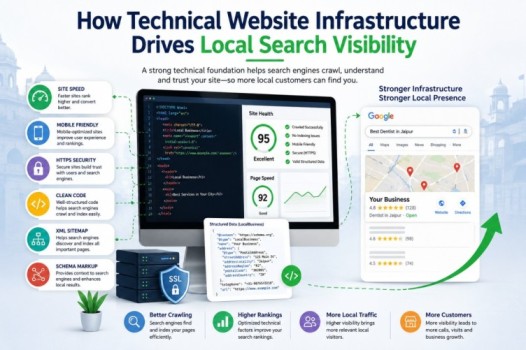
Speed and interactivity are crucial performance indicators, but a reliable technical infrastructure must also prioritise user safety. Beyond fast page loads, maintaining a secure hosting environment is a fundamental trust signal required to compete in modern, mobile-first search indexing. This is where basic security protocols become vital for regional visibility.
Encrypting data not only builds consumer trust but also ensures your site is technically ready for local search competition, a concept clearly detailed in this comprehensive breakdown exploring what an SSL certificate is and why it matters. Without this foundational layer of security, search engines are highly unlikely to serve a website to local users looking for reputable local vendors.
Key Pillars of a Technically Sound Local Site
To ensure your technical web infrastructure is fully optimised for local search visibility, businesses must focus on several core structural elements:
- Server Response Times: Investing in a robust hosting environment is non-negotiable. Every additional second of load time between zero and five seconds causes website conversion rates to drop by an average of 4.42 per cent.
- Mobile-First Responsiveness: A ten-second page load time on mobile devices increases the probability of a user leaving the site by 123 per cent compared to a rapid one-second load time.
- Code Optimisation: Reducing complex JavaScript execution helps meet strict search engine interactivity standards, ensuring users get immediate visual feedback when navigating your commercial pages.
- Security Integration: Active SSL certification remains a baseline requirement to prevent browsers from flagging your site as unsafe to potential local customers.
A strong technical infrastructure does more than just keep a website online. It acts as the primary engine driving local search visibility and user retention. Recent consumer behaviour data shows that 70 per cent of internet users admit a website’s page speed directly influences their willingness to purchase from or contact a business. By prioritising secure hosting, rapid server responses, and seamless interactivity, businesses can create a digital foundation that supports aggressive local search campaigns and consistently converts mobile traffic into loyal customers.