
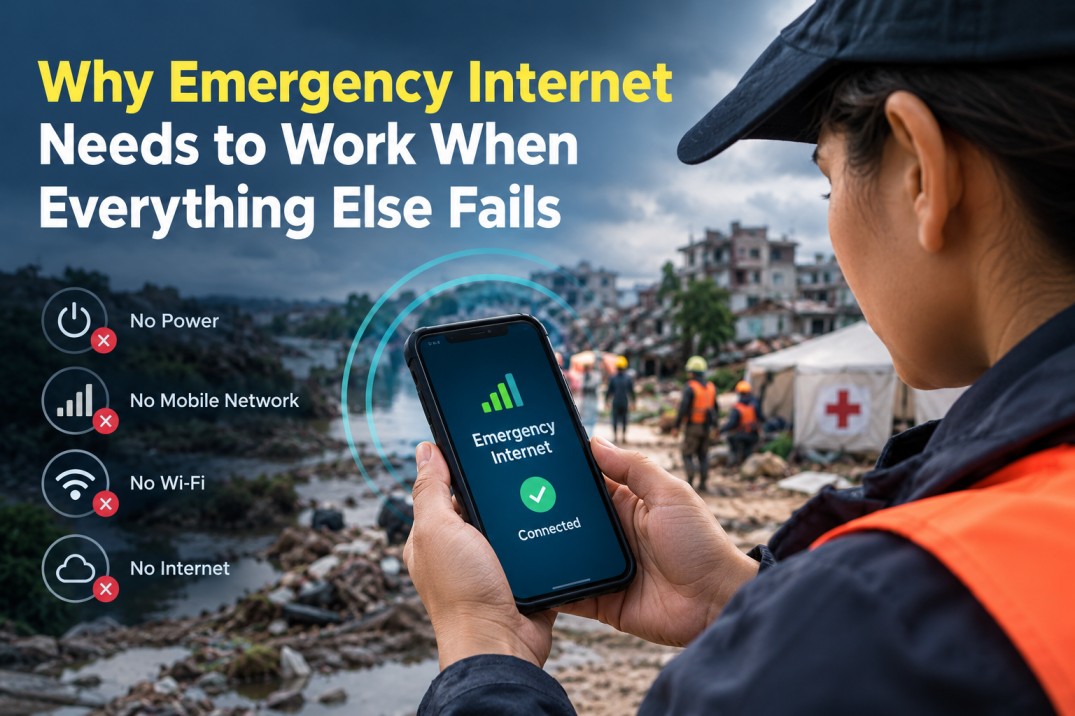
When a flood destroys a road, the road does not simply become a transport problem. It can become a communication problem.
A damaged bridge can prevent rescue teams from reaching a village. A flooded power station can shut down mobile infrastructure. A landslide can cut fibre-optic cables along the same corridor that emergency vehicles need to use. If electricity disappears and telecom towers go offline, a person trapped in an isolated settlement may have no practical way to tell the outside world that help is needed.
This is why the communications challenge during a disaster is much bigger than keeping people connected to the internet.
It is about keeping information moving when the infrastructure carrying that information is breaking apart.
The recent Nepal floods offer a powerful way to understand this problem. In a mountainous country where settlements, roads, rivers, hydropower infrastructure and communication routes are often concentrated along narrow valleys, a single physical failure can disconnect an entire community. During the August 2026 disaster, communication disruptions left some stranded people unreachable, adding another layer of difficulty to an already complex rescue operation.
That raises an uncomfortable but important question:
What happens when the network needed to coordinate the rescue is itself one of the things the disaster has destroyed?
The Internet We Use Every Day Is Not Designed for a Disaster
Most people experience the internet as something almost invisible.
You open a phone, connect to a mobile network or Wi-Fi, and send a message. Behind that simple action is a chain of infrastructure: electricity, towers, fibre cables, backhaul connections, routers, data centres, network equipment and physical access for technicians.
Under normal circumstances, redundancy helps keep the system running.
A disaster changes the equation.
Imagine a flood moving through a Himalayan valley. Water damages a road. The same landslide that blocks the road also damages a fibre cable. Electricity fails in nearby settlements. A mobile tower may continue operating for some time on backup power, but its connection to the wider network could already be disrupted.
The tower may still be standing.
The phone may still be working.
And yet the person holding that phone cannot communicate.
That is the infrastructure problem behind emergency communication systems.
A resilient network is not simply one that rarely fails. It is one that still provides useful communication after parts of it have failed.
Nepal Shows Why the “Last Mile” Matters
Nepal already has experience using telecommunications for disaster warnings. Flood early-warning systems have used hydrological information and mobile networks to send alerts to communities, while telecom operators have supported the dissemination of warnings.
That is valuable because an early warning does not have to be complicated. An SMS reaching someone before floodwater arrives can give a family time to move people, livestock, documents and essential belongings to safer ground.
But there is a crucial difference between warning before a disaster and communicating during the disaster.
Before a flood, the network may be functioning normally.
After roads, electricity infrastructure and communication links are damaged, the same system may become unreliable.
This is why disaster communication technology needs two separate capabilities:
- Reach people before the network is disrupted.
- Keep responders and communities connected after disruption occurs.
The second problem is considerably harder.
What Happens When Mobile Networks Go Down?
A mobile network can fail for several reasons, and not all of them involve the tower itself.
1. Power failure
Telecom equipment needs electricity. Backup batteries and generators can keep critical sites operating temporarily, but prolonged outages eventually become a problem.
2. Backhaul failure
A tower needs a connection to the wider network. Fibre cables, microwave links or other backhaul infrastructure can be damaged even when the tower remains physically intact.
3. Physical access
A functioning tower is not very useful if technicians cannot reach it because a bridge has collapsed or a road is underwater.
4. Network congestion
A disaster can produce an unusual surge in traffic. Thousands of people may simultaneously try to call relatives, send messages or access emergency information. A network that normally handles everyday demand may struggle under this sudden load.
5. Geographic isolation
Mountainous terrain creates another challenge. A community can be only a few kilometres from another settlement geographically while remaining difficult to connect because of valleys, ridges and damaged infrastructure.
These failure points show why simply building “more towers” is not enough.
The network needs different ways to stay connected.
Satellite Communication: The Network Above the Disaster
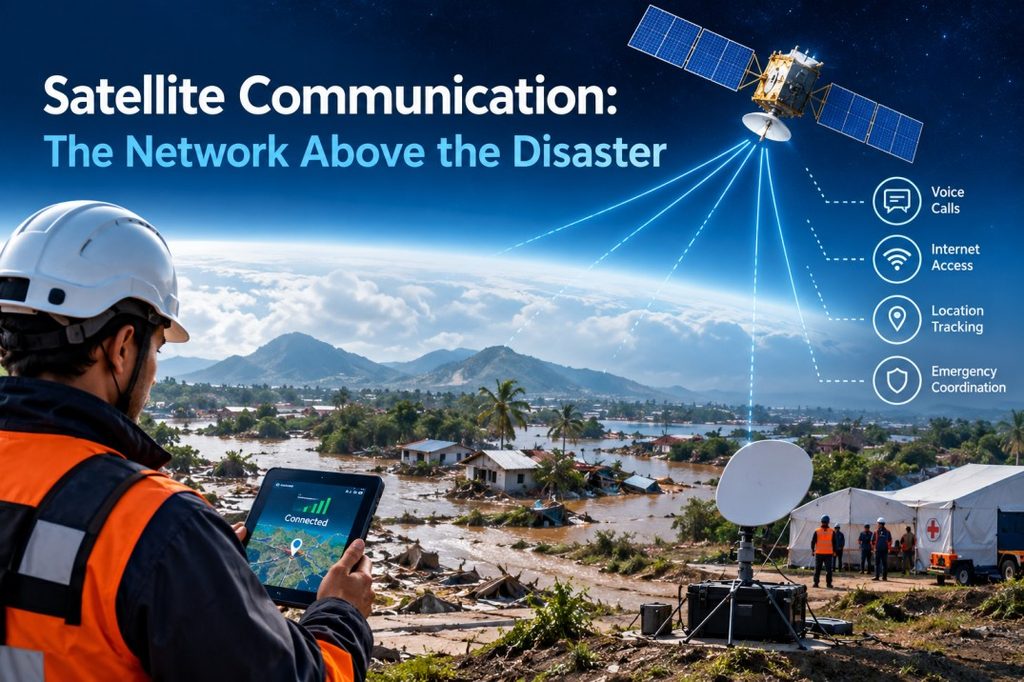
This is where satellite communication becomes especially useful.
A conventional terrestrial network depends heavily on infrastructure on the ground. Satellite communication can bypass some of that infrastructure.
A satellite phone, satellite terminal or satellite internet system can establish a connection without relying on a functioning local mobile tower and terrestrial fibre route.
That makes satellite communication disaster response particularly valuable in remote areas.
Nepal has already seen this principle in earlier disasters. After the 2015 earthquake, emergency telecommunications equipment, including satellite phones and satellite broadband terminals, was deployed to support relief coordination.
The important lesson is not that satellite technology should replace terrestrial networks.
It should not.
Satellite systems can be expensive, equipment may require specialised power and terminals may have limitations in bandwidth, coverage conditions or usability. But they can provide something extremely valuable:
an independent path out of the disaster zone.
For an emergency operations centre, a satellite terminal may be the difference between receiving information from an isolated field team and receiving nothing at all.
Emergency Internet Is Not About Giving Everyone Unlimited Wi-Fi
The phrase “emergency internet” can create the wrong mental picture.
In a disaster, the objective is not necessarily to recreate normal internet service for everyone.
The first objective is to restore critical connectivity.
That may mean prioritising:
- Emergency operations centres
- Hospitals and medical teams
- Search-and-rescue units
- Police and security teams
- Local government offices
- Relief distribution centres
- Temporary shelters
- Field teams working in isolated areas
A rescue team may not need high-speed streaming.
It may need enough bandwidth to send GPS coordinates, photographs, medical information, weather updates and short messages to a coordination centre.
That is a very different network requirement.
The emergency network should answer three questions
Who must communicate?
Emergency agencies, responders, hospitals and affected communities may have different priorities.
What information must move?
Voice, short messages, location data, maps and images can have very different bandwidth requirements.
What happens if the connection disappears again?
A resilient system needs fallback options rather than assuming the first connection will remain available.
Mesh Networks: What If Devices Could Help Build the Network?
One of the more interesting approaches to disaster connectivity is the mesh network.
Instead of every device depending on a central tower, nearby devices or network nodes can relay information between one another.
Imagine several emergency teams spread through a flooded valley.
Team A cannot reach the central network directly.
Team B is closer to Team A.
Team C is closer to a functioning connection.
In a suitable mesh configuration, information can potentially travel:
Team A → Team B → Team C → functioning network
The system effectively creates a chain.
This does not magically solve every connectivity problem. Mesh networks have range, power, equipment and topology limitations, and they work best when nodes are positioned within useful communication distance.
But they offer an important principle for disaster response:
If one connection fails, communication does not necessarily have to stop everywhere.
That is the philosophy of resilient networks.
Three Technologies, Three Different Jobs
It is useful to stop thinking about satellite, mobile and mesh networks as competing technologies.
They can complement each other.
| Technology | Main strength | Main weakness | Best disaster role |
| Mobile networks | Familiar, widespread and relatively inexpensive | Dependent on towers, power and backhaul | Mass communication and public alerts |
| Satellite communication | Can bypass damaged terrestrial infrastructure | Equipment, cost and power requirements | Critical links and remote areas |
| Mesh networks | Can maintain local communication without one central connection | Limited by node placement and range | Local responder and community connectivity |
| Radio systems | Robust and useful for voice coordination | Limited data capability | Field teams and emergency operations |
| Satellite internet | Can provide substantial data connectivity where terminals can operate | Requires suitable equipment and power | Emergency hubs and command centres |
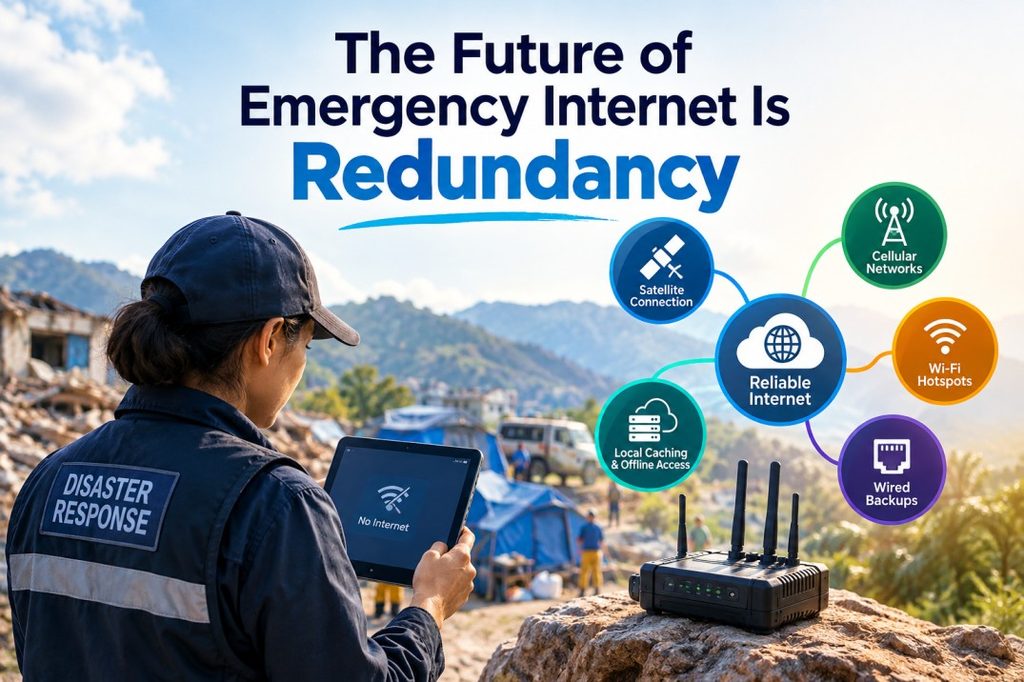
The strongest disaster communication architecture is therefore not a single technology.
It is layered.

The Most Important Network May Be the One You Never Notice
Consider a flood-affected village where the main internet connection has failed.
A conventional response might involve waiting for technicians to repair the damaged infrastructure.
A resilient response could look very different.
A portable satellite terminal arrives at a temporary emergency hub. Solar panels or generators provide power. Local responders connect through Wi-Fi or a short-range mesh network. Emergency teams use the connection to send location information and receive updated instructions. A hospital several kilometres away uses another communication link to coordinate medical evacuation.
The village has not suddenly received a normal telecommunications network.
Instead, a temporary communications island has been created.
That island can later connect to the wider network when infrastructure is restored.
This approach is particularly relevant to Nepal because geography can make physical restoration slow. In mountainous terrain, repairing a damaged cable or reaching an isolated settlement may take considerably longer than deploying portable communications equipment.
Resilience Starts Before the Disaster
One of the biggest mistakes is treating emergency connectivity as something that can simply be brought in after a disaster.
By then, the roads may already be blocked.
Equipment may be sitting hundreds of kilometres away.
Staff may not know how to operate it.
Nobody may know which locations should receive priority.
A resilient communications strategy therefore needs preparation.
A practical preparedness checklist
1. Map communication dependencies.
Identify which communities, hospitals and emergency facilities depend on vulnerable network links.
2. Pre-position equipment.
Satellite terminals, backup power systems, radios and other emergency communication equipment are much more useful when they are already near likely disaster zones.
3. Build multiple communication paths.
Do not allow a critical facility to depend on one cable, one tower or one provider.
4. Test backup systems regularly.
Equipment that has remained unused in storage for years may not be ready when an emergency begins.
5. Train local teams.
A satellite terminal is not a resilience solution if nobody on the ground knows how to deploy and operate it.
6. Prioritise power.
Communication equipment is only as resilient as its energy supply. Solar systems, batteries and generators can therefore be as important as the network technology itself.
The Hidden Problem: Communication Must Work in Both Directions
Emergency communication is often described as broadcasting warnings.
But disasters create a second requirement that is just as important:
people need to communicate back.
An SMS warning can tell a village that flooding is approaching.
But responders also need to know:
- Which roads are blocked?
- Which communities are isolated?
- Where are injured people?
- Which shelters are full?
- Which bridges have failed?
- Where are rescue teams currently operating?
- Which areas have lost electricity?
This makes disaster communication a two-way information system, not simply a public announcement mechanism.
The difference is crucial.
A command centre with excellent information going outward but poor information coming inward can still make terrible decisions.
What a Truly Resilient Disaster Network Looks Like
The ideal system is not one that promises to remain completely operational.
That is unrealistic.
The better goal is graceful failure.
If the main network fails, a secondary network should continue.
If the secondary network fails, local communication should remain possible.
If internet access disappears, radio or satellite voice should still work.
If electricity fails, backup power should keep essential equipment running.
The system loses capability progressively rather than collapsing all at once.
Think of it like a mountain road with several bridges.
If one bridge disappears, traffic should have another route.
If all routes depend on the same bridge, the apparent redundancy was never real.
Nepal’s Lesson Is Bigger Than Nepal
The communications challenge exposed by floods in Nepal is relevant far beyond the Himalayas.
Coastal cyclones can destroy towers.
Earthquakes can damage fibre routes.
Wildfires can cut power.
Hurricanes can overwhelm terrestrial infrastructure.
Landslides can isolate mountain communities.
Across all of these disasters, the same principle appears:
You cannot build an effective rescue system if the rescue system loses its ability to communicate.
That is why investment in disaster resilience should include communications infrastructure alongside roads, bridges, shelters, hospitals and early-warning systems.
A functioning communication link may not look as dramatic as a rescue helicopter.
But it can determine whether the helicopter knows where to go.
The Future of Emergency Internet Is Redundancy
The most important lesson is surprisingly simple.
Emergency internet does not mean making disaster zones behave as though nothing happened. It means ensuring that something continues to work when normal infrastructure stops working.
Mobile networks can provide scale. Satellite systems can provide an escape route from damaged terrestrial infrastructure. Mesh networks can create local connectivity. Radios can maintain basic field coordination. Backup power can keep these systems alive.
Together, they create something far more valuable than internet access alone: a resilient flow of information.
For Nepal’s flood-prone and geographically challenging regions, that resilience can become a critical part of disaster preparedness. The question should no longer be, “Will the network survive the disaster?”
A better question is:
“When part of the network fails, what is the next way for a warning, a location, a medical request or a rescue order to get through?”
That is the real test of an emergency communication system.
Because in a disaster, connectivity is not a convenience.
It is part of the rescue infrastructure itself.