
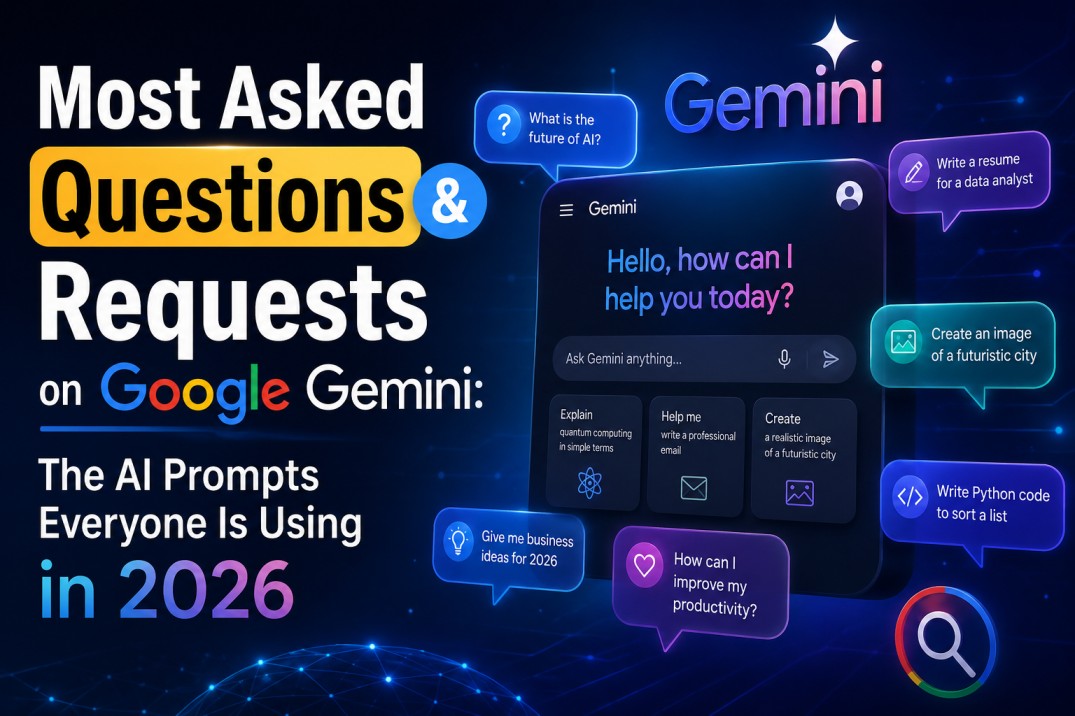
Not too long ago, people opened Google Search whenever they had a question. Today, a growing number of users open Google Gemini, type a request in plain English, and expect a complete answer in seconds. From writing emails and planning holidays to solving maths problems and generating code, AI has changed the way we search for information. That’s exactly why Google Gemini, Gemini AI, Google AI chatbot, best Gemini prompts, how to use Google Gemini, Gemini prompts, AI writing assistant, and Google Gemini tips have become some of the most searched terms online. People aren’t just looking for answers anymore—they’re looking for an assistant that can think, create, explain, and save time.
The interesting thing is that everyone seems to use Gemini differently.
A college student might ask it to simplify a difficult physics chapter before an exam. A software developer may spend hours debugging code with its help. A small business owner could use it to write product descriptions, marketing emails, or social media posts without hiring a copywriter. Even parents are turning to Gemini for meal plans, travel ideas, bedtime stories, and homework support.
This shift says something important about how technology is evolving. Search engines helped us find information, but AI helps us use it.
If you’ve ever wondered what people actually ask Gemini every day, you’re in the right place. In this guide, we’ll explore the most common requests, why they’re so popular, and how you can use them to get smarter, faster, and more accurate responses. You might even discover features you’ve never thought of trying before.
Why Are Millions of People Using Google Gemini Every Day?
Just a couple of years ago, AI chatbots felt like a novelty. People opened them out of curiosity, asked a few funny questions, and moved on. Fast forward to today, and things look very different. Google Gemini has quietly become part of many people’s daily routine. Whether it’s checking facts before a meeting, writing an email on the way to work, or planning a weekend trip, Google Gemini is increasingly becoming the first stop instead of a traditional search engine.
The biggest reason is convenience.
Instead of opening five different websites, comparing articles, and piecing together information yourself, Gemini brings everything together in a single conversation. You can ask follow-up questions, request examples, change the tone of a response, or even ask it to explain something in simpler words. It feels less like searching the internet and more like talking to someone who already understands what you’re trying to achieve.
Another reason for its popularity is that people no longer use AI for just one purpose. A single conversation can start with “Write a professional email,” move on to “Explain mutual funds,” and end with “Plan a three-day trip to Goa.” That flexibility has made Gemini AI useful for students, professionals, entrepreneurs, travellers, content creators, and even people who simply want quick everyday advice. The more people experiment with Gemini AI, the more creative their requests become.
Interestingly, many users who first tried Gemini for writing have now expanded the way they use it. They ask it to analyse spreadsheets, summarise lengthy PDF documents, brainstorm business ideas, translate conversations, create recipes using whatever is left in the fridge, or prepare interview questions. What started as an AI chatbot has gradually become a digital assistant for work and personal life.
There’s also the speed factor. Most tasks that once required twenty or thirty minutes can now be completed in just a few prompts. Of course, AI isn’t perfect, and important information should always be verified, but for everyday productivity, it has become incredibly valuable. That’s one of the biggest reasons why searches related to best Gemini prompts continue to grow—people want to learn how to get even better results from the tool.
So, what exactly are these millions of users asking Gemini every day?
Let’s start with the most popular category of all.
1. “Can You Write This for Me?” – The Most Common Request on Gemini
If there were a competition for the most frequently typed request, writing would almost certainly take the top spot. Every day, millions of users open Google Gemini with one simple goal: to help them write something faster and better. Whether it’s a school assignment, an office email, a blog post, or even a wedding invitation, Google Gemini has become the go-to writing companion for people who don’t want to start with a blank page.
Think about how often we write during a normal week. There are emails to send, presentations to prepare, reports to finish, social media captions to post, and messages that need just the right tone. For many people, the hardest part isn’t writing itself—it’s getting started. That’s where Gemini makes a noticeable difference.
Instead of staring at a blinking cursor, users simply describe what they need.
“Write a formal resignation email.”
“Create a LinkedIn post announcing a promotion.”
“Write a blog on electric vehicles for beginners.”
“Draft a professional client proposal.”
Within seconds, Gemini produces a structured draft that users can refine instead of building everything from scratch. That alone saves a significant amount of time.
But experienced users don’t stop there.
They know that better prompts lead to better answers. Rather than asking for “a blog about fitness,” they might write:
“Write a 1,500-word blog on home workouts for beginners. Use simple English, include practical tips, add FAQs, and keep the tone conversational.”
The difference in quality is remarkable.
This is also why searches for Gemini prompts have increased so much. People have realised that AI isn’t just about asking questions—it’s about learning how to ask better questions.
Content creators have taken this even further. Bloggers use Gemini to brainstorm article ideas, YouTubers generate video scripts, marketers create advertising copy, and freelancers draft proposals in minutes. Some even use it to rewrite existing content in different tones, making it sound more professional, friendly, persuasive, or concise depending on the audience.
That doesn’t mean every word should be copied and pasted. The best writers still edit, personalise, and fact-check the final version. Gemini works best as a creative partner rather than a replacement for human thinking. It helps overcome writer’s block, organise ideas, and produce a strong first draft, leaving the user to add personality, experience, and expertise.
Perhaps that’s why so many people keep returning to it. Once you’ve experienced how much easier writing becomes with AI, it’s difficult to imagine going back to doing everything manually.
2. Students Are Turning Gemini Into Their Personal Tutor
Walk into any college library today and you’ll probably notice something different from a few years ago. Alongside textbooks and notebooks, many students have Google Gemini open on their laptops or phones. It has quietly become a study companion for learners of all ages, not because it replaces learning, but because it makes understanding difficult topics much easier.
Every student has experienced that frustrating moment when a textbook explains something in such complicated language that it feels impossible to understand. Instead of reading the same paragraph five times, students now ask Gemini AI to explain it in simple terms. A concept that once seemed confusing suddenly becomes clear when it’s broken down with everyday examples.
One of the reasons students enjoy using Gemini is that it doesn’t judge. You can ask the same question three different ways, request another explanation, or even say, “Explain it like I’m a 10-year-old,” and it will patiently try again. That kind of flexibility isn’t always available in a classroom.
Some of the most common requests include:
“Explain photosynthesis with an easy example.”
“Summarise this chapter in 300 words.”
“Create ten multiple-choice questions from this lesson.”
“Help me prepare for tomorrow’s chemistry exam.”
“Make revision notes for Indian Polity.”
These requests may sound simple, but together they can save hours of study time. Instead of spending an evening creating revision notes, students can use best Gemini prompts to generate a well-organised summary and then focus on understanding the material rather than rewriting it.
Another growing trend is using Gemini AI for language learning. Whether someone is practising English grammar, improving vocabulary, translating sentences, or preparing for an IELTS interview, Gemini offers instant feedback and examples. It can even act as a conversation partner, making language practice less intimidating.
Of course, there’s one important thing to remember. AI should support learning, not replace it. Simply copying homework answers won’t help anyone in the long run. Students who benefit the most are the ones who use Gemini to understand concepts, organise information, and test their knowledge rather than looking for shortcuts.

3. Developers Are Asking Gemini to Write, Fix and Explain Code
If writing is the most popular everyday use of Gemini, coding is probably its biggest professional use case. Developers across the world rely on Google Gemini to speed up programming tasks, understand unfamiliar code, and troubleshoot errors that might otherwise take hours to solve.
Ask any programmer, and they’ll tell you that coding isn’t just about writing new software. A large part of the job involves reading existing code, fixing bugs, and understanding why something isn’t working. That’s where Gemini AI proves incredibly useful.
Imagine spending an hour searching for a tiny syntax error hidden somewhere inside hundreds of lines of code. Instead of manually checking every line, developers often paste the code into Gemini and ask:
“Why is this Python code returning an error?”
“Optimise this SQL query.”
“Convert this JavaScript function into Python.”
“Explain this React component line by line.”
“Write clean HTML and CSS for a responsive landing page.”
Rather than giving just the corrected code, Gemini can also explain what went wrong. For beginners, that’s often more valuable than the solution itself because it helps them avoid making the same mistake again.
Professional developers use it in more advanced ways too. Some ask Gemini to generate API documentation, write unit tests, review code quality, suggest performance improvements, or even brainstorm software architecture. While experienced programmers still verify and refine AI-generated code, using Gemini prompts dramatically reduces repetitive work.
Interestingly, many people who aren’t software engineers also benefit from these capabilities. Data analysts, automation specialists, website owners, and even hobbyists use Gemini to create small scripts that automate repetitive tasks. What once required advanced programming knowledge is becoming much more accessible thanks to AI assistance.
4. Small Business Owners Are Using Gemini Like an Extra Employee
Running a business often means wearing multiple hats. One minute you’re replying to customer emails, the next you’re planning a marketing campaign, updating your website, or creating invoices. Hiring specialists for every task isn’t always possible, especially for startups and small businesses.
That’s one reason Google Gemini has become so popular among entrepreneurs.
Instead of spending hours writing promotional content, business owners use Gemini AI to prepare first drafts that they can customise later. A restaurant owner might ask for social media captions promoting a weekend offer, while an online store owner may request compelling product descriptions or email newsletters.
Some of the most common business-related requests include:
- Write a professional business proposal.
- Create a monthly marketing plan.
- Draft a customer apology email.
- Suggest startup business ideas.
- Prepare a SWOT analysis.
- Write website content for a new company.
- Generate product descriptions for an online store.
- Create a sales presentation.
The beauty of AI lies in its flexibility. The same prompt can be rewritten for different audiences. A formal email can become friendly, a short advertisement can become a detailed landing page, or a simple product description can be transformed into SEO-friendly website content using the right Gemini prompts.
Business owners are also discovering that Gemini can act as a brainstorming partner. Feeling stuck while naming a product? Need ideas for a festive marketing campaign? Looking for unique taglines? Gemini can produce dozens of suggestions within seconds, helping businesses move from idea to execution much faster.
Of course, successful businesses still rely on human creativity and decision-making. AI simply removes much of the repetitive work, allowing entrepreneurs to spend more time building relationships with customers and improving their products.
5. Travel Planning Has Become Faster Than Ever
Planning a holiday sounds exciting until you actually start doing it.
One website suggests one itinerary, another recommends something completely different, and before you know it, you’ve spent two hours comparing hotel reviews, transport options, and sightseeing lists without making a single decision.
This is exactly why many travellers now begin with Google Gemini instead of opening dozens of browser tabs.
Rather than searching for information piece by piece, users simply describe the kind of trip they want.
“Plan a five-day family trip to Kerala under ₹40,000.”
“Suggest hidden places to visit in Rajasthan.”
“Create a two-day itinerary for Dubai.”
“What should I pack for a winter holiday in Japan?”
Within moments, Gemini AI can suggest day-wise travel plans, estimated budgets, packing checklists, restaurant recommendations, and even local etiquette tips. Instead of collecting information from different sources, travellers receive everything in one organised response.
Frequent travellers often take it a step further. They ask Gemini to compare destinations, estimate daily expenses, recommend the best time to visit, or suggest alternatives if a location is too crowded during peak season.
Families use it to plan child-friendly holidays, couples ask for romantic destinations, backpackers look for budget itineraries, and solo travellers request safety tips before visiting a new country. These personalised recommendations are one of the biggest reasons best Gemini prompts related to travel continue to gain popularity.
Travel planning hasn’t become completely effortless, but AI has certainly made the process much quicker and far less overwhelming.

6. Job Seekers Are Using Gemini to Build Better Careers
Searching for a new job can feel like a full-time job in itself. You spend hours updating your resume, tweaking your LinkedIn profile, writing cover letters, and preparing for interviews. It’s no surprise that career-related requests have become one of the fastest-growing uses of Google Gemini.
Instead of starting from scratch, job seekers now use Gemini AI to create polished resumes that highlight their strengths. Someone with five years of experience in sales can simply describe their work history, and Gemini can turn it into professional resume content with measurable achievements and industry-friendly language.
Cover letters are another area where AI saves a lot of time. Rather than sending the same generic letter to every company, applicants ask Gemini to customise it for each role. A cover letter for a marketing position will naturally sound different from one written for a software engineering role, and that’s exactly what employers expect.
Interview preparation has also changed. Instead of asking friends to conduct mock interviews, candidates ask Gemini questions like:
“Conduct a mock HR interview for a digital marketing role.”
“Ask me Java interview questions one by one.”
“How should I answer ‘Tell me about yourself’?”
“What are the most common interview questions for freshers?”
Gemini doesn’t just provide answers—it can explain why certain responses make a stronger impression and suggest ways to sound more confident. Many users even ask it to review their answers and recommend improvements.
Career changers find it particularly useful because they often need help presenting transferable skills. Someone moving from customer service to project management, for example, can ask Gemini to identify relevant experience that might otherwise be overlooked.
While AI can’t guarantee a job offer, it certainly helps candidates present themselves more effectively. That’s why searches for Gemini prompts related to resumes, interviews, and career growth continue to rise.
7. Health and Fitness Questions Are More Common Than You Think
Health is one of those topics people constantly search for online, so it’s no surprise that many have started asking Google Gemini for everyday wellness advice. From meal planning and workout routines to understanding common symptoms, health-related conversations are becoming increasingly common.
A typical request might look something like this:
“Create a vegetarian meal plan with high protein.”
“Suggest a beginner workout for weight loss.”
“Explain the difference between good cholesterol and bad cholesterol.”
“Give me healthy breakfast ideas for busy mornings.”
People appreciate that Gemini AI can personalise responses based on age, dietary preferences, fitness goals, or available equipment. Someone exercising at home receives different recommendations from someone with access to a fully equipped gym.
Fitness enthusiasts also use Gemini to structure weekly workout plans, calculate approximate calorie requirements, suggest recovery tips after exercise, and recommend healthy recipes based on ingredients already available at home.
However, this is one area where users should be careful. AI is helpful for general education and lifestyle guidance, but it shouldn’t replace qualified medical advice. Persistent symptoms, medical conditions, or treatment decisions should always be discussed with a healthcare professional.
The smartest users treat Gemini as an educational tool rather than a doctor. They use it to understand medical terms, learn about healthy habits, or prepare questions before visiting a healthcare provider.
8. Everyday Life Has Become Easier with Gemini
Not every Gemini conversation is about work, studies, or business. In fact, many people use Google Gemini for ordinary everyday tasks that save just a few minutes here and there. Those minutes quickly add up over time.
Forgot what’s in the refrigerator? People ask Gemini to suggest recipes using the ingredients they already have.
Need to organise a birthday party? Gemini can create a checklist, suggest decorations, and even write invitation messages.
Planning monthly expenses? It can help prepare a simple household budget.
Trying to organise your day? Ask it to create a practical schedule that balances work, exercise, meals, and relaxation.
These everyday requests might seem small individually, but together they show how AI is becoming part of daily routines. Instead of searching multiple websites or downloading separate apps, users simply ask Gemini AI what they need.
Parents ask it for bedtime stories.
Pet owners look for training tips.
Gardeners request seasonal planting advice.
Homeowners ask for cleaning schedules.
Cooking enthusiasts experiment with new cuisines.
Some people even ask Gemini to explain appliance manuals in simpler language. Others use it to compare mobile phones before making a purchase or create personalised gift ideas for family members.
The common theme is convenience. Best Gemini prompts aren’t always complex—they’re often simple questions that make everyday life just a little easier.
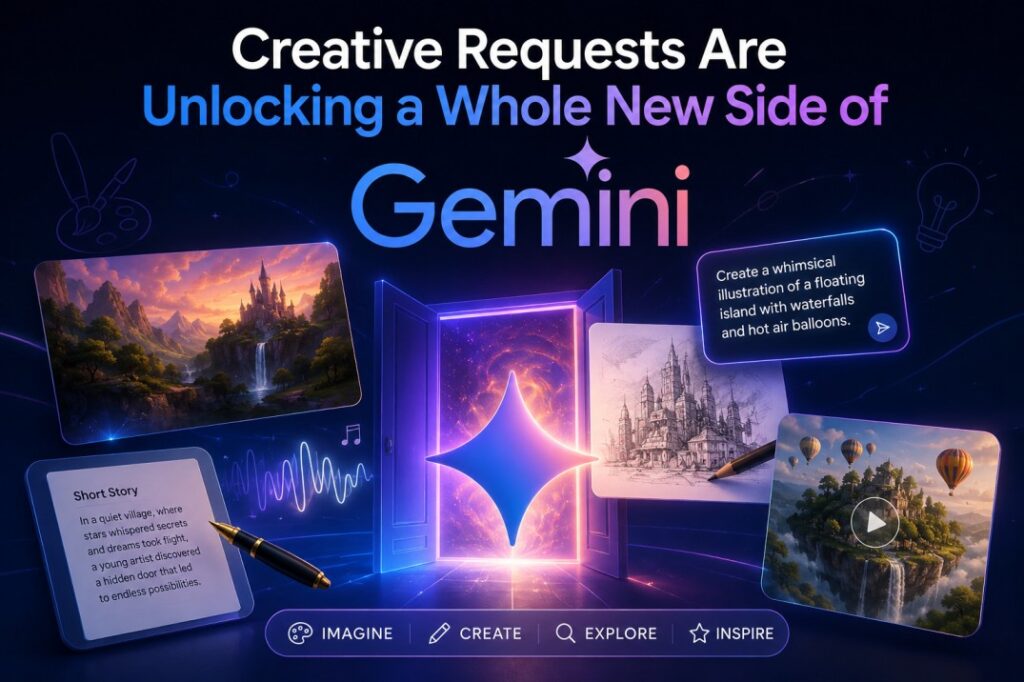
9. Creative Requests Are Unlocking a Whole New Side of Gemini
One of the most enjoyable things about using AI is discovering just how creative it can be. Beyond facts and productivity, Google Gemini has become a playground for imagination.
Writers use it to overcome writer’s block.
Musicians brainstorm song lyrics.
Teachers create classroom activities.
Game developers generate storylines.
Content creators plan YouTube videos.
Novelists develop fictional worlds.
A simple prompt like “Create a mystery story set in an abandoned lighthouse” can produce an entirely original narrative. Ask Gemini to continue the story, introduce a plot twist, or rewrite it from another character’s perspective, and the story keeps evolving.
Children’s stories are another popular request. Parents often ask Gemini to write bedtime stories featuring their child’s favourite animals or hobbies, making story time far more personal than reading from a printed book.
Creative professionals use Gemini AI for brainstorming rather than final production. Designers request slogan ideas, authors outline book chapters, filmmakers develop scene ideas, and marketers generate campaign concepts.
Perhaps the biggest advantage is that creativity becomes collaborative. Instead of waiting for inspiration, users bounce ideas back and forth with Gemini until something clicks.
That’s a very different experience from simply searching Google for inspiration.
10. The Secret Isn’t Gemini—It’s the Prompt
After looking at the most common requests, one pattern becomes obvious.
The people who get the best answers aren’t necessarily using a more advanced version of Gemini. They’re simply asking better questions.
Compare these two prompts:
“Write an article about climate change.”
“Write a 1,500-word beginner-friendly article about climate change. Use simple English, include recent examples, FAQs, and practical tips. Keep the tone conversational.”
Both prompts ask for the same topic, but the second provides context, audience, structure, and tone. Naturally, the response will be much more useful.
This is why learning Gemini prompts has almost become a skill of its own.
Experienced users usually include:
- The goal of the task.
- The target audience.
- Preferred tone.
- Desired length.
- Specific formatting.
- Examples if available.
- Anything that should be avoided.
The more information you provide, the more personalised the response becomes.
Another useful habit is asking follow-up questions. Instead of accepting the first answer, people often say:
“Can you simplify this?”
“Add real-world examples.”
“Rewrite it for beginners.”
“Make it more persuasive.”
“Turn this into a table.”
This back-and-forth conversation is what makes AI different from a traditional search engine. You’re not limited to one answer—you can refine it until it matches exactly what you need.
11. Frequently Asked Questions About Google Gemini
Even though millions of people use Gemini every day, many users still have similar questions before they start relying on it for work or personal tasks. Here are some of the most common ones.
Is Google Gemini free to use?
Yes, Google Gemini offers a free version that covers many everyday tasks like writing, summarising, brainstorming, answering questions, and generating ideas. Google also provides premium plans with access to more advanced AI models and additional features for users who need greater capabilities.
Can Gemini replace Google Search?
Not entirely. Gemini AI is excellent for summarising information, explaining concepts, generating content, and holding conversations. However, Google Search is still the better choice when you need to browse multiple websites, verify the latest news, compare sources, or find official information. Most people use both together rather than choosing one over the other.
Is Gemini good for students?
Absolutely. Students use Google Gemini to simplify complex topics, create revision notes, prepare quizzes, improve writing, practise interviews, and learn new skills. It works best as a learning companion rather than a shortcut for homework.
Can Gemini write professional content?
Yes, and that’s one of its biggest strengths. From business emails and resumes to blogs, marketing campaigns, website copy, and product descriptions, Gemini AI can generate high-quality first drafts. Most professionals review and personalise the final version before publishing or sending it.
Can programmers rely on Gemini for coding?
Many developers already do. Google Gemini can explain code, identify errors, optimise functions, generate documentation, and even write code in multiple programming languages. Like any AI tool, the output should always be tested and reviewed before using it in production.
What’s the secret to getting better answers?
The answer is surprisingly simple—write better prompts.
Instead of typing one short sentence, explain exactly what you want. Mention the audience, preferred tone, desired length, format, and any specific requirements. The clearer your request, the more useful the response usually becomes.
Final Thoughts: Gemini Is Changing More Than Just Search
Not long ago, AI felt like something reserved for technology enthusiasts and software developers. Today, it’s helping students prepare for exams, professionals finish projects faster, entrepreneurs grow their businesses, travellers plan holidays, and families organise everyday life.
That’s perhaps the biggest reason behind Gemini’s popularity.
People aren’t using it because it’s new—they’re using it because it genuinely saves time.
The most interesting part is that we’ve probably only seen the beginning. Every update brings new capabilities, smarter responses, and better integration with the tools people already use every day. As AI continues to improve, the questions users ask will become even more creative, and the answers will become even more personalised.
Whether you’re writing your first blog, preparing for a job interview, learning a new programming language, planning your next holiday, or simply trying to become more productive, Google Gemini can be a valuable assistant when used thoughtfully.
The real advantage isn’t having AI.
It’s knowing how to ask the right questions.
Once you master that skill, you’ll realise that Gemini is capable of much more than answering simple queries—it becomes a partner for learning, creating, solving problems, and turning ideas into reality.