
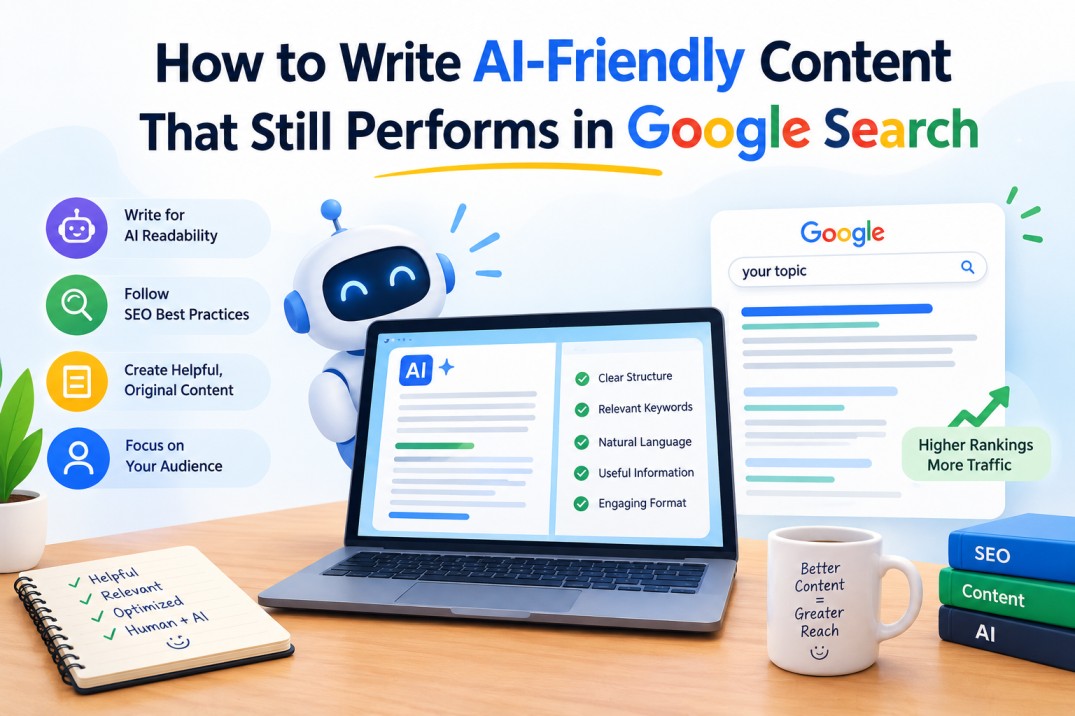
The phrase “AI-friendly content” sounds as if there must be a particular writing style that makes an article easier for artificial intelligence to understand, cite or rank. It is an attractive idea because it suggests a shortcut: change the way you write, follow a few formatting rules, and suddenly your content becomes more visible in Google Search, AI Overviews and other AI-powered search experiences. But that is not really how useful content works. There is no magic AI writing style, no secret sentence structure and no collection of phrases that guarantees an AI system will choose your page. The more useful way to think about AI-friendly content is much simpler: create information that is clear enough for machines to understand, useful enough for people to read and trustworthy enough for search systems to rely on.
That changes the entire approach to AI SEO content. Instead of asking, “How do I write for AI?”, ask a better question: “If a search system needs to understand, compare, summarise or cite the information on this page, have I made that information clear and credible?” This is particularly important as search increasingly involves systems that do more than return ten blue links. Search engines and AI interfaces can identify entities, extract answers, connect related concepts and synthesise information from multiple sources. Your job is therefore not to produce text that somehow pleases a machine. Your job is to produce a page where the important information is obvious, supported and worth using.
What Does “AI-Friendly Content” Actually Mean?
AI-friendly content is best understood as content with a strong information structure rather than content written in a special “AI language.” A well-written article makes its subject, claims, definitions, relationships and supporting evidence reasonably easy to identify. If you publish an article about disaster-ready websites, for example, an AI system should not have to read six vague introductory paragraphs before discovering what an offline-first website actually is. The definition should be clear. The practical implementation should be explained. Examples should demonstrate the concept. Technical claims should have appropriate support. Limitations should be acknowledged. The same qualities that make the page easier for a human reader to understand also make its information easier for automated systems to process.
This is why content for AI search should not be treated as a completely separate discipline from good SEO. There is considerable overlap between the principles of useful search content and the characteristics that make information easier for AI systems to retrieve and summarise. Clear headings establish topical structure. Concise definitions establish meaning. Comparisons clarify distinctions. Examples provide context. Evidence gives claims weight. Internal links establish relationships between pages. Author information and first-hand experience can strengthen credibility. None of these techniques exists solely because an AI system might encounter the page. They work because readers need them too.
A useful test is to remove the phrase “AI-friendly” from your strategy document and see whether the recommendations still make sense. If the advice says to make claims clearer, explain concepts properly, cite reliable sources, demonstrate first-hand knowledge and answer the actual searcher’s question, it is probably sound. If it says to insert certain phrases because “AI likes them,” produce a particular number of words because “AI prefers long content,” or rewrite every heading into a question because “AI search works that way,” you should be much more sceptical.
Don’t Write for an Algorithm That Can’t Be Gamed
The biggest mistake businesses can make with AI SEO is assuming that today’s search features create a new collection of optimisation tricks that can be reverse-engineered indefinitely. Search systems change, AI-generated answers change, interfaces change and ranking systems evolve. A tactic that appears effective for one search feature may become irrelevant when the underlying system changes. Building an entire content strategy around guessing what an algorithm wants is therefore fragile.
Google’s broader guidance has consistently centred on creating helpful, reliable, people-first content rather than producing pages primarily to manipulate search rankings. That principle matters even more when AI becomes part of the search experience. If a system is attempting to answer a user’s question from multiple sources, content that contains clear information, genuine expertise and useful evidence has something meaningful to contribute. Content that exists primarily because someone discovered a keyword pattern has far less value to contribute.
This does not mean ignoring SEO. Quite the opposite. Search intent, keyword research, internal linking, technical accessibility, page structure, metadata and topical relevance still matter. The difference is that these should support the information rather than replace it. Think of SEO as helping the right people discover your content; the quality of the content determines whether there is actually something worth discovering.
There is also an important distinction between optimising content for AI search and trying to manipulate AI-generated answers. You can improve the probability that your information is understood by making it explicit and well structured. You cannot guarantee that an AI system will cite your page, use your wording or select your brand as the answer. Anyone promising a guaranteed formula for appearing in every AI answer is selling certainty that the technology cannot provide.
Put the Answer Before the Fluff
One of the simplest improvements you can make to AI-friendly content is also one of the most neglected: answer the question early. Many articles spend several paragraphs establishing why the topic is important before telling the reader what the topic actually means. That might create the appearance of a thoughtful introduction, but it often delays the information people came to find.
Imagine someone searches for “What is an offline-first web app?” A weak opening might say:
In today’s increasingly connected digital world, websites and applications have become an integral part of how businesses communicate with their customers. As technology continues to evolve and users expect seamless digital experiences across different environments, organisations are increasingly exploring innovative approaches to application development.
There is nothing particularly false about this introduction, but it has not answered the question. It has spent words creating atmosphere.
A stronger opening would say:
An offline-first web app is designed to remain useful when an internet connection disappears. Instead of treating offline access as an error condition, the application stores essential resources and data locally, allowing users to continue key tasks and synchronise changes when connectivity returns.
The second version gives the reader a usable definition immediately. It also gives search systems several meaningful concepts to associate with the topic: offline-first architecture, local storage, connectivity, synchronisation and application behaviour.
This does not mean every paragraph should be reduced to two sentences. Thick paragraphs are valuable when they develop an idea. The point is not to make content short; it is to make the information hierarchy obvious. Give the reader the answer, then provide the explanation, context, evidence, examples and nuance that make the answer genuinely useful.
Write in Information Blocks
A strong article can be thought of as a collection of information blocks. Each block should accomplish a recognisable job, while the complete article develops the subject naturally from one idea to the next. This approach is useful for readers because they can navigate the article according to what they need, and it creates a clearer semantic structure for search systems.
Definitions
Definitions establish exactly what a term means before the article begins using it repeatedly. This is particularly important for technical subjects where similar terms are often treated as interchangeable when they are not. If you are discussing progressive web apps, offline-first architecture and disaster-ready applications, explain the relationship between those concepts rather than assuming they mean the same thing. A clear definition can prevent an entire article from becoming ambiguous.
Direct answers
A direct answer should address the question the reader actually asked rather than circling around it. If the query is “Can a website work without internet?”, explain that a conventional website generally depends on network connectivity, while an appropriately designed offline-capable web application can continue providing selected functionality without a live connection. The explanation can become more sophisticated afterward, but the reader should not have to excavate the basic answer.
Processes
Processes are particularly valuable because they transform abstract information into something actionable. Instead of merely saying that websites should support offline operation, explain the process: identify critical functionality, cache required assets, store necessary data locally, detect connectivity changes, queue actions where appropriate and synchronise safely when a connection returns. A reader can act on a process; a vague recommendation is much harder to use.
Comparisons
Comparisons help readers understand boundaries between related concepts. “Offline-first vs responsive design,” for example, is more useful than discussing both terms independently because the comparison exposes what each one solves. Responsive design primarily addresses how an interface adapts to different screens and devices; offline-first design addresses how an application behaves when network connectivity is unreliable or absent. The distinction prevents readers from adopting the wrong solution to the wrong problem.
Evidence
Evidence gives information weight. Statistics, research findings, documented case studies, technical benchmarks, original experiments and credible external sources can transform an assertion into a defensible claim. When you make a statement that could influence a business decision, technical implementation or professional recommendation, ask what supports it and whether the evidence is strong enough for the importance of the claim.
Examples
Examples provide the missing bridge between explanation and understanding. A technical article can explain service workers, caching strategies and local databases correctly and still leave a non-technical reader wondering what any of it looks like in practice. An example such as an emergency reporting application that allows field workers to record incidents offline and upload them once connectivity returns gives the architecture a concrete purpose.
Give AI Systems Something Worth Quoting
If your entire article repeats information that hundreds of other websites already publish, there is little reason for a search system to treat your page as a particularly valuable source. This is where many AI SEO content strategies miss the bigger opportunity. They focus heavily on making existing information easier to parse without asking whether the information itself is distinctive.
Original information creates a much stronger reason for your content to be discovered and referenced. That could be an original dataset, a survey of your customers, results from an experiment, an analysis of industry trends, a technical benchmark, a detailed implementation example or a documented lesson from a project. It could even be an expert observation that explains why a commonly recommended approach fails under particular circumstances.
Consider two articles discussing website performance. One says that “website speed is important for user experience,” which is broadly known and provides little differentiation. Another publishes the results of an internal test showing how a particular JavaScript-heavy interface behaved across three connection speeds, explains the performance bottlenecks discovered and documents what happened after specific optimisations were implemented. The second article gives readers something they cannot get from a generic definition.
This is an important principle for content for AI search: don’t merely make information easier to extract. Create information worth extracting.
Expert commentary is particularly valuable here. A genuine practitioner can explain trade-offs that generic content tends to flatten. They can say, for example, that a particular caching strategy works well for static assets but creates problems when data changes frequently, or that an offline mode is meaningless if the application fails to provide users with a clear way to resolve synchronisation conflicts. Those details demonstrate understanding rather than merely repeating terminology.

Use AI to Improve Content—Not Manufacture Expertise
Generative AI can be extremely useful in content production, but the strongest workflow does not begin and end with a prompt. Treating AI as an automatic expert is one of the fastest ways to create content that sounds polished while becoming less trustworthy underneath the surface.
A better workflow looks like this:
Research → AI assistance → expert input → original writing → fact-check → editorial review
Research comes first because you need to understand the subject before asking AI to help shape it. AI can then help organise research, identify gaps, generate alternative explanations, suggest questions readers may have or turn rough notes into an initial structure. Expert input adds the experience and judgement that generic generation cannot reliably manufacture. Original writing ensures the final article reflects your own reasoning, examples and voice rather than reproducing predictable patterns.
Fact-checking is particularly important because fluent language can disguise incorrect information. A sentence can sound authoritative while containing a wrong statistic, outdated product detail, invented citation or technically misleading explanation. Editorial review should therefore examine not just grammar but substance: Does every important claim hold up? Does the article answer the intended search query? Are there unnecessary repetitions? Are examples realistic? Does the conclusion actually follow from the evidence?
Used this way, AI becomes closer to a research and editorial assistant than an invisible ghostwriter. It can accelerate parts of the process without becoming the source of expertise.
What Generic AI Content Gets Wrong
Generic AI-generated content often fails in ways that are surprisingly consistent. The problem is not necessarily that every sentence is grammatically poor. In fact, the opposite can be true: the prose can be perfectly polished while the article remains frustratingly empty.
Vague statements
Generic content frequently makes statements that sound informative without actually communicating much. Phrases such as “businesses need to adapt to the rapidly changing digital landscape” can technically fit almost any business article. They do not tell the reader what changed, what adaptation is required or what happens if the organisation does nothing.
Useful content replaces broad declarations with specific explanations. Instead of saying that businesses should “embrace digital transformation,” explain which process should change, why it should change and what measurable outcome the change is expected to produce.
Fake specificity
AI-generated writing can sometimes produce extremely precise-sounding details without a reliable basis. A statistic with a decimal point looks authoritative, but precision is not evidence. If a number cannot be traced to a credible source, it should not be presented as fact simply because it sounds plausible.
Repetition
Another common problem is semantic repetition disguised as progression. An article may explain that AI is transforming search, then explain that search is being transformed by AI, then discuss how AI-driven search is changing search behaviour. Three sections appear to cover different points, but the reader has essentially been told the same thing repeatedly.
Predictable phrasing
Stock transitions such as “In today’s digital landscape,” “It is important to note,” “Furthermore,” and “In conclusion” are not inherently wrong, but excessive reliance on them creates a recognisable machine-written rhythm. Human writers vary their transitions because their thinking varies: sometimes the next paragraph contrasts with the previous one, sometimes it extends the argument, sometimes it introduces an exception and sometimes it simply moves to the practical question.
No experience
A page can contain accurate definitions and still feel like it was written by someone who has never actually encountered the problem. Experience introduces useful friction. People who have implemented systems know that the neat diagram is rarely the whole story. They know where projects get stuck, which assumptions break in production and which recommendations look sensible until real users interact with them.
No evidence
Assertions without evidence become especially problematic when an article makes technical, financial, medical, legal or operational recommendations. “This approach improves performance” is much weaker than explaining what was measured, under what conditions and what the result actually showed.
Search-intent mismatch
Perhaps the biggest failure is answering a different question from the one the reader asked. Someone searching “how much does an offline-first web app cost?” is looking for factors that influence cost, likely development ranges or a way to estimate a project. Giving them 1,500 words about the history of progressive web applications does not become useful merely because the keyword appears throughout the page.
How to Make AI-Assisted Articles Sound Human
Making AI-assisted content sound human is not primarily about adding slang, deliberately inserting grammatical imperfections or running the article through another “humanizer.” Those techniques often produce an unnatural version of unnatural writing. Human writing feels human because it contains judgement, specificity, perspective and variation.
Start by varying sentence rhythm naturally. A paragraph can contain a longer sentence that develops an idea followed by a shorter sentence that lands the point. Do not make every paragraph follow the same mechanical pattern. Avoid forcing every section into identical structures simply because the template is convenient.
Talk directly to the reader when appropriate. Instead of repeatedly saying “businesses should consider implementing an effective strategy,” say what the reader actually needs to do: “Before you add an offline mode, decide which actions users genuinely need when the connection disappears.” That sentence sounds more like advice from someone who understands the problem and less like a generic content template.
Concrete examples also make an enormous difference. Compare “organisations should ensure their applications remain resilient during connectivity disruptions” with “If a field worker is documenting flood damage and the mobile connection disappears halfway through the inspection, the application should not throw away the report.” The second sentence creates a situation the reader can picture, which makes the technical recommendation easier to understand.
Finally, remove stock language wherever it adds no meaning. If a paragraph works without “In today’s rapidly evolving digital landscape,” delete it. If “Furthermore” contributes nothing, remove it. If three sentences repeat the same idea, combine them. Humanisation is often less about adding personality and more about removing the habits that make writing feel manufactured.
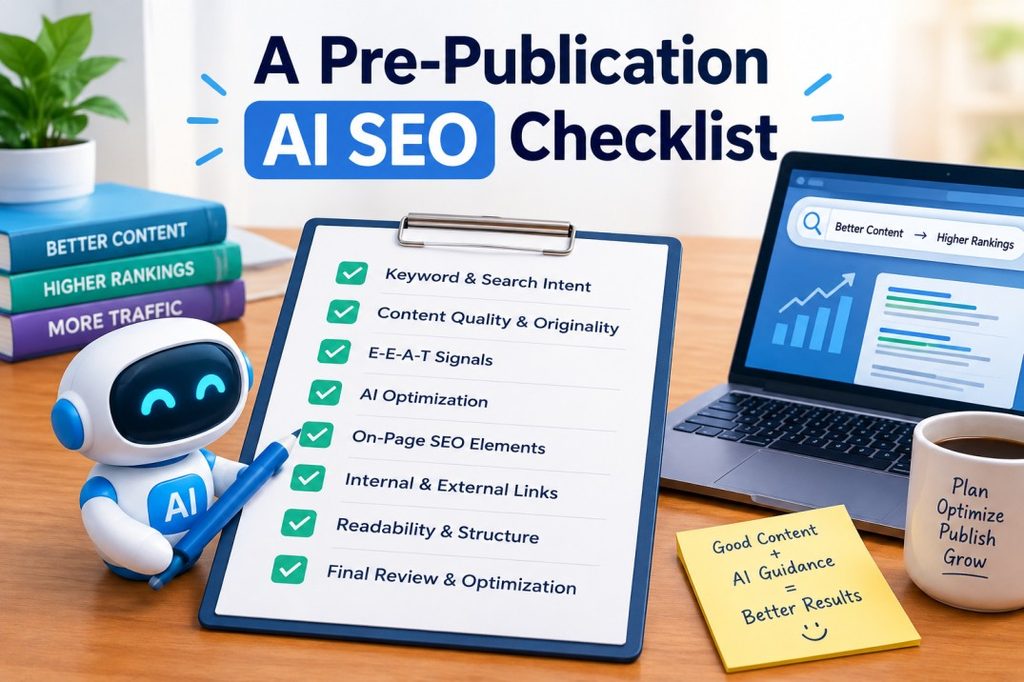
A Pre-Publication AI SEO Checklist
Before publishing an AI-assisted article, run it through a review that checks both search usefulness and editorial quality. The following checklist is deliberately practical: it is designed to catch the problems that keyword optimisation alone will miss.
Search intent
- Does the article answer the primary query directly?
- Have you understood what the searcher is actually trying to accomplish?
- Does the content provide the level of detail the query requires?
- Have you avoided padding the article simply to increase word count?
- Are secondary keywords used naturally rather than forced into headings and paragraphs?
Information quality
- Is the main definition clear?
- Are important claims supported by credible evidence?
- Have statistics and dates been fact-checked?
- Are technical explanations accurate?
- Have you distinguished facts from opinions and recommendations?
- Does the article contain genuinely useful examples?
Originality
- Does the article contain original observations, examples, research or analysis?
- Have you added experience that a generic AI system would not automatically know?
- Is there a reason for someone to reference this article instead of ten competing pages?
- Have you avoided simply rephrasing information already available everywhere?
Structure
- Does every major section have a clear purpose?
- Are headings descriptive rather than decorative?
- Can a reader quickly locate definitions, answers, processes and comparisons?
- Does each paragraph develop an idea rather than merely fill space?
- Are related concepts clearly connected?
Human quality
- Does the writing have natural sentence variation?
- Have generic AI transitions and stock introductions been removed?
- Are there concrete examples instead of endless abstractions?
- Does the article sound like it was written by someone who understands the subject?
- Have repetitive ideas been consolidated?
- Does the writer make useful judgements instead of presenting every issue as equally important?
Technical SEO
- Is the page accessible to search engines?
- Is the title accurate and compelling without being clickbait?
- Does the meta description accurately represent the page?
- Are relevant internal links included?
- Are images appropriately described and optimised?
- Is the page usable on mobile devices?
- Are there technical issues that prevent important content from being discovered or rendered?
Final editorial test
Read the article without looking at the keywords.
Then ask one uncomfortable question:
If Google disappeared tomorrow, would this still be worth publishing?
If the answer is yes because the article teaches something useful, solves a real problem, documents original knowledge or gives the reader a perspective they cannot easily find elsewhere, you are probably moving in the right direction. If the answer is no because the article mainly exists to capture searches, adding more keywords will not fix the underlying problem.
The future of AI-friendly content is therefore unlikely to be about discovering the perfect way to write for machines. Search systems will continue changing, and any rigid formula built around today’s interface can become obsolete. The more durable strategy is to make information clear, structured, specific, authoritative and genuinely useful. Those qualities help people understand your work, help search engines interpret it and give AI systems something meaningful to retrieve when they need an answer.
That is the real opportunity with AI SEO: don’t try to make your content sound more like a machine. Make it contain more of the things machines—and people—actually need.