
For 3D designers, modelers, and independent CG studios, the gap between creative vision and client perception remains one of the industry’s most persistent challenges. A meticulously crafted 3D model or complex architectural visualization often fails to communicate its true value when presented as static renders or lengthy technical documentation. The traditional workflow—scripting narration, coordinating voice talent, managing multi-layer edits, and synchronizing animations—demands resources that smaller studios simply don’t possess.
As the 3D industry evolves toward faster project turnarounds and more competitive pricing, creators face an uncomfortable reality: the time spent producing a single portfolio video could have been invested in actual design work. This efficiency gap has quietly reshaped how successful 3D professionals approach their craft.
The emergence of AI-driven video production tools has introduced a new possibility: what if creators could generate professional-quality explainer content without the traditional production overhead? This isn’t about replacing cinematography—it’s about enabling creators to produce the supporting narrative content that turns impressive renders into compelling business cases.
How AI-Powered Explainer Tools Are Reshaping 3D Portfolio Strategy
The most significant impact of AI video generation on the 3D industry lies not in production quality, but in production velocity and accessibility. Consider the typical workflow for a 3D designer presenting a complex modeling project: scripting takes hours, coordinating voice talent adds days, and editing multiple takes often extends the timeline further. For a creator managing multiple projects simultaneously, this overhead often means portfolio videos never materialize—clients receive only renders and documentation.
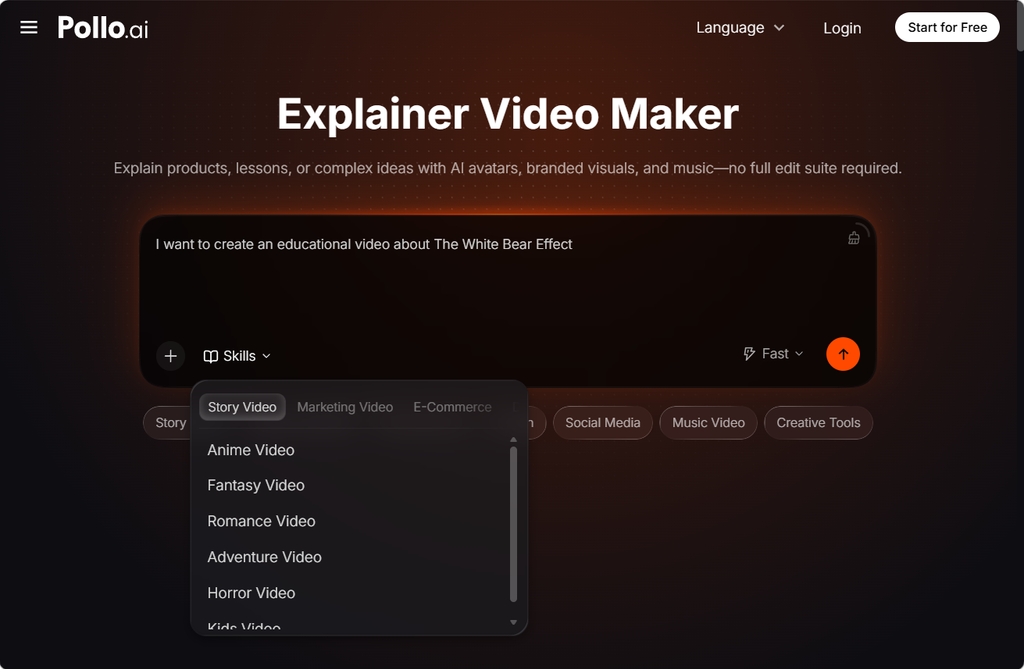
Tools like Pollo AI’s explainer video maker have fundamentally altered this equation. By enabling creators to transform detailed project briefs, technical documentation, and modeling rationales directly into narrated video presentations, these platforms eliminate the production bottleneck. A 3D designer can now document a modeling workflow—from concept to final topology optimization—as a structured narrative, which the AI system converts into a professionally narrated video with synchronized visuals and custom branding. The AI virtual presenter handles voice delivery with natural pacing and inflection, while the creator focuses entirely on content structure and visual asset curation.
The practical implications are substantial. A game asset creator can now produce individual showcase videos for each model in their portfolio, each tailored to specific client needs (performance metrics for technical leads, aesthetic appeal for art directors). An architectural visualization specialist can generate client-specific walkthroughs that explain design rationale and material choices. A 3D printing service provider can create instructional content demonstrating model preparation and printing optimization.
What distinguishes this approach from generic video creation tools is its alignment with how 3D professionals actually work. Rather than forcing creators into traditional filmmaking workflows, Pollo AI’s explainer video maker operates within the creator’s existing documentation practices. A technical breakdown becomes a script; render sequences become visual supporting material; the AI handles the presentation layer.
Streamlining 3D Portfolio Presentation: A Practical Framework
Successfully integrating AI video generation into your 3D portfolio workflow requires moving beyond tool familiarity into strategic content planning. The most effective approach treats video generation not as a production phase, but as an extension of your existing project documentation.
Step One: Restructure Your Project Documentation as Narrative Content
Before generating any video, audit your current project documentation. Identify the key insights that differentiate your work: unique modeling approaches, technical challenges overcome, optimization decisions, or aesthetic innovations. For a character modeler, this might be topology flow and deformation testing. For an architectural visualizer, it could be material authenticity and lighting strategy. For a 3D printing specialist, it might be support structure optimization and material selection rationale.
Reframe this documentation as a three-to-five-minute narrative arc: problem context, your approach, technical execution, and tangible results. This narrative structure is precisely what Pollo AI’s explainer video maker processes most effectively—it converts structured technical communication into compelling visual storytelling without requiring you to adopt traditional scriptwriting conventions.
Step Two: Curate and Sequence Your Visual Assets
Rather than creating new renders specifically for video, work with your existing portfolio of project imagery. Select render sequences that best illustrate your narrative—wireframe progressions, material iterations, animation cycles, or final showcase angles. The key is intentional sequencing: each visual should reinforce a specific point in your narrative, not simply showcase aesthetic appeal.
For complex technical processes, consider generating supplementary visuals: annotated wireframes highlighting topology flow, timeline graphics showing optimization metrics, or comparison images demonstrating before-and-after technical improvements. These supporting assets, when synchronized with AI-generated narration through Pollo AI’s explainer video maker, create a comprehensive communication layer that static portfolios cannot achieve.
Step Three: Generate and Customize Your Video Presentation
Input your narrative structure into the platform, selecting an AI presenter personality that aligns with your brand positioning. A technical-focused modeler might choose a professional, detail-oriented presenter voice; a creative-focused studio might select a more dynamic, enthusiastic persona. Pollo AI’s explainer video maker accommodates these stylistic preferences while maintaining professional consistency across multiple videos.
The platform’s customization capabilities—branded backgrounds, music selection, color grading—ensure each video reflects your studio’s visual identity rather than appearing as generic AI content. This is critical: your video should feel like an extension of your existing portfolio, not a technological novelty.
Step Four: Repurpose and Distribute Strategically
Once generated, your explainer video becomes adaptable content. A single project breakdown can be reformatted for different platforms: a full-length version for your portfolio website, a condensed 60-second highlight for social media, a client-specific version emphasizing particular technical aspects. This adaptability is where AI video generation delivers genuine ROI—the production cost remains constant while distribution possibilities multiply.
Enhancing Multi-Project Consistency: The Role of Unified Video Generation
As your portfolio video library grows, maintaining visual and stylistic consistency across projects becomes increasingly important. When you’re producing dozens of explainer videos spanning different projects, client bases, and technical focuses, inconsistency in presentation can undermine professional positioning.
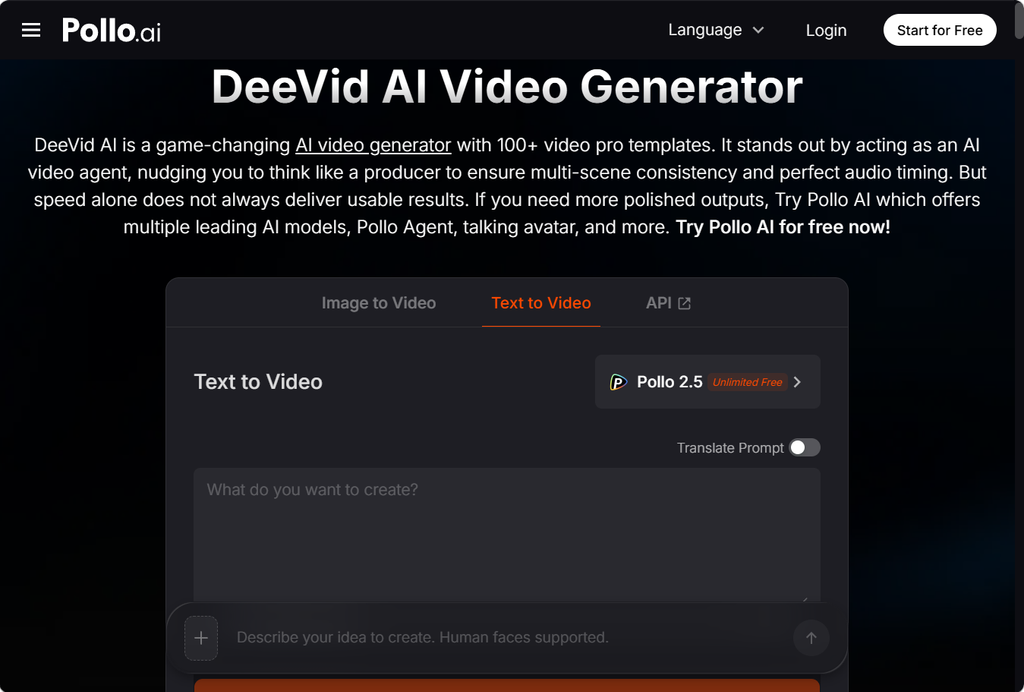
This is where complementary tools like Pollo AI’s DeeVid AI Video Generator enter the workflow. While Pollo AI’s explainer video maker excels at narrative-driven project explanations with AI presenters, DeeVid AI Video Generator provides capabilities for managing multi-segment video projects with guaranteed consistency across visual elements, character appearances, and motion styles. For 3D creators managing extensive project portfolios or producing episodic content series, DeeVid AI Video Generator’s template-based approach and style-locking features ensure that whether you’re producing your fifth or fiftieth portfolio video, each maintains cohesive visual language and professional presentation standards.
The distinction matters practically: if your workflow involves generating numerous explainer videos across different projects, DeeVid AI Video Generator’s emphasis on maintaining consistent character presence and visual styling across multiple segments provides additional control. For studios developing branded video series or comprehensive portfolio documentation, this consistency layer becomes increasingly valuable.
Conclusion: The New Standard for 3D Professional Communication
The 3D industry’s transition from static portfolio presentation to dynamic, narrative-driven communication represents more than a technological shift—it reflects changing client expectations and competitive pressures. Creators who master this transition, leveraging tools like Pollo AI’s explainer video maker to systematically transform their technical expertise and project documentation into compelling visual narratives, position themselves advantageously in an increasingly competitive market.
The efficiency gains are measurable: hours of production work compressed into minutes of content generation. The business impact is tangible: clients who understand your technical approach and creative rationale make faster decisions and value your work more accurately. The strategic advantage is clear: portfolio presentation at scale becomes accessible to creators of all sizes.
For 3D professionals seeking to elevate how their work is perceived and communicated, the question is no longer whether video presentation matters—it clearly does. The question is whether you’ll continue managing this critical communication layer with outdated workflows, or embrace tools designed specifically for your industry’s needs. The most successful 3D creators are already making that choice.