
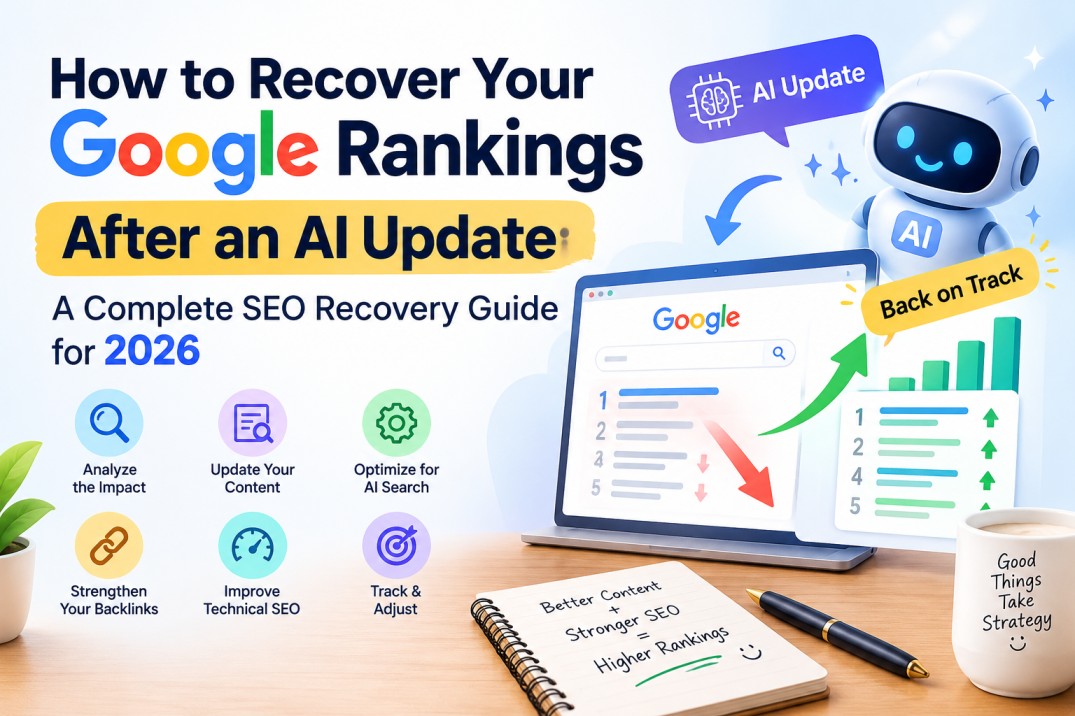
If your Google ranking dropped after an AI-related change, don’t immediately rewrite your entire website. First determine whether you’ve lost rankings, clicks, impressions, or visibility because of an algorithm change, technical problem, changing search behaviour, or stronger competition. Then use Search Console, content analysis and technical checks to decide what actually needs fixing.
Table of Contents
- The Day Your Traffic Graph Falls Off a Cliff
- Did an AI or Google Algorithm Update Actually Cause Your Ranking Drop?
- Start With Search Console, Not Your Content Calendar
- Audit the Pages Google May No Longer Consider the Best Answer
- Why Generic AI Content Is Becoming a Problem
- How to Write Content That Works in AI Search Without Writing “For AI”
- The New SEO Is Bigger Than Keywords
- Technical SEO Still Matters in the AI Era
- Don’t Chase Every New “AI SEO Hack”
- Should You Rewrite, Improve, Merge or Delete Content?
- How to Build a Content System That Survives Future Updates
- Measure More Than Rankings
- A Practical 30-Day SEO Recovery Plan
- What SEO Looks Like After the AI-Search Transition
- Frequently Asked Questions
The Day Your Traffic Graph Falls Off a Cliff
You open Google Search Console on Monday morning because something feels off.
A page that normally brings 2,000 organic visits a month suddenly has almost no clicks. Another page has slipped from the top three positions to page two. Your overall traffic report is heading downward, and the first instinct is almost always the same: Google changed something, and now I need to fix my SEO.
Then the panic starts.
Someone suggests adding more keywords. Another person recommends publishing fifty new articles. A consultant says you need “AI-friendly content.” Somebody else wants to change the URL structure, rewrite the metadata and start building backlinks immediately.
This is where many recovery efforts go wrong.
A website can lose organic traffic for several completely different reasons, and those reasons require completely different responses. A ranking change caused by a technical indexing issue cannot be fixed by rewriting an introduction. A decline in clicks caused by a new search-result layout cannot necessarily be solved by gaining five more backlinks. A page that fell because competing results became more useful may need substantial improvement, while a page that only moved from position two to four may need no intervention at all.
The first rule of recovery is therefore simple:
A traffic drop is a symptom, not a diagnosis.
Before you change content, understand exactly what changed.
Did an AI or Google Algorithm Update Actually Cause Your Ranking Drop?
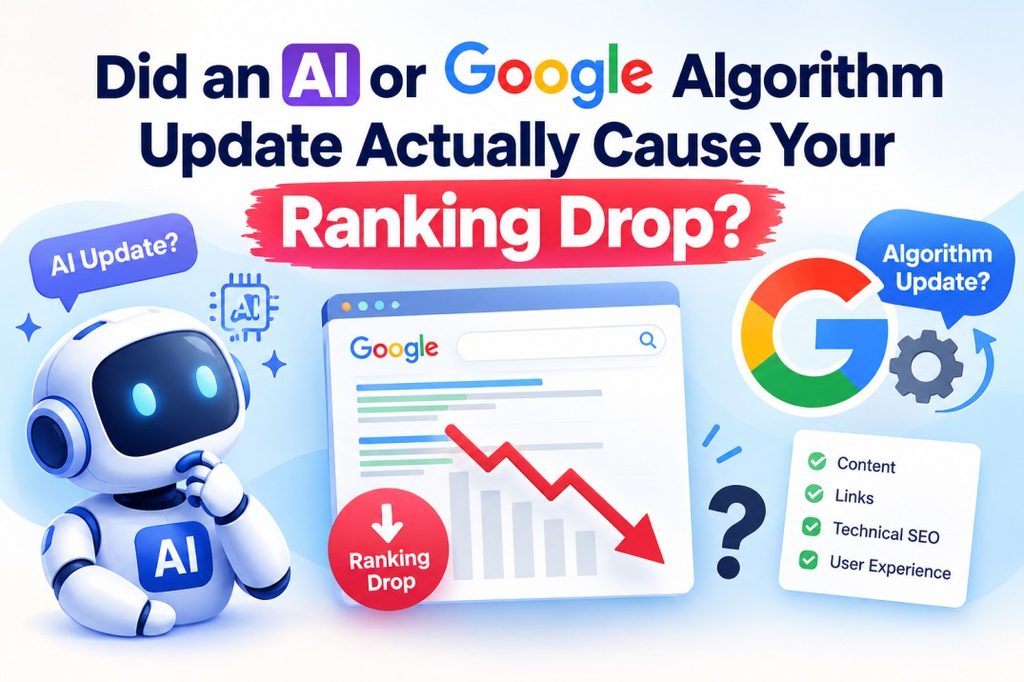
A Google algorithm update may coincide with a ranking decline, but timing alone does not prove causation. A proper investigation separates algorithmic changes from technical problems, changes in search demand, competitor movement and changes in the search results themselves.
Google describes core updates as broad changes to its ranking systems rather than penalties aimed at individual sites. When a site declines during an update, Google’s own guidance recommends examining the affected pages and queries carefully instead of assuming that a single problem or universal fix exists.
Start by separating four possibilities
The first possibility is an actual Google algorithm update. Broad updates can change the relative visibility of pages because Google’s systems have changed how they assess and rank information.
The second possibility is a technical problem. A deployment may have accidentally added a noindex directive, changed canonical tags, broken internal links, generated server errors or prevented important pages from being crawled. From the outside, this can look remarkably similar to an algorithmic decline.
The third is competition. Search rankings are relative. Your content can remain exactly the same while another site publishes something more complete, gains relevant authority or creates a better answer for the same query. You can lose position without your own page becoming objectively worse.
The fourth is changing search behaviour. Search demand can fall, terminology can change, seasonal interest can shift, or the results page itself can evolve. A page may receive fewer clicks even when its average position has barely changed.
That distinction matters because the wrong diagnosis produces the wrong recovery strategy.
A ranking drop is not always a traffic drop
These terms are often used interchangeably, but they describe different things.
A page might remain around position three while receiving fewer clicks because the search results now contain more features above or around the organic listings. Conversely, a page might lose several positions but continue receiving meaningful traffic because search demand increased at the same time.
You therefore need to distinguish between:
- Impressions: how often your result appeared.
- Clicks: how many people visited from Search.
- CTR: the percentage of impressions that generated clicks.
- Average position: an aggregate indication of where your result appeared.
- Conversions: whether organic visitors actually completed a valuable action.
A strong SEO recovery starts by identifying which of these metrics changed and by how much.
Start With Search Console, Not Your Content Calendar
Before rewriting an article, open Search Console and investigate the pages and queries that actually changed. Search Console and Google Trends can help distinguish algorithmic changes, search-demand shifts, query changes and page-level performance problems from one another.
This is where you stop guessing and start collecting evidence.
Compare the right periods
Do not simply compare “this month” with “last month” and declare victory or failure.
If you suspect a core update, use the rollout dates and compare appropriate periods around the update. Google recommends waiting until a core update has finished rolling out before doing the deeper comparison, because rankings can fluctuate while an update is still propagating.
For the affected site, examine:
- clicks before and after the decline
- impressions before and after
- CTR changes
- average-position changes
- affected search queries
- affected landing pages
- device differences
- country or region differences
- search type, such as Web, Images, Video or News
This often reveals something much more specific than “traffic fell.”
Look for the shape of the problem
A simple diagnostic table can save hours of unnecessary work.
| What you see | What it may suggest |
| Impressions and position both fall | Visibility or ranking problem |
| Impressions remain stable but clicks fall | CTR or SERP-layout change |
| One page falls sharply | Page-level issue |
| Hundreds of pages fall together | Sitewide, technical or broader algorithmic issue |
| One topic cluster falls while others remain healthy | Content, intent or competition problem |
| Traffic falls but rankings remain relatively stable | Demand or SERP-feature change |
These are clues, not verdicts. Treat them as starting points for investigation.
Don’t rewrite pages that aren’t actually broken
This sounds obvious, but it is one of the easiest mistakes to make after an update.
Suppose an article moved from position two to four. The page still receives substantial impressions, its conversion rate remains healthy and competitors around it are broadly similar. Rewriting the entire article could introduce new problems without solving the original one.
By contrast, if a page moved from position four to twenty-nine across many related queries, disappeared from several important variations and is now clearly being outranked by more useful resources, a deeper audit is justified.
Small movement requires observation. Large sustained movement requires investigation.
Audit the Pages Google May No Longer Consider the Best Answer
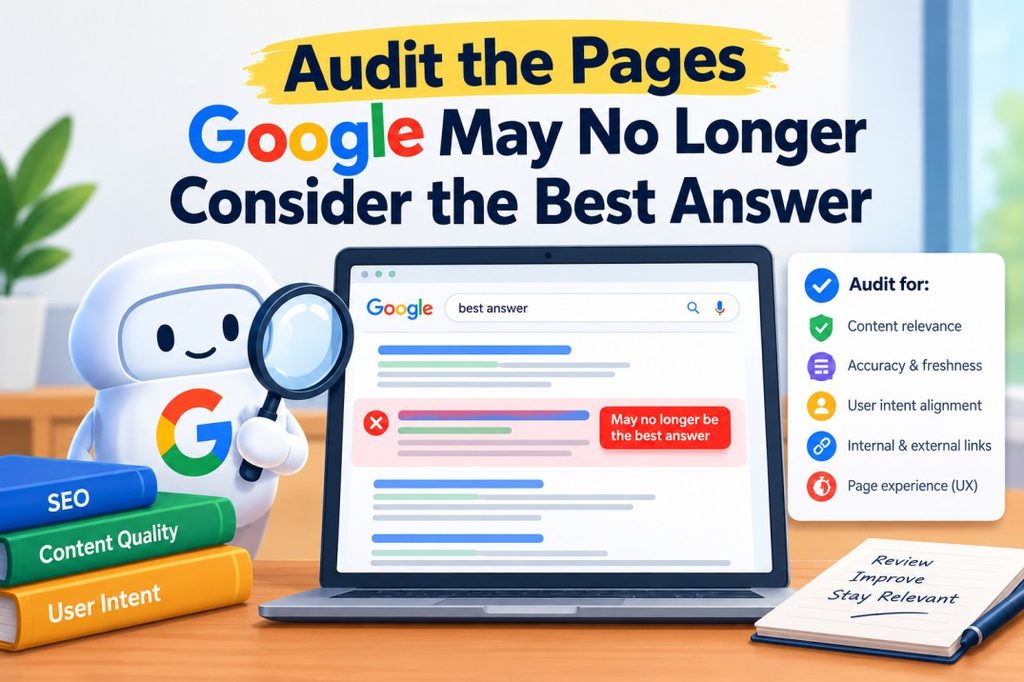
A content audit should not begin with “How many times does my keyword appear?” It should begin with a harder question:
If I were the searcher, is this still the most useful page I could choose?
Google’s current guidance for both traditional and generative search continues to emphasise helpful, reliable, people-first content, along with technical accessibility and genuine value beyond what is already available elsewhere.
Does the page satisfy the real search intent?
Search intent can shift even when the keyword does not.
Take a query such as “best accounting software for small businesses.” A page that spends 2,500 words explaining what accounting software is may be perfectly accurate but poorly aligned with what the searcher needs. The query suggests evaluation. The user probably wants comparisons, pricing, features, limitations, screenshots, practical recommendations and perhaps advice based on different business situations.
The lesson is broader than any particular keyword:
Do not optimise for the phrase. Optimise for the job behind the phrase.
Is the page contributing anything competitors don’t?
Open the top-ranking results and look for patterns.
If every article provides the same five generic points, ask what your page can contribute that those pages cannot.
That might be:
- original testing
- first-hand observations
- a better comparison
- proprietary data
- screenshots
- calculations
- expert commentary
- implementation examples
- local knowledge
- a clearer process
- mistakes learned through actual experience
This is especially important as search systems become better at synthesising information from multiple sources. A page that simply repeats what ten other pages already say has little reason to be chosen as a distinctive source.
Does it show first-hand knowledge?
There is a major difference between explaining a subject from research and demonstrating that you have actually worked with it.
Consider two articles about website migration.
The first explains redirects, canonicals and sitemaps from publicly available documentation.
The second explains those concepts and then shows what happened during a real migration: which URLs caused problems, how many redirects were discovered, what the Search Console report looked like, how indexing changed over time and which mistakes took the longest to identify.
The second article has something much harder to commoditise.
Experience creates evidence. Evidence creates differentiation.
Has the information become stale?
Content can become weaker without becoming inaccurate.
A guide may still correctly explain how something works while using screenshots from an obsolete interface, recommending discontinued tools, quoting old statistics or ignoring new developments that changed the decision a reader needs to make.
Freshness should therefore mean more than changing the publication date.
Ask:
What has changed in the real world since this page was last reviewed?
Then update the substance accordingly.
Is the article mostly summarising other articles?
One of the clearest warning signs is an article that could be reconstructed almost entirely from the first page of Google results.
That does not make it automatically bad. Good content often synthesises existing knowledge.
The problem begins when synthesis is the entire value proposition.
If the reader can get the same information, examples and conclusions from several stronger sources, the page has little distinctive reason to win.
Why Generic AI Content Is Becoming a Problem
AI-generated text is not automatically a ranking problem. The more important issue is whether the publishing process creates large amounts of content that offer little original value, little effort and little reason for users to prefer the page.
That distinction matters because “Google hates AI content” is an attractive explanation that is much too simplistic.
Google’s current guidance allows generative AI to be useful for activities such as research and adding structure to original work. The problem arises when automated systems are used at scale to produce pages without sufficient value for users. Google’s spam policies classify this kind of large-scale low-value production as scaled content abuse regardless of whether the pages were made entirely by AI, entirely by humans or through a combination of methods.
AI-assisted writing is not the same as AI-only publishing
Used properly, AI can help a content team move faster.
It can help you:
- organise research
- compare competing explanations
- identify missing subtopics
- create initial outlines
- process large datasets
- turn messy notes into usable structures
- identify repetitive sections
- help edit for clarity
Those are process improvements.
They do not replace expertise.
Human input should still provide the things generic generation struggles to invent credibly:
- actual experience
- strong opinions backed by reasoning
- original examples
- proprietary observations
- case studies
- tested recommendations
- editorial judgement
- verification of facts and claims
The strongest workflow is often not human versus AI.
It is:
AI for acceleration + human expertise for value.
The real danger is scalable sameness
Imagine a website publishes 150 articles in six months.
Every article begins with the same kind of introduction. Every section follows the same pattern. The examples are generic. The statistics appear on dozens of other sites. The advice avoids taking a position. The conclusion merely restates the introduction.
Technically, the site may have produced 150 “unique” URLs.
From the reader’s perspective, it may have produced almost nothing new.
That’s the kind of content system that becomes vulnerable when search systems get better at identifying useful sources.
The goal is not to make AI-generated writing “look human.”
The goal is to make the finished content worth publishing even if nobody knew AI had been used during production.

How to Write Content That Works in AI Search Without Writing “For AI”
There is no secret writing dialect that makes an article “AI-friendly.” Google’s current documentation says the foundational SEO practices used for normal Search also apply to AI Overviews and AI Mode, with no separate special optimisation requirement.
That does not mean structure is unimportant.
It means good structure helps because it helps readers and search systems understand the content, not because a particular heading format unlocks AI visibility.
Give the answer early
Do not spend the first 300 words telling readers that the topic is important.
Tell them what they came to learn.
Suppose the question is:
“Why did my Google traffic drop after an update?”
The opening should establish the likely causes and the first diagnostic step quickly. The detailed explanation can follow.
This serves both impatient readers and systems that need to understand a page’s subject and purpose early.
Make claims easy to verify
Whenever you make a consequential claim, give the reader enough context to assess it.
For example, instead of saying:
“Long-form content ranks better.”
Explain what you actually observed, what kind of query you’re discussing, what evidence supports the claim and what exceptions exist.
Specificity is much more useful than confident generalisation.
Build information that can be extracted without destroying the reading experience
Use meaningful structures such as:
- comparisons
- tables
- definitions
- step-by-step processes
- examples
- checklists
- clearly labelled sections
- useful FAQs
The key word is meaningful.
A table is useful when a reader needs to compare options. It is not useful merely because someone told you that tables are “good for AI.”
Build around problems, not endless keyword variations
One of the easiest ways to create low-value SEO content is to turn every slight wording variation into a separate page.
For example:
- how to recover Google rankings
- how to regain Google rankings
- how to restore Google rankings
- how to get Google rankings back
- how to recover website ranking
These may represent the same underlying need.
A stronger site builds one genuinely useful resource that answers the underlying problem, then expands into adjacent topics where the intent is meaningfully different.
Make the page cite-worthy
The best way to think about generative search visibility is not:
“How do I trick AI into quoting my article?”
Think:
“What would make another system choose this page as a reliable source?”
Clear explanations help.
Original research helps more.
Useful evidence helps more.
First-hand experience, specific examples and genuinely distinctive information are harder to replace than generic prose.
The New SEO Is Bigger Than Keywords
Keywords still matter because they help connect language with search intent. They are simply no longer a sufficient description of SEO.
Modern search optimisation involves the relationship between a page, its topic, the rest of the website, the user’s task and the credibility of the information being presented.
Search intent comes first
A useful content system distinguishes between informational, commercial, transactional, navigational and mixed intents.
This prevents a common mistake: trying to make every page rank for every interpretation of a keyword.
One page might explain a concept.
Another might compare solutions.
Another might review a product.
Another might provide a tool.
Another might convert the reader into a customer.
The site becomes stronger when each page has a clear job.
Build coherent topical relationships
A website should not feel like a pile of unrelated articles that happen to share a domain name.
Your topic clusters should make sense together.
A pillar page can establish the broad subject. Supporting articles can answer narrower questions. Commercial pages can address products or services connected to that subject. Internal links can help readers move naturally among them.
This is much stronger than publishing dozens of unrelated keyword targets simply because a keyword tool suggested them.
Internal links should explain relationships
Good internal linking does more than distribute authority.
It tells the reader:
“This is what you should read next because it goes deeper into the problem you just encountered.”
Suppose this article explains why a traffic decline needs diagnosis before rewriting content. A supporting article about diagnosing a ranking drop should be the natural next step.
That relationship is useful for users, search crawlers and information architecture alike.
Semantic coverage is not synonym stuffing
You do not need to repeat ten variations of “SEO ranking drop.”
You need to cover the ideas a knowledgeable explanation requires:
Search Console, impressions, CTR, average position, queries, indexing, technical issues, competitors, search intent, content quality and changing SERPs.
That is semantic completeness.
It is very different from forcing synonyms into paragraphs.
Original information matters more
A site becomes harder to replace when it creates information rather than merely repackaging it.
Think about:
- surveys
- experiments
- internal datasets
- screenshots
- original calculations
- case studies
- customer observations
- expert interviews
- implementation lessons
- comparisons based on actual testing
The more of that you can legitimately add, the less interchangeable your content becomes.
Technical SEO Still Matters in the AI Era
AI search does not rescue a page that search engines cannot reliably crawl, index, understand or retrieve. Google’s current guidance says pages generally need to be indexed and eligible to appear in normal Search in order to be eligible as supporting links in AI Overviews or AI Mode.
This is why a content-only recovery strategy can fail even when the writing is excellent.
Crawlability
Make sure important pages are accessible to search crawlers and are not accidentally blocked by robots.txt, CDN rules, hosting configuration or other controls.
Indexing
Check whether the pages you care about are actually indexed.
A beautifully rewritten page that sits outside Google’s index cannot recover organic traffic.
Canonicalisation
Canonical tags should reflect the version of the page you actually want indexed. Incorrect canonical signals can complicate how search engines interpret duplicated or similar URLs.
Redirects
Site redesigns, migrations and URL changes can create ranking losses when redirects are missing, chained excessively or implemented incorrectly.
JavaScript rendering
If important content depends on JavaScript, verify that search engines can access the content and the links that matter. Modern web applications can be powerful, but complexity should not obscure essential information.
Internal links and sitemaps
Important content should be discoverable through the site’s architecture, not hidden behind layers of navigation or isolated without meaningful internal references.
XML sitemaps can help discovery, but they do not replace a sound internal-link structure.
Structured data
Structured data can help search engines understand eligible content types, but it is not a magic ranking layer. Whatever structured data you provide should accurately represent visible page content.
Performance and page experience
A page should not force users to fight through slow loads, unstable layouts or unnecessary interactions to reach the information they came for.
Technical SEO is not separate from user experience.
It is one of the ways a good user experience becomes technically accessible at scale.

Don’t Chase Every New “AI SEO Hack”
Every major search change produces a new market for shortcuts.
Some of these ideas are useful. Many are merely old SEO habits wearing new terminology.
The safest question is:
Does this improve the underlying information or experience, or does it only try to send a ranking signal?
“AI-friendly formatting”
Useful formatting is good.
You should use headings, tables, lists and concise answers when they make information easier to understand. But there is no evidence that turning every article into a rigid template automatically earns visibility in AI search.
Structure should follow meaning.
“Write exactly 40-word answers”
A concise direct answer can be useful, but forcing every question into an artificial word count can make content worse.
Sometimes the correct answer needs 40 words.
Sometimes it needs 140.
The objective is clarity, not numerical obedience.
“Add llms.txt”
This has been widely discussed, but Google’s current guidance does not require an llms.txt file for Search and does not present it as a special optimisation needed to appear in AI features.
Do not spend your recovery budget building machinery that Google’s own documentation says you do not need.
“Create a page for every possible query”
This is another easy trap.
A growing number of query formulations does not necessarily represent growing informational value.
If ten search variations all express the same need, one exceptional page is often more useful than ten thin pages competing with each other.
“Add more keywords”
A keyword becomes useful when it accurately reflects the subject and language readers use.
It does not become useful simply because it appears another twenty times.
The modern SEO advantage usually comes from better information architecture, better intent matching and better information, not from squeezing extra occurrences into paragraphs.
Should You Rewrite, Improve, Merge or Delete Content?
Not every underperforming page should be rewritten. Some should be updated, some consolidated, and some left alone.
A useful recovery process classifies pages before editing them.
| Situation | Better action |
| Good rankings but outdated information | Update |
| Strong traffic but weak conversions | Improve intent and UX |
| Large sustained ranking decline | Deep content review |
| Two pages target the same intent | Consolidate |
| Thin pages duplicate stronger resources | Merge or remove |
| No useful demand or strategic role | Consider removal |
| Strong impressions but weak CTR | Review title/snippet and SERP intent |
| Good position but fewer clicks | Investigate SERP changes |
Updating is not the same as changing the date
A meaningful update can involve replacing obsolete advice, adding current examples, revising recommendations, improving explanations, correcting weaknesses and removing sections that no longer contribute anything.
Changing “2025” to “2026” without improving the page is not a content strategy.
Consolidation can solve cannibalisation
Suppose three articles on your site cover almost the same question.
Each has some backlinks. Each ranks occasionally. None is particularly strong.
Instead of producing a fourth article, examine whether the existing information should be consolidated into one substantially better resource.
The strongest outcome is not always more URLs.
Sometimes it is fewer, stronger URLs.
Do not delete because a page looks old
Content removal can be useful when pages are genuinely unhelpful, duplicative or irrelevant. But deleting large sections of a site simply because they have low traffic is not automatically an SEO improvement.
Ask whether the page contributes:
- useful information
- authority
- internal-link value
- conversions
- brand value
- historical relevance
- another form of measurable business value
Then decide.
How to Build a Content System That Survives Future Updates
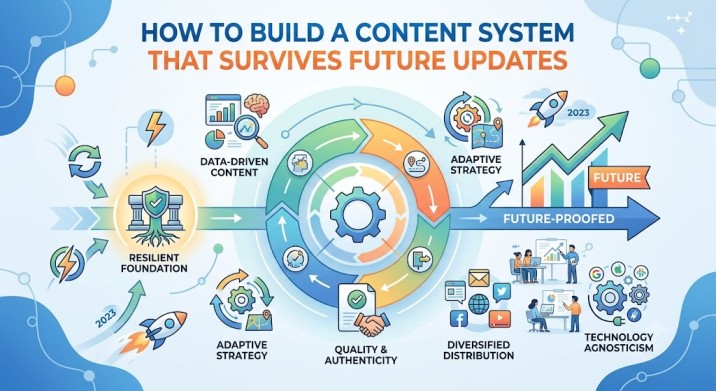
Recovery is only half the job.
A site that regains its rankings and immediately returns to mass-produced, interchangeable content has not solved the underlying problem.
It has only postponed it.
Build topic clusters instead of keyword piles
A strong cluster might contain:
One comprehensive pillar → several genuinely distinct supporting articles → relevant product/service pages → evidence, examples and internal references.
Each piece has a different job, but they reinforce the same subject area.
This makes future content easier to plan and reduces the temptation to manufacture articles for every tiny variation of a keyword.
Create content with a reason to exist
Before approving an article, ask:
What can this page provide that the searcher cannot get more easily from existing pages?
The answer should be specific.
“More information about SEO” is not enough.
“An illustrated framework showing exactly how to distinguish a ranking decline from a CTR decline using Search Console data” is a reason to exist.
Keep important pages maintainable
Evergreen content should be designed so important sections can be updated without tearing down the entire article.
Keep current facts easy to locate.
Separate evergreen explanation from time-sensitive statistics.
Use tables that can be refreshed.
Create sections where new examples can be added naturally.
This makes your content system less fragile.
Track what changed
When a page is updated, record what was changed.
That might seem administrative, but it becomes valuable when traffic moves again.
Without a record, teams often end up asking:
“Why did this page recover?”
or
“What did we change before it dropped?”
With a change log, you have evidence rather than memory.
Review the site as a system
A ranking decline in one article may be a page problem.
A decline across an entire topic may suggest a broader weakness.
A decline across the whole domain may require technical and sitewide assessment.
Look at patterns, not just individual URLs.
Measure More Than Rankings
Rankings remain useful, but they should not be your only success metric.
A page can lose a position and gain revenue. It can gain a position and lose clicks. It can maintain traffic while becoming less valuable to the business.
Your measurement system should therefore extend from visibility to outcomes.
Track the complete journey
At minimum, monitor:
- organic clicks
- impressions
- CTR
- average position
- organic conversions
- assisted conversions
- branded versus non-branded traffic
- landing-page engagement
- important query groups
- visibility across relevant Search features
This makes it much easier to separate vanity improvements from meaningful recovery.
Watch the SERP, not just your dashboard
Two pages can have identical rankings and very different click potential.
One may appear in a relatively clean result.
Another may compete with ads, featured content, image results, videos, local elements, product modules or AI-generated responses.
That is why a traffic decline with stable rankings deserves investigation rather than an automatic content rewrite.
AI visibility is becoming measurable
Google introduced dedicated Search Console reporting for visibility in generative AI features such as AI Overviews and AI Mode in June 2026, initially rolling the reports out to a subset of sites.
That is a useful development because it moves the conversation beyond speculation.
Instead of asking only, “Are we appearing in AI search?” site owners can increasingly begin examining actual visibility data where the relevant reporting is available.
The lesson is not to abandon traditional SEO metrics.
It is to add new measurements as the search interface evolves.
A Practical 30-Day SEO Recovery Plan
A ranking recovery project becomes easier when you stop treating it as a giant website-wide rewrite.
Start with evidence, prioritise pages, make controlled changes and measure the result.
Days 1–3: Diagnose
Document the traffic decline.
Mark the dates.
Check Search Console.
Check Google’s published ranking-update information.
Look for sitewide versus page-level patterns.
Review recent technical changes, migrations, deployments and indexing issues.
Most importantly, resist the urge to change everything before you know what happened.
Days 4–7: Identify the affected URLs and queries
Create a shortlist of pages that experienced the most meaningful decline.
For each page, record:
- previous position
- current position
- impressions
- clicks
- CTR
- major lost queries
- search intent
- competing pages
- conversion value
Then divide the pages into groups.
High-value pages with major declines deserve the earliest attention.
Healthy pages with small fluctuations should generally be monitored rather than aggressively rewritten.
Week 2: Fix technical and indexing problems
Review the foundations first.
Check:
- index status
- robots directives
- canonical tags
- redirects
- internal links
- sitemap coverage
- server responses
- mobile usability
- page performance
- rendering issues
- structured-data accuracy
There is little value in spending three days rewriting an article if the important URL is not being indexed correctly.
Week 3: Improve the pages with real recovery potential
Start with the pages that combine:
high business value + meaningful traffic loss + clear evidence of a content or intent weakness.
For each one, ask:
- What does the searcher actually need?
- What are the current best results doing better?
- What information is missing from our page?
- What can we add that is genuinely original?
- Which sections can be removed because they add little?
- Can the page demonstrate more first-hand knowledge?
- Does the title accurately communicate what the page delivers?
This is content optimization with a purpose.
Week 4: Strengthen the surrounding ecosystem
Once important pages are improved, look outward.
Build relevant internal links.
Strengthen supporting articles.
Consolidate obvious duplication.
Improve navigation between related resources.
Review whether your pillar and supporting content actually form a coherent topic cluster.
Then begin tracking the results.
Do not expect every change to produce an immediate jump. Some changes can take days to show effects, while broader improvements may take considerably longer for search systems to reassess.
Use the following framework for each URL:
Keep → Improve → Consolidate → Remove → Monitor
That simple classification can prevent months of unfocused work.
What SEO Looks Like After the AI-Search Transition
The most useful way to think about modern SEO is not that traditional SEO has disappeared and been replaced by “GEO.”
The transition is subtler.
Search engines are changing how they discover, organise and present information, while the underlying need remains remarkably familiar:
Find trustworthy information that satisfies the user.
Google’s current guidance says the foundational SEO practices that have long applied to Search remain relevant for AI Overviews and AI Mode. Its newer guidance for generative AI search also places strong emphasis on unique, valuable, non-commodity content rather than special tricks designed solely for AI systems.
That suggests the unit of competition is becoming more interesting.
A traditional search result asks, in effect:
Which pages should appear for this query?
A generative search experience can involve another layer:
Which sources provide useful evidence for constructing this answer?
That does not make the page irrelevant.
It makes the quality of the underlying source even more important.
A generic explanation may still rank.
A genuinely useful source has more opportunities to be discovered, linked to, cited, revisited and trusted across changing interfaces.
The sites most likely to survive are not necessarily the ones chasing every update
They are the ones with strong fundamentals:
- technically accessible pages
- clear information architecture
- useful internal linking
- strong topic depth
- original information
- accurate and maintained content
- evidence of expertise
- good page experience
- a reason for users to choose them
That is a much more durable strategy than trying to reverse-engineer every new feature.
The Real Recovery Strategy
When rankings fall, the internet tends to produce the same advice immediately: use more AI, write more content, add more keywords, optimise for AI search, publish faster.
The harder answer is less exciting and considerably more useful.
Find out what actually changed.
If the issue is technical, fix the technical problem.
If the search landscape changed, understand the new intent and SERP structure.
If competitors became better, study what they genuinely improved rather than copying their headings.
If your content has become stale, update the substance.
If your site has accumulated dozens of interchangeable pages, consolidate them.
And if AI has made your publishing process dramatically faster, use that speed to improve research, analysis and editorial quality—not to flood the web with another hundred nearly identical articles.
The goal is not to make your website “look human” after a ranking update.
The goal is to make the website more useful, more specific, more trustworthy and harder to replace.
That is the SEO recovery strategy worth building in 2026.
Frequently Asked Questions
How do I recover my Google rankings after an algorithm update?
Start by confirming whether your decline actually correlates with an update and whether the change is page-level or sitewide. Use Search Console to compare affected queries, pages, impressions, clicks and positions. Then investigate technical issues, search intent, content quality and competitor changes before making targeted improvements.
Does Google penalize AI-generated content?
AI-generated content is not automatically disqualified from ranking simply because AI was involved. The key issue is whether the content provides genuine value and complies with Google’s spam policies. Using AI to create large quantities of low-value pages without adding meaningful originality or usefulness can create serious SEO problems.
How do I know why my website traffic dropped?
Look at clicks, impressions, CTR and average position together rather than relying on traffic alone. Then segment the data by page, query, device, country and search type. Compare the timing with confirmed Google updates, check for technical problems and investigate whether search demand or the competitive landscape has changed.
How should I write content for AI Overviews and AI search?
Do not try to write in a special “AI language.” Use the same strong principles that make content useful in traditional Search: answer the question clearly, satisfy intent, provide unique information, demonstrate expertise, use meaningful structure and keep important information accessible as text. Google’s current guidance says foundational SEO remains relevant to AI search features.
Should I delete old content after a Google ranking drop?
Not automatically. First determine whether the content is outdated, duplicative, unhelpful or simply experiencing a temporary decline. Strong pages may need improvement rather than removal, while overlapping or genuinely low-value pages may benefit from consolidation or deletion. Make the decision based on usefulness and strategic value, not age or traffic alone.